
SAN ANTONIO DE LOS BAÑOS, Cuba, March 10 - One morning almost five years ago, the normally quiet town of San Antonio de los Baños erupted into street demonstrations that quickly inspired similar protests across the island. Marchers, driven by prolonged shortages of food and medicine and extended power outages as the coronavirus pandemic lingered, took to chanting "Patria y Vida" - "Homeland and Life" - a slogan that inverted the long-standing Communist refrain "Patria o Muerte" - "Homeland or Death."
The mobilization of July 11, 2021 grew into a movement that was forcefully suppressed by state security forces. Today, the neighborhoods that saw the fiercest confrontations remain marked by those events. A series of visits and interviews in San Antonio de los Baños and in La Güinera, a marginalized neighborhood of Havana, found residents retaining vivid memories of the violence of the crackdown, alongside differing views about blame and responsibility for the island's worsening hardship under a U.S.-imposed oil blockade and additional sanctions.
In conversations with 12 people on the record and several others who declined to be identified, many recounted the intensity of the government's response in 2021 and its ongoing chilling effect on public dissent. Some interviewees blamed the United States and the tightening of sanctions for deepening the economic crisis. Others focused criticism on domestic governance failures. Across perspectives, there was broad agreement that a repeat of the mass rallies witnessed in 2021 is unlikely in the near term.
Fear, arrests and internet cuts
Participation in street protests, residents say, has been significantly suppressed by a combination of tactics. Dissident leaders who helped organize or encourage demonstrations have largely been jailed or exiled since the uprisings, and authorities have shown a readiness to cut internet access at early signs of unrest - a tool used on the day of the 2021 protests. Those measures, interviewees reported, compound an atmosphere of fear.
"I assure you, people won’t protest in the streets because they’re afraid," said Brian Jimenez, 26, a baker from San Antonio de los Baños. Jimenez said he was beaten by police on the day of the protests and detained for several days afterward. He described initial restraint by some officers, followed by the arrival of Interior Ministry units identifiable by black berets who, he said, roughed up people and set an example that still echoes.
"A lot of my friends are still in jail," Jimenez said.
The reporting could not independently verify Jimenez's account of beatings of detainees. Other demonstrators and human rights groups have reported similar allegations of abuse. The Cuban government did not reply to a request for comment.
Economic penalties and social consequences
Alongside fear of repression, residents described how protest participation carries enduring economic consequences. At the town square where many gathered in front of the church on the day of the mass protests, university student Robert Perez said he and others linked to the demonstrations face retaliatory measures that have prompted self-censorship.
"When you protest, you can’t find work. They take action against you or your family," Perez, 27 and a sociology student at Artemisa University, said. "In Cuba, everyone knows that one way to make a living is to open a small business and sell goods. Those who rose up on July 11th can’t do that."
International rights organizations, the European Union and the United States have estimated that between 1,000 and 1,500 people were jailed in connection with the wide protests. Many of those individuals continue to serve lengthy prison terms. Cuban authorities have not provided a public tally in response to queries about how many prisoners they currently hold on convictions related to the July 11 unrest. Official statements from Cuban institutions say those convicted were found guilty of crimes including public disorder, resisting arrest, robbery and vandalism. The government also accuses the United States of funding and encouraging the unrest, which it presents as part of a broader effort to overthrow the island's government.
Shortages, blackouts and small-scale protest
Anger over regular power outages has persisted. Residents described responses that range from banging on pots in public displays of frustration to small localized gatherings. Several demonstrations were witnessed in poor neighborhoods of Havana on a recent Saturday night in which people beat on kitchenware to demand electricity; in at least one case the lights came back on mid-protest, and the demonstration ended quickly.
"We’re tired of so many days of blackouts. Three days in a row of the same," said a man identifying himself as Edward Rafael, 18.
Smaller protests have also cropped up in urban centers unrelated to an organized national movement. On a recent Monday about 20 students sat on the steps of the University of Havana, publicly voicing concerns about spotty power and intermittent internet access which have disrupted remote learning and contributed to class suspensions amid the crisis.
Sanctions, oil blockade and shifting blame
Long before the summer of 2021, the United States had imposed what is described in public debate as the most comprehensive and longest-running unilateral sanctions regime in the world on Cuba, aimed at pressuring the Communist government on political and human rights grounds. Interviewees said the pressure escalated further in the most recent period: the United States, they said, captured Venezuelan President Nicolas Maduro, described as Cuba's most important patron; then imposed a near-total oil blockade on Cuba; and aligned with another international actor in actions against Iran, a longtime Washington adversary. One former senior U.S. official, cited in public statements, said his government is negotiating with Cuban leaders to reach some kind of deal; Cuba has not publicly acknowledged any official talks.
Those developments have led some residents to redirect anger toward external actors rather than local authorities. "The U.S. embargo of Cuba is a genocide," said Nieves Fuentes Osoria, 82, of San Antonio de los Baños. Holding up both fists, she invoked past collective resistance as a model of how Cubans respond when they perceive an external threat. "When we’re in danger, this is what we do," she said, referencing episodes of unified defense that older residents recall.
Other residents adopted a more neutral stance politically but were skeptical about the impact of the demonstrations. "What did they accomplish? Nothing," said Deisy Garcia, 73. "They made a fuss, stirred up all this, and life goes on as usual."
Everyday life under strain
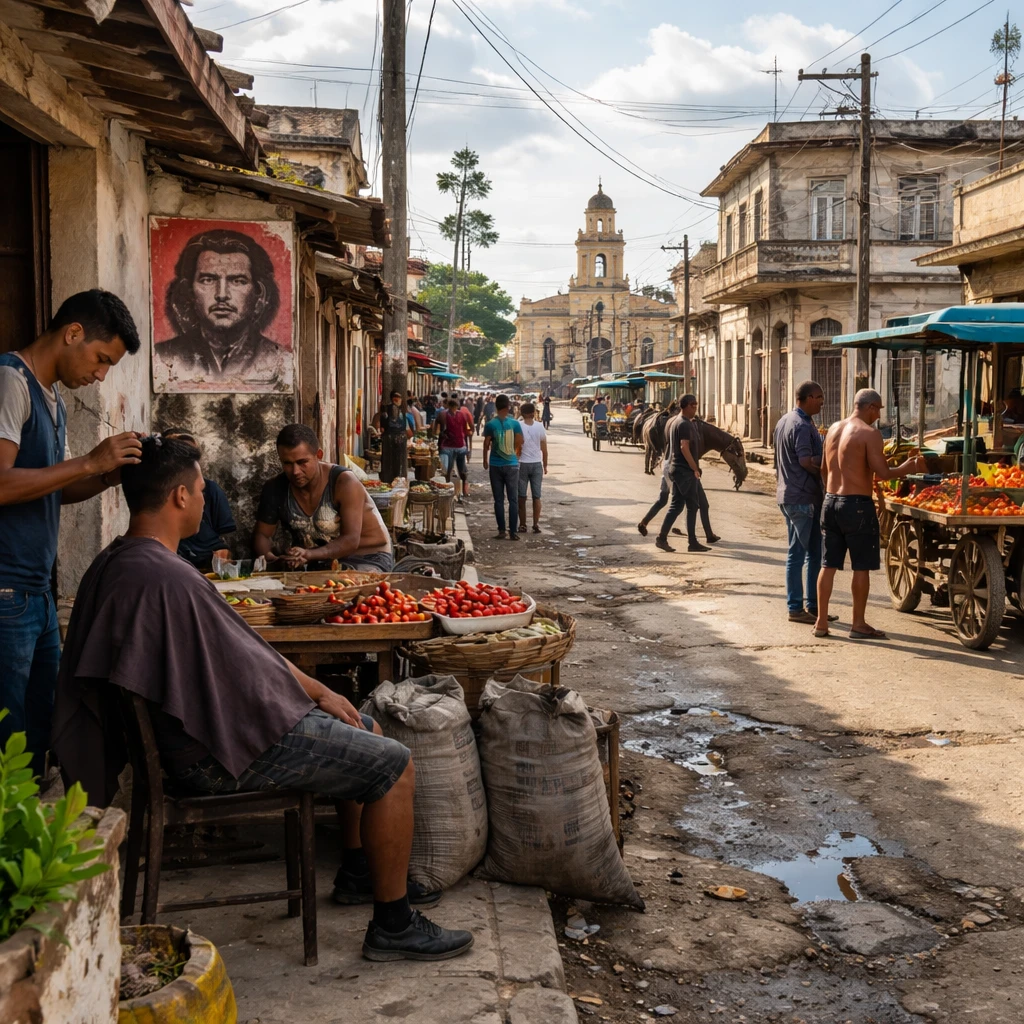
On the streets of La Güinera, despite fuel shortages and recurring blackouts, ordinary commerce continued under the midday sun. Pedestrians moved amid potholes while electric motorbikes threaded through traffic. Barbers worked with rechargeable cordless trimmers. Food kiosks sold produce as supply allowed; on the day observers were present, tomatoes were available at several stalls.
Local vendor Yuniel Romero, 37, who cuts hair from the front porch of a high-street business, expressed skepticism that another uprising would take hold. "The people are not going to get involved because in real life nobody wants to be imprisoned again. The people have no way to defend themselves," he said.
Ariel Anillo, 52, sold sacks of charcoal beneath a poster of Fidel Castro. The demand for charcoal has risen, he said, as cooking gas has become scarce. Anillo described a population that is persevering through outages and shortages while also mindful of the consequences of dissent. "You know that if you go to a protest they can put you in prison for 15 to 20 years," he said. "Then the situation is worse, and your family suffers."
Across both San Antonio de los Baños and La Güinera, residents painted a picture of people negotiating how to survive amid persistent scarcity, uncertainty and a recalibrated balance of risk. For now, the memory of the 2021 crackdown, combined with arrests, internet restrictions and the economic squeeze of sanctions and an oil blockade, seems to have curtailed the prospect of another nationwide wave of street protests.
Reporting note
The accounts in this article are based on on-the-record interviews with 12 named residents and additional conversations with several others who requested anonymity. Officials did not provide responses to requests for comment on many of the allegations raised by interviewees.