
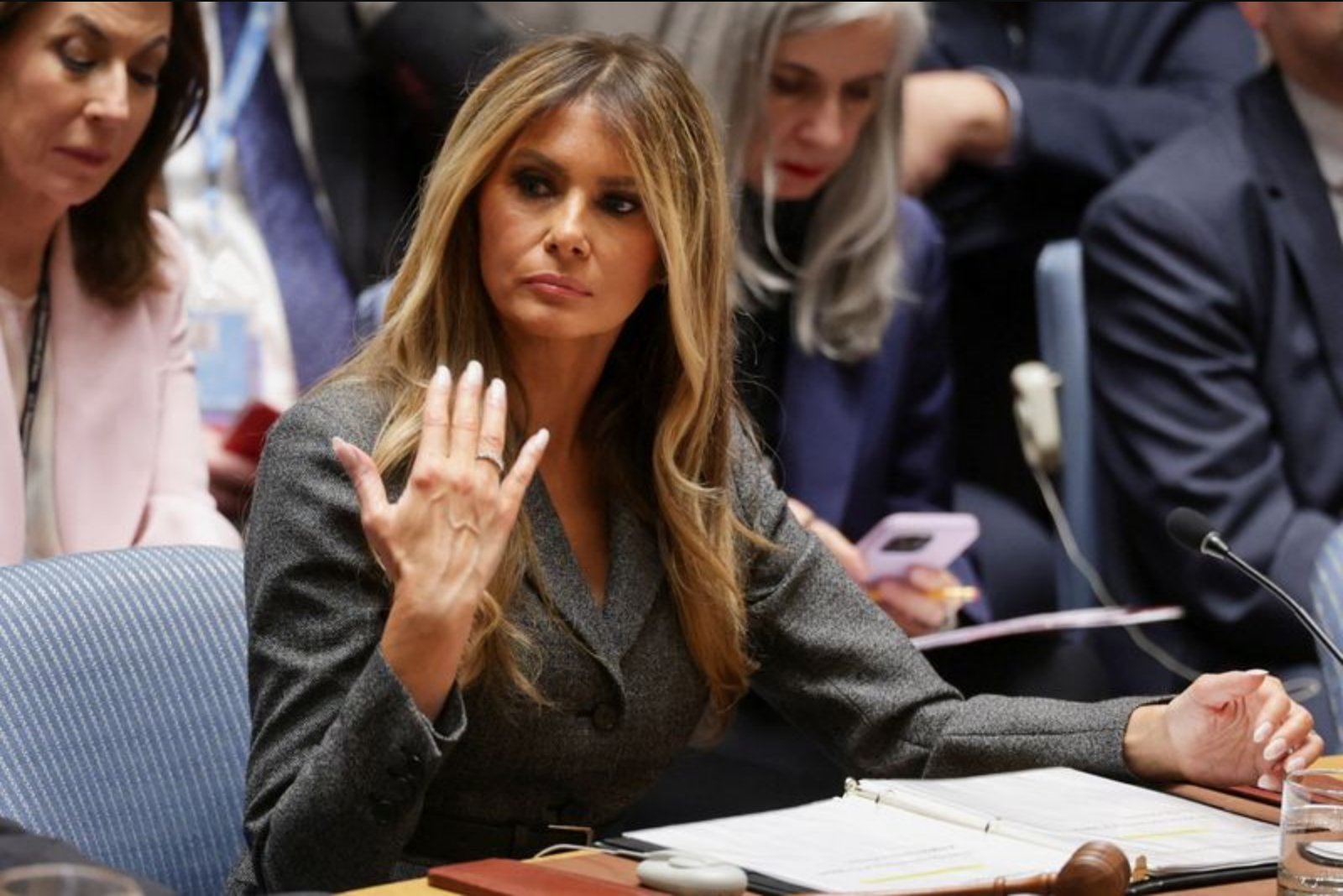
Melania Trump chaired a United Nations Security Council meeting on children and education in conflict on Monday, marking the first instance in which the spouse of a serving world leader has presided over a session of the 15-member council charged with maintaining international peace and security.
The session, convened under the United States' monthly rotating presidency of the council, carried the title "Children, Technology, and Education in Conflict." Melania Trump’s office said the goal was to highlight education as a vehicle for promoting tolerance and global peace. In a statement delivered to the council, she said: "The U.S. stands with all of the children throughout the world. I hope soon peace will be yours."
The meeting was announced last week, before the United States and Israel launched strikes on Iran earlier in the week - actions that prompted a U.N. warning about the safety of children in the region. The council session took place against a backdrop of heightened tensions and competing narratives about recent violence.
Iran has accused Israel and the United States of carrying out a strike on a girls’ primary school in the southern Iranian town of Minab on Saturday. Iran's U.N. envoy, Amir Saeid Iravani, said the attack killed 165 schoolgirls. The reports could not be independently confirmed. At the Security Council meeting, Iravani described it as "deeply shameful and hypocritical" for the United States to convene a meeting on protecting children in armed conflict "while at the same time launching missile strikes against Iranian cities and bombing schools and killing children."
On Saturday, the U.N. children’s agency, UNICEF, issued a statement referencing the Iranian reports and warned that the military escalation in the Middle East "marks a dangerous moment for millions of children in the region." UNICEF echoed a call by U.N. Secretary-General Antonio Guterres for an immediate cessation of hostilities.
Responding to questions, U.S. Secretary of State Marco Rubio told reporters on Monday that "the United States will not deliberately target a school." Israel’s U.N. ambassador said he had seen differing accounts, including claims that the Iranian Revolutionary Guard Corps targeted the school, and said Israel regretted the loss of any civilian life.
At the council meeting, China’s U.N. ambassador, Fu Cong, stated that attacks on schools are among the grave violations against children identified by the United Nations and urged that the international community respond to such incidents with robust investigations and accountability measures.
The use of a first lady to chair this Security Council session also served as another example of how President Trump has personalized U.S. foreign policy by involving friends and family in diplomatic matters. The decision to place the first lady in this role was noted by U.N. spokesperson Stephane Dujarric, who said last week that Melania Trump’s plan to chair the meeting showed "the importance that the United States feels towards the Security Council and the subject at hand," when referring to the meeting’s agenda.
President Trump has been an outspoken critic of the United Nations since his first term in the White House, saying the 193-member world body is ineffective and requires reforms. The United States is reported to be billions of dollars behind in its contributions to the U.N. budget, and that shortfall has grown substantially under President Trump.
Last month, President Trump adopted a relatively more conciliatory posture toward the U.N. at the inaugural meeting of his Board of Peace - an initiative he has described as aimed at resolving conflicts globally. The effort, however, has drawn concern from many world leaders who worry it may have been designed to supplant the United Nations.
The first lady has largely remained out of the public spotlight for much of the Trump administrations, but she has previously advocated for children’s causes. Her past activities include a 2025 letter to Russian President Vladimir Putin calling for the return of Ukrainian children who, she said, had been taken to Russia during the war.
Context and implications
The council session illustrated two concurrent threads: a diplomatic emphasis on protecting children and their access to education in conflict zones, and the immediate political frictions triggered by recent strikes and the resulting cross-accusations. While the meeting underscored education as a mechanism for tolerance and peace, it also exposed sharp disagreements among member states over responsibility for recent civilian casualties and the credibility of conflicting reports.
With key United Nations agencies publicly warning of risks to children amid military escalation, the discussion at the Security Council highlighted both humanitarian concerns and the political strains that complicate reaching consensus on accountability and protection measures.