
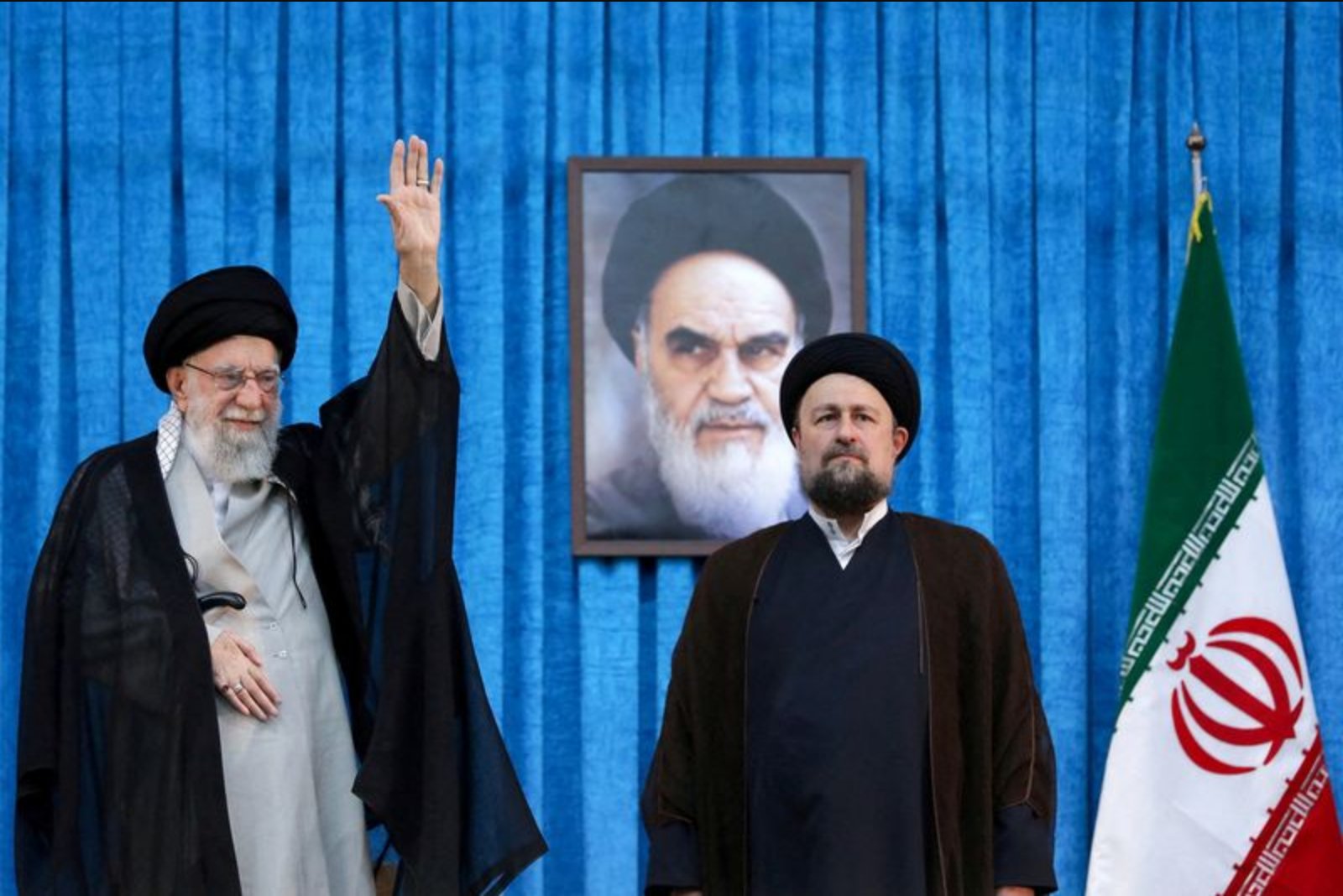
March 1 - Hassan Khomeini, a grandson of Ayatollah Ruhollah Khomeini, the founder of the Islamic Republic, is likely to feature prominently in the deliberations that Iran’s clerical leadership will hold as they consider who could succeed Ayatollah Ali Khamenei as Supreme Leader. The killing of Khamenei, 86, in a U.S.-Israeli attack has intensified questions about succession - a subject that carried little public clarity despite Khamenei’s advanced age.
Khomeini, 53, is the most visible among the late Ayatollah’s 15 grandchildren and is frequently portrayed within Iran’s clerical ranks as a relative moderate. He maintains close relationships with figures from the reformist camp, including former presidents Mohammed Khatami and Hassan Rouhani, both of whom favored engagement with the West during their presidencies.
His public presence is underscored by a symbolic custodial role: he is the custodian of his grandfather’s mausoleum in southern Tehran, a position that confers high visibility without having required prior government service. He has never held a formal government post.
Political profile and reformist ties
Within domestic political circles, some politicians have viewed Hassan Khomeini as a potential counterweight to hardline elements that expanded their influence under Khamenei, including Khamenei’s son Mojtaba. The argument for selecting a more moderate successor gained traction among certain Iranian politicians following widespread unrest in January, seen by some as a signal that a moderate figure might help stabilize the Islamic Republic amid growing dissent.
That said, Hassan Khomeini’s positions are nuanced. While loyal to the Islamic Republic established after the 1979 revolution, he has on multiple occasions advocated for reform and has sometimes publicly criticized state institutions. In 2021, for example, he condemned the Guardian Council after it barred reformist candidates from running in elections - a move that cleared a path for hardliner Ebrahim Raisi to win the presidency.
At the time he said bluntly: "You can’t pick someone for me and tell me to vote for them!"
Accountability and public unrest
Khomeini also pressed authorities to be accountable in the wake of Mahsa Amini’s death in 2022, when the young woman died after being detained by morality police for alleged dress-code violations. That incident sparked nationwide protests. Khomeini demanded transparency, saying that authorities "must transparently and precisely account for what has happened to this 22-year-old girl under the pretext of ’guidance and education’."
At the same time, Khomeini has not been an unambiguous critic of the establishment. During the protests that swept Iran in December and January - described as the deadliest unrest since the 1979 revolution - he supported the state line in several respects. He accused some rioters of serving Israel, participated in a pro-government march, and likened some of the violence to actions by Islamic State. In a condolence letter following the recent death of Khamenei, he wrote that Khamenei would remain "the hero of the people of Iran and Muslims," and said the Iranian people would "once again walk the path of the Imam (Khomeini) by overcoming this incident."
Religious standing and past electoral bids
Hassan Khomeini sought to stand for election to the Assembly of Experts - the clerical body charged with selecting the Supreme Leader - a decade ago. Initially, he received approval for his candidacy from Khamenei, who reportedly gave his blessing while warning Khomeini to avoid doing harm to his grandfather’s reputation. The Guardian Council later disqualified him. Official explanations cited his religious rank - Hojatoleslam, one tier below Ayatollah - but many observers viewed the disqualification as intended to prevent a potential electoral advance by the reformist camp.
Earlier in his career, in 2008, Khomeini was widely seen as criticizing the Islamic Revolutionary Guards Corps (IRGC) when he said those claiming to honor his grandfather’s legacy should follow the Imam’s instruction that the military remain outside politics. Despite that public admonition, he maintains close ties to the Guards, the elite force responsible for defending the Islamic Revolution.
Public statements and ideological stance
Hassan Khomeini has at times expressed views that align with a progressive theological outlook on issues such as music, women’s rights, and social freedoms, according to statements made by acquaintances in recent years. He has engaged with Western philosophy alongside Islamic thought and follows trends on social media. Close friends and associates portray him as interested in a more open social discourse.
He has also expressed strong anti-Israel rhetoric in line with mainstream positions within the system. He has described Israel as the "evil Zionist regime" and "a cancerous tumor" backed by the West, and said the Muslim world should strengthen itself to confront Zionism, according to remarks reported by outlets associated with Khomeini’s memory.
During the 12-day air campaign between Israel and Iran last year, he wrote to Khamenei praising his leadership and stating that Iranian missiles had become "a nightmare for Israel and a source of satisfaction for the Iranian nation," as reported by Jamaran, a news website dedicated to his grandfather’s legacy.
Personal life and background
Khomeini is fluent in Arabic and English. He was an avid footballer until age 21, when his grandfather insisted that he go to Qom to pursue Islamic theological studies. His wife, Sayyeda Fatima, is the daughter of an Ayatollah; the couple have four children. Reformists once encouraged him to run for the presidency in 2012, a bid he declined.
What his prominence means for markets and sectors
While the clerical process that will determine Khamenei’s successor remains internal and opaque, the emergence of a figure viewed as a relative moderate could factor into political stability calculations. Sectors sensitive to geopolitical risk - including energy, shipping, and regional trade corridors - would likely watch the succession closely. Security-related industries and firms connected to the defense and energy sectors in the region could face heightened short-term volatility as political jockeying unfolds.
For now, Hassan Khomeini’s blend of symbolic status, reformist connections and occasional public dissent, coupled with moments of establishment support, positions him as a consequential figure in the debate over Iran’s future leadership - though the outcome will depend on deliberations among clerics and institutional gatekeepers.