
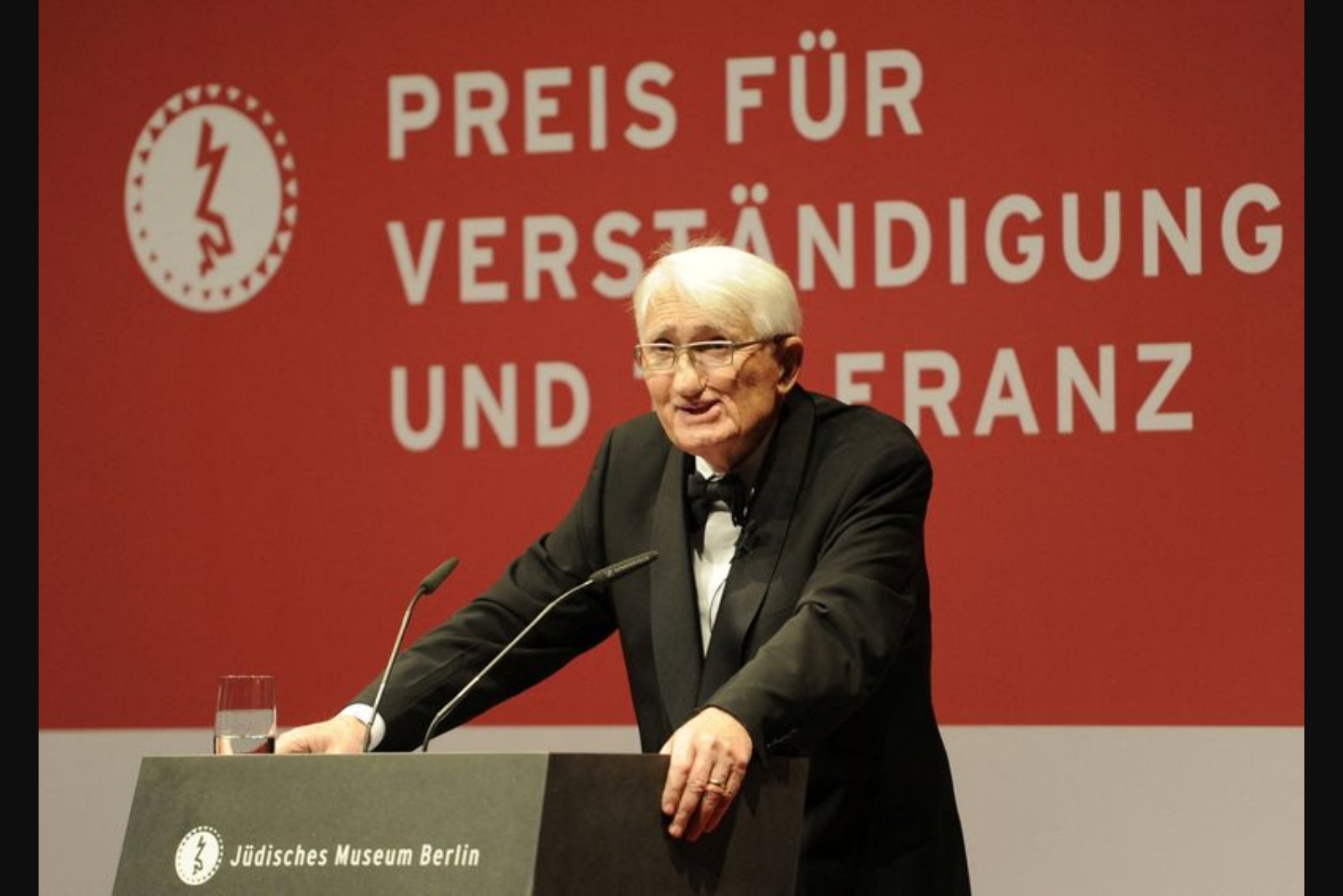
Juergen Habermas, the German philosopher widely recognised for his theories of consensus-building and communicative action, died on Saturday at the age of 96 in Starnberg, his publisher Suhrkamp said. Over a career spanning roughly seven decades, Habermas intervened repeatedly in Germany’s public debates, issuing forceful critiques of fascist ideas in the 1950s and later voicing concern about the return of militaristic and nationalistic sentiment in his country.
Born into a bourgeois family in Dusseldorf on June 18, 1929, Habermas endured medical treatments shortly after birth and in early childhood for a cleft palate. Those surgeries left him with a speech impediment that observers frequently link to his enduring focus on communication and language in his philosophical work. He grew up in a devout Protestant household. His father, an economist by profession, joined the Nazi party in 1933; Habermas later described his father as no more than a "passive sympathiser." Like most German boys of his generation, Habermas was a member of the Hitler Youth.
As the Second World War drew to a close, Habermas avoided conscription into the Wehrmacht by hiding from military police at age 15. In the post-war period he studied at the University of Bonn, where he formed a close personal and intellectual partnership with fellow student Ute Wesselhoeft. The couple shared interests in modern art, cinema and literature and married in 1955. Wesselhoeft died in the year before Habermas’s own passing. Two of their children, Tilmann and Judith, survive them; a third child, Rebekka, a modern historian, died in 2023.
Habermas first came to public attention in the 1950s through his dual work as a journalist and an academic. Influenced by the Frankfurt School and Marxist thinkers such as Theodor Adorno and Max Horkheimer, he developed a framework for understanding how public opinion forms. His habilitation traced the evolution of the public sphere from the salons of 18th century Europe to a 20th century shaped increasingly by mass media. That analysis found traction in post-war West Germany, where citizens were learning to debate politics openly following liberation from Nazi rule and where a broadly conservative government often showed limited tolerance for dissent.
Biographer Philipp Felsch, who wrote a book titled "The Philosopher," characterised Habermas as a kind of public educator for a society rebuilding its democratic habits - a figure at once hopeful and sceptical about the prospects for sustaining liberal democracy. Habermas’s voice helped steer a national conversation about how Germans should come to terms with the crimes of the Nazi period.
In 1986 he became a central figure in a heated debate over the Holocaust after historians such as Ernst Nolte suggested Nazi crimes might be placed within the wider context of wartime violence in Europe. Habermas defended the view that the atrocities of the Third Reich were singular and insisted that "Vergangenheitsbewältigung," or coming to terms with the past, should be central to Germany’s identity. Former foreign minister Joschka Fischer said it was crucial that Germany adopt a clear position on guilt and that Habermas’s contribution took on fuller meaning over time. The culture of remembrance that followed from this debate has, according to the article’s reporting, come under renewed pressure as the far-right Alternative for Germany (AfD) downplays Nazi crimes and suggests the Holocaust is wielded as a political cudgel against it.
The possibility of German reunification in 1989 drew Habermas back into public contention. He expressed scepticism about a reunified German nation-state, a stance that provoked anger among many compatriots. In subsequent decades he became a vigorous proponent of deeper European integration, offering it as a safeguard against a resurgence of German nationalism. At the turn of the century he campaigned for a European constitution, an effort that ultimately did not succeed.
Over time Habermas reassessed aspects of his earlier secular outlook and began to regard religion as an enduring social resource. He argued that religion could play a constructive role in modern life, describing it as "still indispensable in ordinary life for normalising intercourse with the extraordinary." On his own faith he once quipped that he was, "religiously-speaking, rather unmusical," signalling a personal distance from theological certainty even as he recognised religion’s social functions.
Habermas’s recent public interventions included contentious commentary on the 2022 Russian invasion of Ukraine. He initially supported then-chancellor Olaf Scholz’s cautious policy on military aid to Kyiv and later called for negotiations with Moscow. That position prompted sharp rebuke from Andrij Melnyk, who was then Ukraine’s ambassador to Germany; Melnyk said Habermas was a "disgrace for German philosophy" whose stance would make Kant and Hegel "turn over in their graves." Habermas subsequently clarified his position, describing Russia’s attack as "a fateful violation" of post-World War II European restraints on the use of force and expressing worry that the conflict with a nuclear-armed state "did not trigger any anguished reflection, but instead immediately prompted a highly emotionalised war mentality."
During a visit in the autumn of 2023, his biographer Philipp Felsch found Habermas to be "very gloomy," concerned that his political and philosophical legacy might be at risk. Habermas reportedly feared that the war in Ukraine could lead Europe to "gamble away the last remnants of its geopolitical credibility" and worried that a resurgence of militarism was gaining traction in Germany. Felsch said he encountered a lucid thinker who, in his view, embodied a version of Germany that had ceased to exist.
Across seven decades of writing and public engagement, Habermas remained a prominent, sometimes polarising, figure in debates over memory, democracy and Europe’s institutional architecture. His critiques and appeals - from early condemnations of fascist ideology to later cautions about nationalism and militarism - repeatedly emerged at moments when German society wrestled with its recent past and its future direction.
Key points
- Habermas shaped public debate in post-war Germany for seven decades, influencing discussions on democracy, memory and Europe.
- He defended the uniqueness of Nazi crimes and argued that confronting the past - Vergangenheitsbewältigung - must be central to German identity; that culture of remembrance now faces renewed pressure from the far-right AfD.
- In recent years he voiced concern about resurgent militarism and nationalism in Germany and advocated European integration as a bulwark against renewed dominance of the nation-state.
Sectors potentially affected: defence and government/political institutions, given the article's focus on debates over militarism, national policy and European integration.
Risks and uncertainties
- The growing influence of the far-right AfD, which the article links to attempts to downplay Nazi crimes, poses a risk to the culture of remembrance and to democratic norms in Germany; this carries implications for political stability.
- Resurgent militarism and a shifting public appetite for the use of force, highlighted by Habermas and observed during discussions around the Ukraine war, create uncertainty about future defence and security policy choices in Europe.
- Habermas himself feared that the war in Ukraine might erode Europe’s geopolitical credibility and that his intellectual legacy could be imperilled by changing public attitudes; this reflects uncertainty about the endurance of the ideas he championed.
Final note
Habermas leaves behind a body of work and a record of public interventions that, for many in Germany and beyond, served as a moral and intellectual compass through decades of democratic reconstruction and debate. His death marks the end of an era in which a single public intellectual could repeatedly shape national conversation on guilt, memory and the structures of democratic life.