
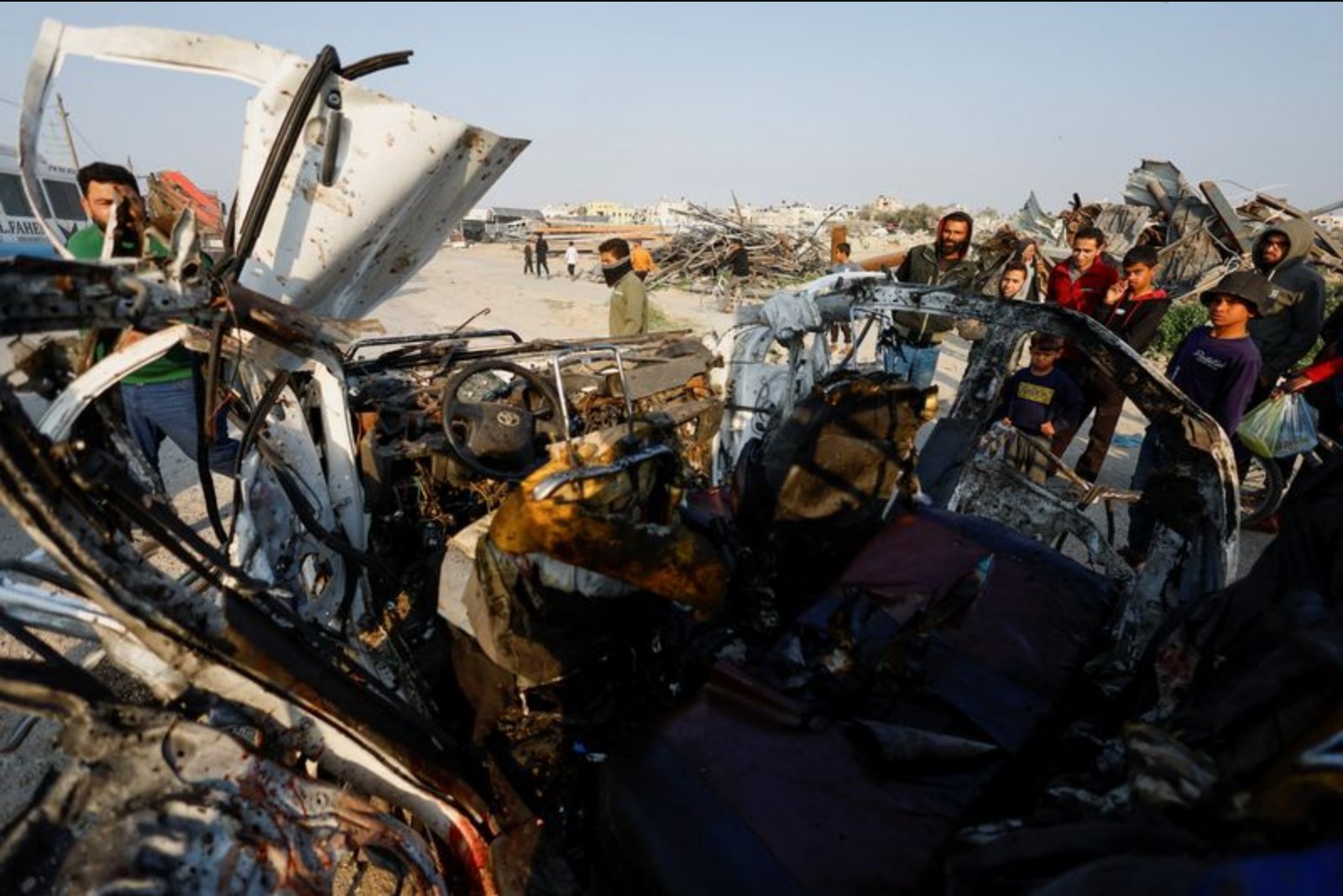
Israeli military action has killed almost a dozen members of the Gaza police force in recent days, Gaza authorities say, in a renewed campaign targeting the body that Hamas has used to reassert governance in the parts of the territory it controls.
The existence and future role of Hamas’ police, which the group says numbers nearly 10,000 officers, has become a major point of contention in efforts to implement a U.S. plan for Gaza. Hamas insists its officers be included in any new policing arrangement under the plan, while Israel refuses to accept the participation of any personnel with Hamas affiliations.
The U.S. plan calls for the militant group to lay down its weapons and transfer governance to a committee of Palestinian technocrats, who would then take responsibility for managing Gaza’s police as Israeli forces withdraw. Progress on disarming Hamas has been stymied, officials say, by a wider U.S.-Israeli conflict with Iran.
On the ground in Gaza, mostly unarmed officers wearing navy police uniforms have been visible in the narrow seaside area where Hamas retained administrative control after an October ceasefire that followed two years of war. Observers in Gaza City reported seeing officers directing traffic and patrolling markets and makeshift tent camps on Monday.
Ismail Al-Thawabta, director of the Hamas-run Gaza government media office, said that more than 2,800 Gaza police officers have been killed since October 7, 2023, when Hamas-led militants launched an attack on southern Israel that precipitated the wider conflict. He said dozens of officers have been killed since the ceasefire, including at least 10 since the start of the current U.S.-Israeli hostilities with Iran.
To try to limit further losses, Al-Thawabta said "operational orders and precautionary measures" were issued "to reduce risks to police personnel, including reorganizing movements and deployments." He did not provide additional details.
Israel maintains that its strikes on police targets in Gaza are aimed at removing threats to Israeli troops stemming from Hamas. Israeli forces remain deployed across roughly 53% of Gaza, which is under Israeli control.
The most recent, and most contested, incident occurred on Sunday in Zawayda in central Gaza. Gaza medics reported that an airstrike on a car killed nine police officers and left the vehicle's wreckage and bloodstains on the street amid surrounding damaged buildings. The Israeli military described the same strike as targeting an armed Hamas cell that it said was planning an attack on its troops, and said six people were killed.
Neither Hamas nor the Israeli military immediately reconciled the differing casualty figures.
Hamas accuses Israel of deliberately targeting police officials it says are focused on maintaining public security and order across Gaza following the two-year war. Israel rejects that characterization and says its actions seek to curtail Hamas’ ability to conduct or direct hostile operations.
Palestinian political analyst Reham Owda framed the strikes as reflecting Israeli concern about Hamas tightening its grip in areas under its control. "These strikes aim to disrupt Hamas’ security efforts in the territory and convey a clear message that Israel will not accept any expanded security role for Hamas within Gaza," Owda said.
Separately, Gaza’s health ministry reports that at least 670 people have been killed by Israeli fire since the October ceasefire took effect. Israeli authorities say four Israeli soldiers have been killed by militants in Gaza over the same period.
Violence has continued to produce targeted losses. On Wednesday, an Israeli airstrike killed a locally based armed Hamas commander, Mohammad Abu Shahla, in Khan Younis in southern Gaza, Gaza medics and Hamas reported. Overnight another incident in Gaza City left a senior Hamas police officer wounded after two men on a motorbike opened fire; Hamas blamed the attack on what it called "Israeli collaborators." Israel did not immediately comment on those incidents.
Among residents, the police are credited with providing a degree of protection in a territory where most of the population of more than 2 million people is internally displaced. Abdallah Al-Araisha, who lives in a tent camp in Gaza City, said the police had been active in fighting crime and protecting residents. "Without the police, we would be ruined," he said.
The ongoing clashes underline the political and operational difficulty of separating policing functions from the military and political structures of Hamas. The fate of the police force remains a central unresolved issue in any move toward disarmament and transfer of governance under the U.S. plan. Until that question is settled, security arrangements, casualty accounting, and public safety in Gaza are likely to remain contested.