
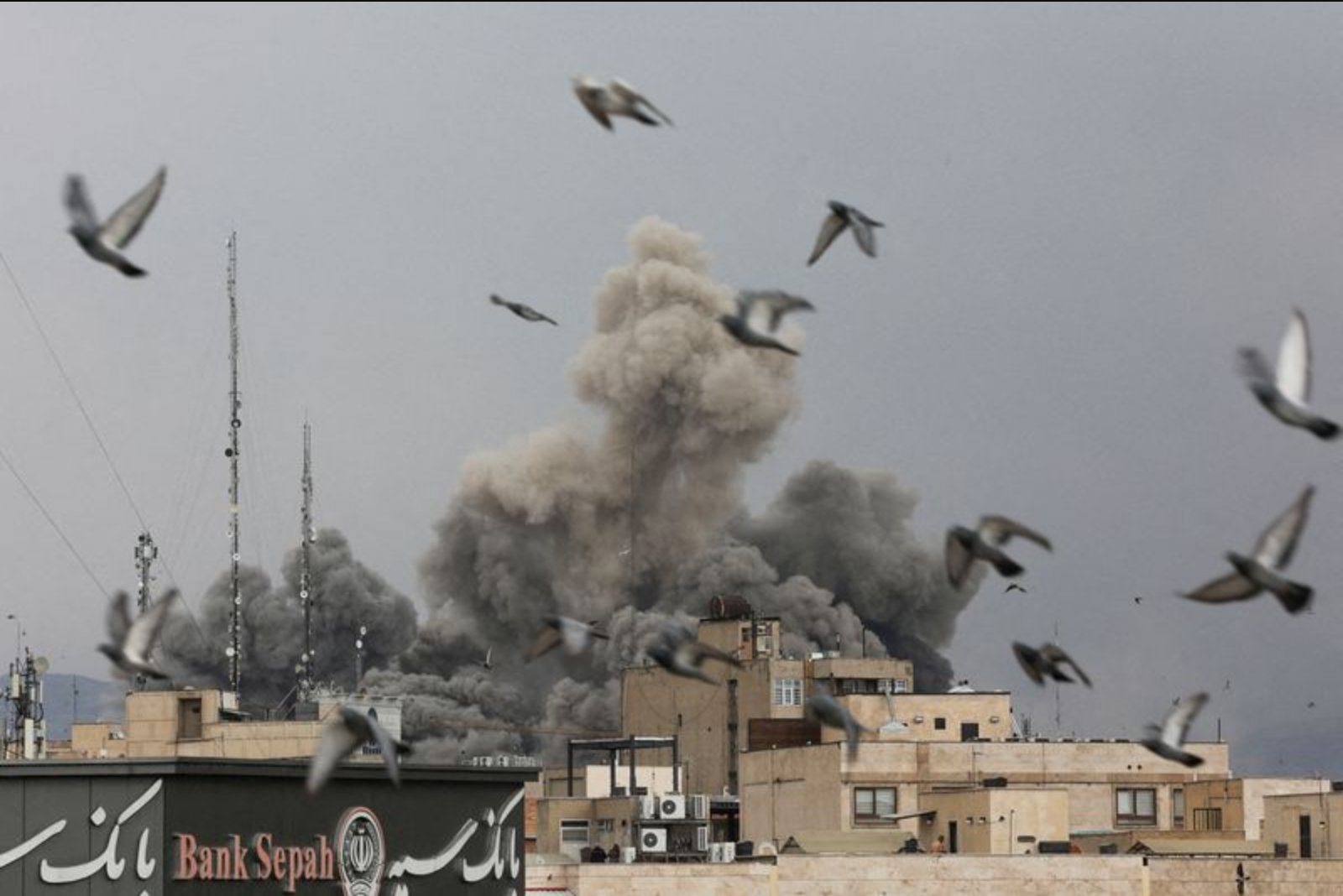
For decades Tehran invested resources, training and political capital in creating an array of foreign fighters and Iraqi paramilitary formations intended to serve as an extension of its military and political power. Among those people nurtured by that long-term effort is a commander known by the initials A.J., a member of a pro-Iranian militia in Iraq who has been ready to mobilize on short notice. After a week in which the United States and Israel launched direct strikes against the Islamic Republic, A.J. and many fighters like him have been waiting for orders from Iran - but the orders have not come.
The absence of mass mobilization among Iran-aligned groups inside Iraq marks a striking contrast with the way Tehran once relied on a network that reached from Tehran’s borders through Syria and Lebanon to Gaza and Yemen. Iraqi security and Kurdish officials, militia members, clerics and outside analysts interviewed say Iran’s ability to call on those forces appears diminished: some small strikes attributed to pro-Iran groups in Iraq have been reported, but many of the missile and drone strikes have been launched directly from Iranian territory, officials say, and attacks claimed online under generic labels have caused little or no demonstrable damage.
In recent days, a spate of online claims by a group using the label Islamic Resistance of Iraq appeared, but security assessments indicate the reported strikes largely failed to produce significant impact in the field. Kurdish officials in particular have attributed most of the long-range strikes to launches from Iran rather than operations staged within Iraq. A.J. himself expects that, if Tehran issues explicit orders to act, those orders will likely go to a narrow subset of the Iraqi Shi’ite militias Tehran still trusts outright. "I just don’t think most of them are reliable anymore," he said. "Some will act. Others would have front groups that could launch attacks with deniability. But many are just looking out for their own interests these days."
Why the proxies have not fully rallied
Interviewees across Iraq and beyond traced the weakening of Iran’s Iraqi proxies to several overlapping causes. They point to a years-long campaign by the United States and Israel to degrade Iran’s regional network, the shrinkage of the Syria corridor that once enabled the transit of weapons and fighters, and the gradual absorption of militia leaders into Iraq’s political and commercial spheres. Those factors, they say, have combined to hollow out a network that once appeared resilient.
More than two dozen people interviewed for this account - including militia members, Iraqi and Western officials, Shi’ite clerics, and analysts who study what was once called the "Axis of Resistance" - described a proxy ecosystem damaged by the targeted killings of senior field commanders who were difficult to replace, by the loss of safe transit points for arms and training, and by the transformation of key commanders into actors with political seats and business interests that make open military confrontation costly to their personal fortunes.
"The Iraqi militia leaders don’t want sanctions on them as individuals, they want to have access to Western healthcare, to have their children educated abroad," said Gareth Stansfield, a professor of Middle East politics and senior fellow who has advised governments in the region. Those incentives, Stansfield and others argued, have accelerated since last year’s 12-day confrontation between Israel and Iran, when the calculus around direct confrontation shifted for several commanders.
At the same time, insiders and officials said the proxies retain the potential to join the fight if certain conditions materialize - for instance if the conflict persists and Tehran asks for greater support, or if a strike occurs that Iraqi factions interpret as an attack on Shi’ites broadly, or if U.S.-backed Kurdish forces take action against Iran. But even the commanders and fighters willing to act face operational constraints: they are using older systems in the limited strikes reported so far, and A.J. said his group has not received fresh shipments of weapons from Tehran since last year’s confrontation with Israel.
Moving new armaments across borders at present, A.J. warned, would be too perilous: modern reconnaissance assets could detect transports and make them vulnerable to interdiction. That risk, he said, reduces the practicable options for groups that might want to escalate on behalf of Iran.
Claims and denials
Some Iraq-based pro-Iran factions did claim strikes in the days following the onset of the war. One group announced drone strikes on what it called "enemy bases in Iraq and the region," and several explosions were reported in Erbil, a Kurdish-run city that hosts a U.S. base. But Iraqi Kurdish authorities say the bulk of the missile and drone activity has originated in Iran, and security analysts assessing the online claims found little evidence that many of the purported attacks caused damage.
Israel’s military issued a statement describing "terrorist factions in Iraq" as proxies for Iran and noting that operations against the Iranian-led resistance axis, combined with Israel’s public posture that it would protect its civilians, have reduced attacks launched from Iraqi territory toward Israel. Governments in Baghdad and Tehran did not respond to requests for comment for this piece. The White House and the Pentagon also did not reply to requests for comment.
A moment of symbolic loss and muted reaction
On the second day of the conflict, A.J. and fighters with his group observed the death of Iran’s Supreme Leader Ali Khamenei, killed in an airstrike during the Israeli-U.S. assault on Tehran. The reports of his death were mourned by some members of Iran-aligned circles in Baghdad, but that did not translate into immediate operational orders from Tehran to mobilize across Iraq.
In Baghdad, thousands of demonstrators — including off-duty members of Iran-backed paramilitary formations — gathered at the gates of the fortified Green Zone, shouting anti-American slogans and attempting to press forward toward the U.S. embassy. Iraqi riot police held the approaches and used force, including tear gas, to stop the crowd from reaching a bridge that leads into the diplomatic complex. Notably absent from public view were the familiar faces of the better-known commanders associated with Tehran’s Iraqi affiliates.
Qais al-Khazali, a militia leader under U.S. sanctions whose banners were carried by protesters, issued a restrained statement calling for denunciation of the United States and urging supporters to "wear black" in a show of anger. Khazali, who in previous years had threatened U.S. interests and whose fighters were implicated in the death of U.S. troops in 2007, stopped short of calling for armed action in this instance. His office did not reply to a request for comment for this story.
In footage posted online, an agitated protester called on the militia commanders to take action, taunting them that if they did not "come stand with us and burn the (American) embassy, you are cowards." The protester referenced the 2019 episode when Iran-aligned demonstrators and militants attacked the U.S. embassy compound in Baghdad following American airstrikes in Iraq and Syria that killed dozens of paramilitary members. That 2019 incident is often recalled as a high point in the public projection of Iran’s Shi’ite proxy influence in Iraq.
From insurgency to institutions
The arc of Iraqi Shi’ite militias mirrors major shifts over two decades. Many militants that fought against U.S. forces after the 2003 invasion later embedded themselves in Iraqi political institutions. The rise of Islamic State in 2014 prompted a rapid expansion of Shi’ite paramilitary formations as volunteers mobilized to repel the extremist Sunni organization. After the defeat of Islamic State in 2017, leaders with long ties to Iran leveraged battlefield legitimacy into formal political capital in subsequent elections and rose within the Popular Mobilization Forces (PMF), a state-affiliated paramilitary umbrella that counts roughly 150,000 members.
With that formalization came additional resources and opportunities for those commanders to pursue business and political agendas. The confluence of armed force, state funding and private economic interests changed incentives for some commanders, increasing the costs of taking risks that could jeopardize their positions or assets abroad.
Decapitations and coordination challenges
Observers and militia personnel pointed to the U.S. assassination of Qassem Soleimani in early 2020 as a turning point that weakened Tehran’s capacity to orchestrate its regional network. Soleimani, the commander of Iran’s Quds Force, was widely seen by those interviewed as a uniquely commanding figure who coordinated operations across multiple proxies. After his killing, A.J. and others said that coordination suffered and that Esmail Ghaani, Soleimani’s successor, did not command the same level of authority.
A.J. keeps a photograph on his phone from a meeting with Ghaani, but he told interlocutors there is "no comparison" between the two leaders. In the months after Soleimani’s death, Lebanese Hezbollah — long viewed as Iran’s most capable and trusted proxy — assumed a greater role in trying to knit together Tehran’s affiliates across the region. A.J. recounted that a Lebanese figure close to Hezbollah convened Iraqi and other Tehran-aligned factions in Beirut for strategic discussions at that time.
Those lines of coordination frayed further after the later outbreak of fighting between Israel and Hamas in October 2023, which drew Hezbollah more directly into the conflict. The escalation culminated in the Israeli assassination in September 2024 of Hezbollah’s leader, Hassan Nasrallah, an event several interviewees described as another irreplaceable loss for the axis. "Nasrallah was also irreplaceable. Leaders like this come along only once," A.J. said. With Hezbollah’s senior leadership decapitated, Beirut ceased to serve as a safe hub for meetings and training, and Iraqi operatives confined much of their activity to Iraq and Tehran.
Multiple respondents said Nasrallah’s killing loosened Hezbollah’s hold on Lebanese institutions, including key transport points such as Beirut’s airport, which had previously allowed Iraqis affiliated with Tehran to travel with relatively less scrutiny. That tightening of access, interviewees said, reduced Iraq-based proxies’ ability to coordinate freely or to train and transit through Lebanon without attracting attention.
Syria’s collapse as a logistical artery
Syria once provided a critical land bridge connecting Iran to Hezbollah in Lebanon and to other groups operating across the Levant. From 2011, Iran and its regional allies deployed fighters from various countries to Syria to prevent what they viewed as the collapse of the Assad regime, and for many Iraqi Shi’ite fighters, the mission included protecting Shi’ite shrines.
By around 2020, many foreign militias reduced their footprint in Syria as the Assad government appeared to have survived the most acute period of the uprising. Nevertheless, offices, weapons and the institutional ties that facilitated transfer of arms and personnel remained in place for potential operations against Israel.
A.J. and other Iraqi commanders say that the security environment in Syria changed sharply after 2023. During a tense meeting of Iran-backed factions in Damascus, A.J. recalled warning Syrian military counterparts that hostile agents were operating throughout the country. In the months that followed, several senior Iranian commanders were killed in Syria, and A.J. suggested that Syrians allegedly compromised by Israeli influence provided targeting information. Analysts who track Iraqi factions said local informants or agents helped supply coordinates for the strikes.
Those assassinations, combined with an abrupt political shift in Damascus - described by respondents as the ouster of Assad and the seizure of power by forces led by Ahmed al-Sharaa - removed Syria as a secure springboard. The fall of the Assad regime in December 2024, as recounted by multiple interviewees, triggered the dispersal of remaining pro-Iran factions and the withdrawal of Iraqi elements across the border. "Damascus was the key for coordinating the axis of resistance," A.J. said. "That was a big turning point for us." Syria’s governing authorities did not reply to requests for comment for this piece.
Money, power and political integration
In Baghdad, visible construction projects owned and financed by militia leaders illustrate another dimension of how the scene has changed: many of the commanders cultivated by Iran have leveraged battlefield prestige into local wealth and influence. A former Iraqi intelligence chief described to an interlocutor the sprawling development projects owned by militia-linked figures and argued those assets create competing priorities as well as motives to avoid risk.
"These men were made by Iran, and might ultimately prove loyal to it," the former official said, "but there are two gods they worship above all - weapons and money." That dynamic helps explain why some commanders have moderated their anti-Western rhetoric and why others now cultivate political and diplomatic contacts that previously would have been unthinkable.
Some of those commanders have moved to a more openly political posture. Khazali’s militia spawned a political party that he leads, and he is among a cohort of Iran-aligned commanders who have secured seats in parliament and positions of influence within the Iraqi state. Those affiliations have allowed armed groups to be folded into the Popular Mobilization Forces, which receives an annual budget from Baghdad estimated at over $3 billion, according to people interviewed. At the same time, militia leaders have built broad business portfolios.
Those political and commercial connections have at times led senior commanders to tone down their threats to Western interests and to avoid military steps that might jeopardize their economic or diplomatic ties. Since the recent war began, many of these commanders have not issued threats against the United States, their groups have not claimed fresh attacks on U.S. targets, and several have privately aligned with the United States on the sensitive issue of selecting a new Iraqi prime minister.
Khazali and Shibl al-Zaidi, another leader under U.S. sanctions who also heads a political party, publicly rejected an Iran-favored nominee for prime minister, Nouri al-Maliki, according to people in Zaidi’s party and other Iraqi political figures. The two men have also been engaging with European officials; a spokesman for Zaidi’s party said a senior British embassy official recently met with the head of their parliamentary alliance. British diplomatic officials declined to comment for this account.
Some Iraqi politicians and commentators suggested that these diplomatic overtures serve multiple purposes: protecting political leaders from being singled out in potential strikes, preserving their positions within Iraq, and maintaining income streams. Several interviewees noted that Iran previously used complex channels - including middlemen, cash deliveries and illicit oil trade - to extract financial value from Iraq. While those practices are referenced in sanctions designations, respondents also said that preexisting sanctions had already constrained the flow of money to Iran from such channels prior to the current conflict.
Who remains loyal and who has drifted?
Voices inside Iraq presented divergent perspectives on which factions remain firmly committed to Tehran and which have shifted priorities toward local power and profit. Abu Turab al-Tamimi, a former commander associated with Kataib Hezbollah, said that only a handful of groups remained reliably loyal to Iran: he named Kataib Hezbollah, Harakat al-Nujaba (often shortened to Nujaba), and a few others. He explicitly excluded Khazali’s movement from that short list.
Several interviewees agreed that the cadres most likely to undertake risky military action were those who had not fully integrated into the political-economic elite and who still had limited ties to the institutions of state and commerce. Conversely, the cadre that had transitioned into political office or business ownership had acquired incentives to avoid direct confrontation that could risk sanctions, asset freezes, or restricted travel.
Those incentives, observers said, help explain why many senior commanders have been outwardly cautious in the opening days of the Iran war.
Recent strikes and casualties
Fighting since the war began has resulted in fatalities among Iran-aligned militants. On the third day of the conflict, A.J. mourned the death of a compatriot - a fighter and drone operator from Kataib Hezbollah - who was killed in an airstrike in Iraq. That death was among at least six Iran-backed militants reported killed in strikes since the onset of the war, according to the people interviewed. Such losses could affect the calculations of factions about whether to escalate or further retreat into politics and business.
What might draw the militias back into open combat?
Interviewees broadly agreed that the line between inaction and escalation could be crossed if Iraqi Shi’ites perceive an existential threat to their community or to Shi’ite holy sites inside Iraq. Several clerics and politicians suggested that an attack perceived as targeting Shi’ite religion or culture broadly could galvanize fighters and pull more groups into combat, even if the immediate orders do not come from Tehran.
"Iraqi Shi’ites share an ideology with the Islamic Republic of Iran, and that is defense of our religion," said Sheikh Karim al-Saidi, a cleric who participated in pro-Iran demonstrations in Baghdad. "We hope for peace, but if it comes to confrontation we’re ready."
Separately, many paramilitaries have not seen full-scale warfare since the campaigns against Islamic State in Iraq and Syria. Several fighters and commanders said they remain prepared to confront a renewed threat from that group if it re-emerges from cross-border sanctuaries in Syria. Some within the militias also interpret recent developments - including U.S. engagement with Syria’s new president - as indicative that the United States may be trying to shape regional dynamics in ways that could push Sunni jihadists closer to Iraq, a development they view as a threat they might have to counter.
"Our leaders might be busy with politics," said Seif, a member of Khazali’s armed group who gave only his first name. "But all we know is jihad."
Conclusions and outlook
After decades of Tehran cultivating a constellation of militias and foreign fighters, the initial week of direct fighting between the United States, Israel and Iran has demonstrated significant limits to the mobilization capacity of those Iraq-based proxies. The reasons are manifold and interlinked: the attritional campaign from Israel and the United States, the loss of key transit and training zones in Syria and Lebanon, the decapitation of senior leaders, and the domestic political and business integration of formerly militant commanders.
Those dynamics have left Tehran with fewer reliable instruments in Iraq and have raised questions among observers about how much of the old network remains capable of synchronized, large-scale action. Insiders and analysts caution, however, that the situation could change if the conflict prolongs, if strikes are perceived as targeting Shi’ite communities at large, or if other triggers spur a more robust response. For now, many of the militias Iran once counted on appear to be weighing their institutional and economic stakes as carefully as they consider their historical ties to Tehran.
Note: Several Iraqi and regional figures quoted or referenced did not respond to requests for comment; other official institutions likewise did not reply to outreach for this report.