
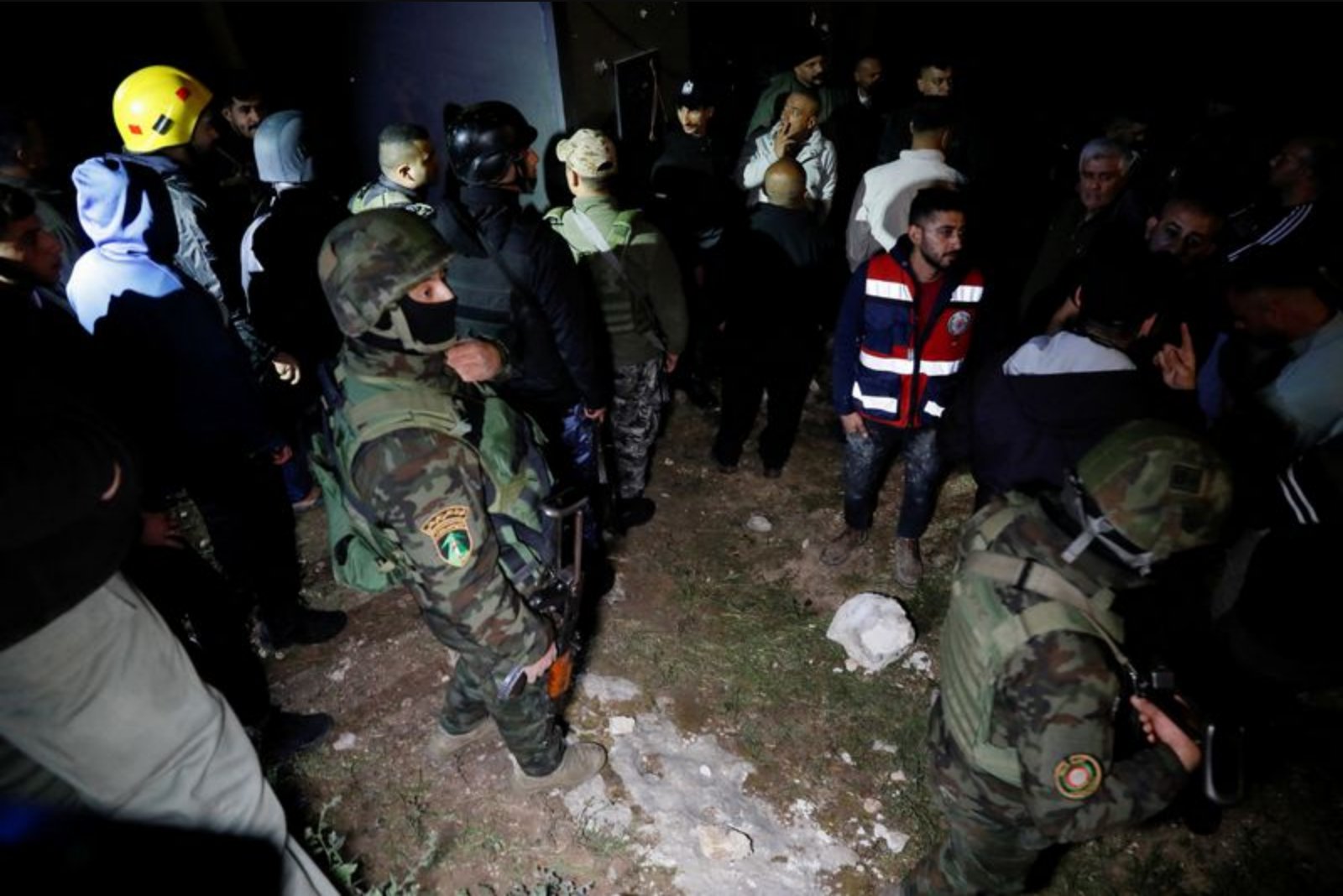
JERUSALEM, March 18 - Three Palestinian women were killed late on Wednesday when a missile struck a hair salon in the town of Beit Awwa, southwest of Hebron, the Palestinian Red Crescent and the Palestinian Authority’s official news agency WAFA reported. Thirteen people were wounded in the attack, including one person who was described as seriously injured.
Palestinian authorities characterized the strike as an Iranian missile attack, and officials noted that this represents the first deadly Iranian strike in the occupied West Bank and the first such attack to kill Palestinians since the start of the U.S.-Israeli war with Iran.
The Israeli military said it understood the blow had been caused by a cluster munition - a warhead that breaks apart into numerous small bomblets that scatter over a wide area. Cluster munitions pose a particular danger to civilians because the dispersed submunitions can strike multiple targets across a broad zone.
Since the end of February, when Israel and the United States launched attacks on Iran, at least 15 people have been killed in Israel, a toll that officials say has contributed to a broader regional conflict. Iran has been dispatching missiles daily toward Israel, according to accounts of the ongoing exchanges, though there have been no reports that Iran has deliberately targeted Israeli-occupied Palestinian territories prior to this strike.
There is a marked disparity in civilian protection between Israeli and Palestinian populations in the area. Most Israelis have access to bomb shelters designed to provide protection from cluster munitions and falling debris. In contrast, virtually no comparable shelters are available for Palestinians in the West Bank.
Many Palestinians rely on the sound of sirens originating in nearby Jewish settlements or neighboring Israeli cities to receive warning of incoming rocket volleys. The settlements, built on land captured by Israel in the 1967 Middle East war, are regarded as illegal by most world powers. Israel disputes that characterization and asserts a biblical claim to the land.
The attack occurred as streets in parts of the West Bank were crowded with families buying sweets and presents ahead of Eid al-Fitr, the holiday that marks the end of Ramadan.
Note: The article reports on the strike, casualties, the type of munition involved as described by the Israeli military, and the broader context of missile exchanges since late February. Where specific intent or targeting by Iran toward Palestinian territories is not documented, this article reflects that limitation.