
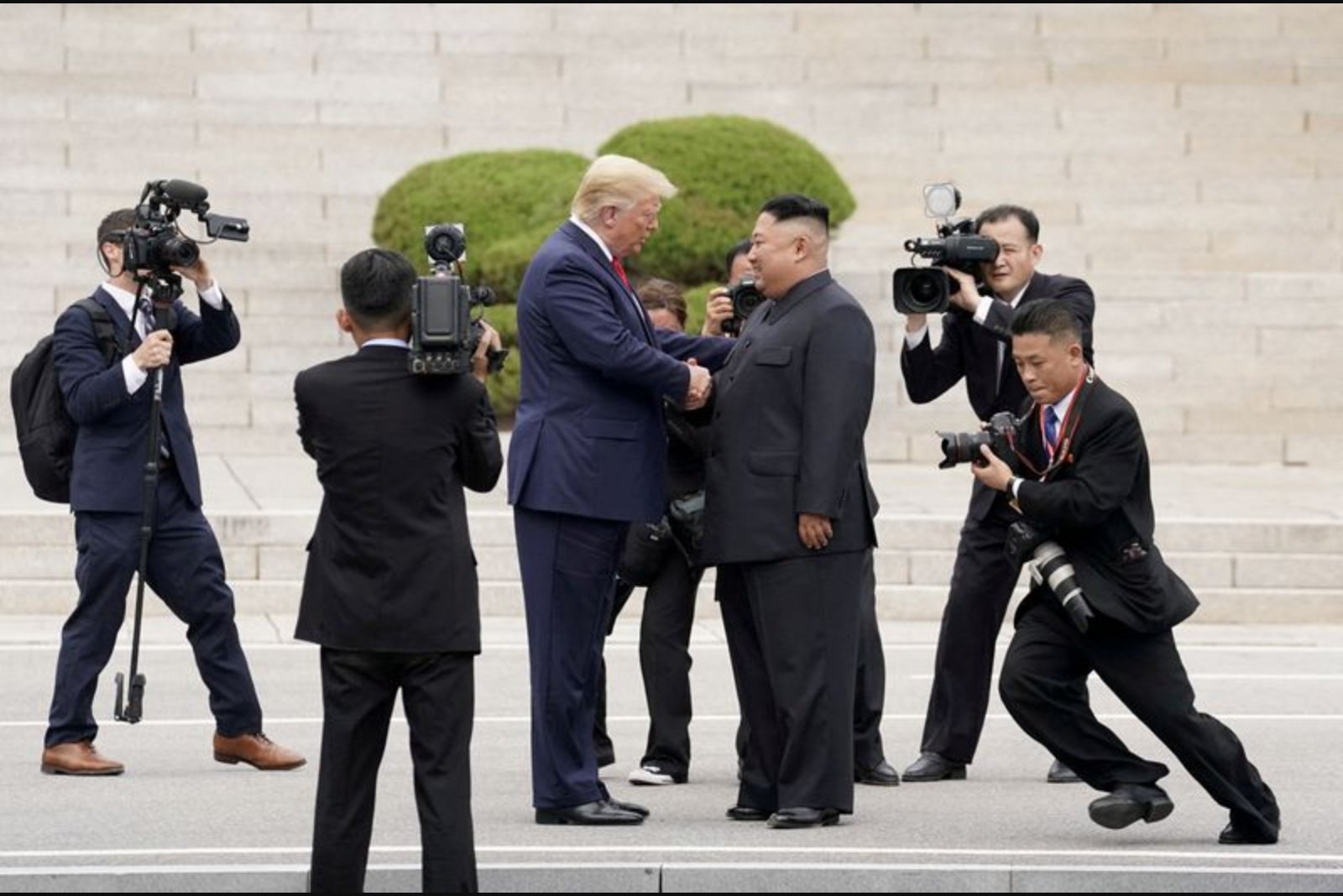
U.S. and Israeli military strikes on Iran have, according to analysts and former officials, sharpened North Korea’s assessment of the value of nuclear deterrence and may influence whether leader Kim Jong Un reengages in negotiations with President Donald Trump.
Diplomatic efforts to curb Pyongyang’s development of nuclear warheads and ballistic missiles collapsed after a brief period of summit diplomacy between Kim and Trump in 2018 and 2019. Despite those earlier meetings, sanctions have continued to penalize Pyongyang’s weapons programs, and bilateral talks have not resumed.
The recent strikes on Iran - which the article reports killed Supreme Leader Ayatollah Ali Khamenei - occurred two months after U.S. special forces, under orders from President Trump, captured Venezuelan President Nicolas Maduro in a raid, further shaping the regional and global context in which Pyongyang evaluates its security strategy.
"Kim must have thought Iran was attacked like that because it didn’t have nuclear weapons," said Song Seong-jong, a professor at Daejeon University and a former official at South Korea’s Defence Ministry. Song’s observation reflects a widely cited interpretation among analysts that the display of U.S. force against states without nuclear deterrents can increase incentives for those states to pursue or retain such capabilities.
A statement published by North Korea’s foreign ministry in state media described the military operation as inevitable, attributing it to the "hegemonic and rogue" nature of the United States.
At a ruling party congress held last week, Kim pledged to build additional nuclear weapons, while simultaneously indicating a willingness to engage in talks if Washington altered its approach. KCNA, the North’s state news agency, quoted Kim as saying: "If the United States withdraws its policy of confrontation with North Korea by respecting our country’s current status ... there is no reason why we cannot get along well with the U.S."
President Trump has expressed a desire to hold fresh talks, and some speculation has arisen that the two leaders could meet during the President’s trip to China from March 31 to April 2.
Experts differ on how the Iran strikes will affect Pyongyang’s calculations. Leif-Eric Easley, a professor of international studies at Ewha Womans University in Seoul, said the message the Trump administration seeks to convey to nations it deems pariah states is clear: stop threatening the United States and its allies, and negotiate before it is too late.
At the same time, analysts note North Korea is technologically more advanced than Iran in the development of nuclear warheads and in delivery systems, including intercontinental ballistic missiles. That technical lead affects both Pyongyang’s negotiating leverage and the practicality of any denuclearization process.
In 2022, North Korea codified the right to launch preemptive nuclear strikes in law, a step Kim has described as making the country’s nuclear status "irreversible." That legal posture and Kim’s public statements have lowered the priority of renewed talks with the United States, according to Sydney Seiler, a senior adviser at the Center for Strategic and International Studies and a former U.S. special envoy during six-party talks on the North’s nuclear program. Seiler said: "President Trump’s willingness to use military force and threats for negotiating leverage must make Kim nervous and less likely to hastily seek talks."
Others argue a heightened perception of threat could produce the opposite effect, prompting Pyongyang to seek engagement as a means of managing risk. Cho Han-bum of the state-run Korea Institute for National Unification offered a pragmatic observation about the limits of denuclearization efforts: "Unlike Iran, it’s impossible to denuclearise North Korea," he said, citing the scattering of nuclear sites across the isolated state.
External estimates cited in the debate include a Stockholm International Peace Research Institute assessment last year that North Korea has assembled roughly 50 warheads and retained enough fissile material to produce up to 40 additional warheads.
Seoul-based academics and former officials outlined several possible tactical motives for Pyongyang to resume contact with Washington. Yang Moo-jin, a professor at the University of North Korean Studies in Seoul, said Kim could seek to leverage a personal rapport with President Trump to probe U.S. positions on North Korea while buying time to further advance nuclear capabilities.
Nam Sung-wook, a professor at Sookmyung Women’s University and former head of a think-tank at South Korea’s intelligence agency, suggested Kim might contemplate a conditional meeting if the United States acknowledged North Korea’s nuclear status. Nam also noted that Kim likely views his relationships with China and Russia as a partial shield, a belief reinforced by his September armoured-train trip to Beijing and his public presence alongside Chinese President Xi Jinping and Russian President Vladimir Putin at a major military parade.
Ko Young-hwan, a North Korean diplomat-turned-defector who has advised the South Korean government, argued Kim may also seek to reassure the United States about the limited intent to employ nuclear weapons directly against the U.S. "The incident in Iran must have made him think he should manage relations with the United States better," Ko said.
Contextual note - The views presented above reflect the perspectives of analysts and former officials cited in Seoul, and outline competing interpretations of how military action against another state may influence Pyongyang’s nuclear strategy and diplomatic choices. The situation remains fluid, and the ultimate direction of North Korea’s policy will depend on decisions by its leadership and responses from the United States and other actors.