
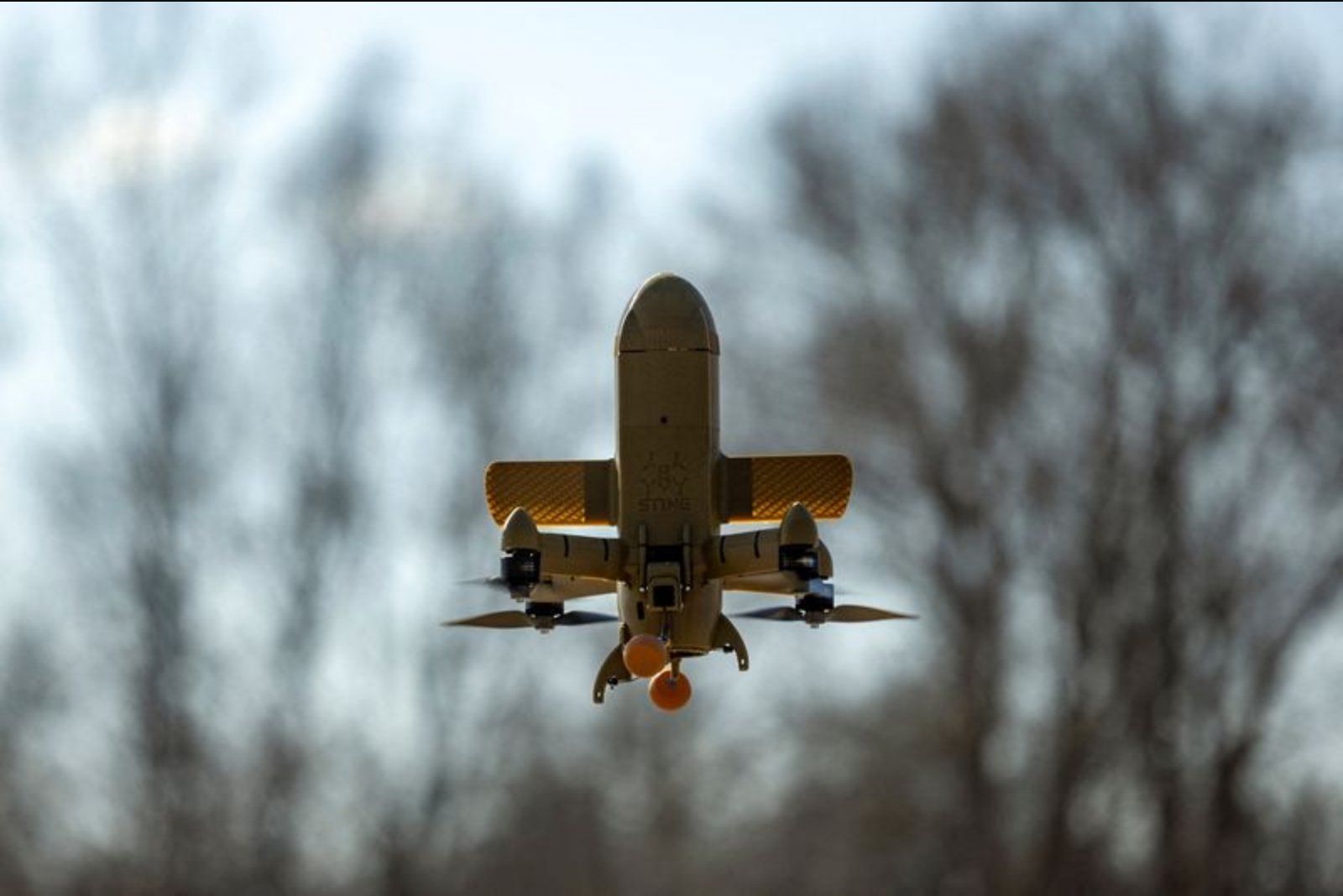
Streaking overhead with a high-pitched wail, a squat quadrocopter twists and dives with a responsiveness that seems improbable for a device some observers liken to a winged lava lamp. Once a speculative idea, the interceptor drone created by the private Ukrainian company Wild Hornets has become central to Kyiv’s efforts to shoot down Russian drones and is drawing attention from states confronting Iranian-made strikes in the Gulf.
Officials in Kyiv and Ukrainian drone manufacturers report that the United States and its partners have sought Ukrainian help to blunt attacks by Iranian Shahed drones that have targeted sites across the Middle East. Wild Hornets says customers from the region have expressed interest in its interceptors, but the company will not strike export deals until it receives approval from Ukraine’s government.
Field demonstration
At an undisclosed site, a Wild Hornets team demonstrated one of its interceptor systems for Reuters. Around a control console, masked engineers monitored a clear camera feed relayed from the aircraft. A test pilot using the call sign "Paskudnyk" - a name that translates to "nasty guy" - flew the device and described the experience.
"You can’t describe it in words - you need to feel it," said the pilot, who previously worked as a furniture builder and now supports Ukrainian pilots in active operations.
The demonstration underscored a design philosophy focused on speed, simplicity and compatibility with existing pilot skills in Ukraine.
Performance and operating model
The STING interceptor is capable of reaching speeds up to 280 km per hour (174 miles per hour), and uses a 360-degree antenna to support operations at ranges up to roughly 37 km. The aircraft is intended to intercept slower, propeller-driven drones by approaching them from a distance and detonating a warhead on impact.
Wild Hornets says its controls are straightforward for operators experienced with first-person-view (FPV) drones, which are widely used by pilots in the conflict. "If you already know how to fly an FPV drone, then moving to this device is a matter of three or four days," the test pilot said.
Scale, cost and evolution
According to the company, since entering regular service in June 2025 the STING has shot down more than 3,000 Russian Shahed drones. Wild Hornets reports monthly production exceeding 10,000 units, and says each interceptor costs around $2,000 or less. By comparison, the Shahed drones they engage are estimated at $20,000 to $50,000 each.
The company has also developed a second-generation model engineered to fly faster and to engage jet-powered variants of the Shahed that Russia continues to field. A company representative who asked not to be identified for security reasons said the upgraded version has already been used in defensive operations, but that detailed technical specifications are being withheld.
Exports and political oversight
Wild Hornets emphasizes that its priority is strengthening Ukraine’s own defenses and that it will only proceed with exports at the request of the Ukrainian government - a position the company said is especially pertinent if Kyiv receives additional U.S. Patriot systems to address ballistic missile threats. "We’ve received requests in our inbox," the company representative said, "but we’re not reacting to them for now."
Since the outbreak of conflict between Iran-aligned forces and other parties on February 28, Gulf Arab states have faced more than 2,000 missile and drone attacks that struck U.S. diplomatic posts, military bases, oil facilities, ports, airports, commercial and residential buildings, and ships. Kyiv has indicated a willingness to provide assistance, but with conditions.
President Volodymyr Zelenskiy said last week that Kyiv expects financial and technological compensation in exchange for helping Middle Eastern nations. He said that three Ukrainian teams of air-defence specialists have been dispatched to the region. Zelenskiy also criticized certain Ukrainian firms and foreign governments that he said attempted to negotiate anti-drone equipment deals without formal approval from Kyiv.
Strategic context without additional commitments
Interceptors like the STING present a lower-cost tactical option compared with multimillion-dollar U.S. Patriot missiles, offering a practical way to engage slower drones at closer ranges. At the same time, Wild Hornets and Ukrainian authorities have signaled caution about moving forward with exports until formal government permissions and trade arrangements are in place.
The company’s current stance reflects a focus on sustaining Ukraine’s own air-defence needs while remaining open to regional requests that are coordinated with Kyiv.