
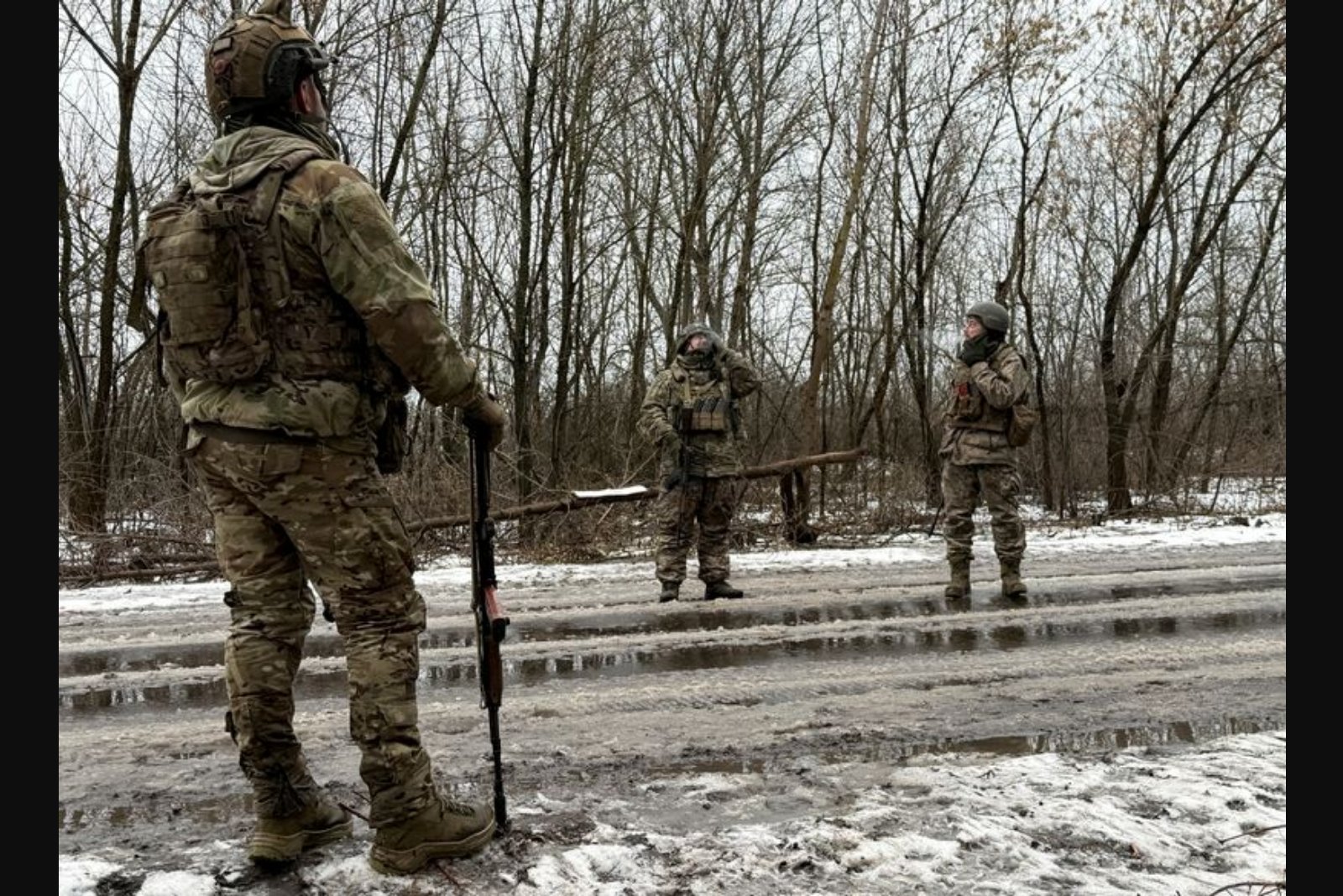
KHARKIV REGION, Ukraine, Feb 24 - Valentyn Bohdanov, a senior sergeant and tank platoon commander in Ukraine’s 127th Separate Heavy Mechanised Kharkiv Brigade, recalls a phase of the war when heavily armoured forces engaged in direct confrontations that resembled boxers trading blows in a ring. Those days, he says, have largely passed. Small, agile "first-person-view" drones now patrol the skies above frontline positions, creating a near-constant aerial threat that makes movement of tracked vehicles and assault formations exceptionally hazardous.
Bohdanov, who uses the call sign "Bodia" and is 36 years old, said: "They won’t enter an open field: they’ll be peppered by FPV drones and stronger ones." His own T-72 tank, captured from Russian forces, has been parked beneath webbing near a snowy stretch of the northeastern Kharkiv frontline and is effectively limited to serving as stationary artillery rather than an instrument of manoeuvre.
Those observations reflect a larger tactical transformation that has unfolded since the early stages of Moscow’s February 2022 invasion. Thousands of precision drones now fly daily across an expanding "kill zone" along the roughly 1,200-kilometre front. Many of these systems cost only several hundred dollars each, but they operate in numbers and in concert with a growing toolkit of more capable drones capable of longer ranges and heavier payloads.
The practical consequence is that almost any movement - whether troop rotations, supply convoys, evacuations or armoured assaults - carries heightened risk. A recent report by the French Institute of International Relations, published this month, described the war’s evolution into what it called an "air battle of mutual denial," and highlighted a sharp rise in drone-inflicted casualties. Those casualties rose from less than 10% of the total in 2022 to as much as 80% last year, according to the report.
Mobile defence and drone-hunting
Mobile teams tasked with detecting and countering drones have become common along contested supply routes. Reuters visited one such unit near the besieged eastern city of Kostiantynivka where soldiers patrolled roads shielded by anti-drone netting and littered with burnt-out vehicles. The teams are tasked with keeping lines of supply open to troops in sectors where Russian forces are making advances.
One member of a drone-hunter unit who identified himself by the call sign "Marine" and serves with the 93rd Mechanised Brigade recounted witnessing intense swarms: he said he once saw 54 drones attack a single target within one hour. "Three would circle, another would attack while the others join," he said. "They’re in the air like that all the time, not letting anyone get away."
Soldiers directly under such strikes often describe being overwhelmed by the FPV drones’ speed and maneuverability. Video of FPV attacks has flooded social media platforms on both sides of the conflict, illustrating how difficult it can be to evade or counter these weapons once they are committed.
Frontline and hospital testimony
In a military hospital in the northeastern city of Kharkiv, Andriy Meskov recounted an attack in which drones pursued him and two comrades as they sought shelter. Meskov, 42, who also serves as a drone pilot in the 151st Separate Reconnaissance-Strike Battalion, said the speed of the FPV drones made them impossible to outrun. "The speed of a human being doesn’t compare to the speed of an FPV drone, so I didn’t even have time to pick up my rifle to shoot at it," he said.
Meskov’s injuries were severe: a drone ricocheted off his helmet, exploded near his leg, and shattered his knee. He was evacuated on an unmanned ground vehicle, reflecting a broader shift in the use of robotic systems for non-combat missions. Ground drones are now increasingly used for logistics, resupply and casualty evacuation in order to reduce the number of personnel exposed to aerial attack. Defence Minister Mykhailo Fedorov said these ground platforms carried out more than 7,000 missions in January, and he indicated that Ukraine plans to boost their production and procurement this year.
Longer evacuation times are a further consequence of the expanded kill zone. Col. Viacheslav Kurinnyi, 45, the chief doctor at the Kharkiv hospital treating Meskov, said the drone threat to vehicles had pushed the average time for medical evacuation beyond three days. That extended delay runs counter to the military medical principle known as the "golden hour," the 60-minute window when intervention is typically most critical to saving a wounded soldier’s life. "Any countries that are preparing for war at home need to realise that there will be no 'golden hour'," Kurinnyi said. "Maybe a 'golden day' if they’re lucky." He recounted a case in which the hospital received a wounded soldier who had worn a tourniquet for more than two months.
Equipment, doctrine and the search for the next breakthrough
At the snow-covered position where Bohdanov stood next to his immobilised tank, he expressed skepticism about the future role of heavy armour in its traditional form. He argued that such weapons are increasingly less relevant on an ever more drone-dominated battlefield and suggested that emphasis should shift to longer-range artillery. Bohdanov said his crew would be willing to retrain to serve in roles where they could be more effective.
Observers note that tanks still have roles in close-quarters fighting in urban environments and in adverse weather, but that large-scale armour-led assaults have largely been replaced by smaller infantry-focused operations on many parts of the front. Military analyst Rob Lee of the Foreign Policy Research Institute said the current diminished role of tanks reflects the pace of change in technology and tactics. "Right now, the current role is diminished, and I think we’re waiting for the next technological breakthrough that will enable manoeuvring again," he said.
For now, the combination of inexpensive precision drones, larger strike-capable unmanned systems, mobile counter-drone units and increased use of ground robotics for logistics and medical evacuation is reshaping how both sides operate. Those shifts are prompting adjustments in procurement, training and command decisions as commanders adapt to an environment in which control of the airspace at low altitudes is a determining factor in survival and operational freedom.
Summary
Low-cost FPV drones and more capable unmanned systems have become the dominant factor in many frontline sectors in Ukraine, constraining armoured manoeuvre, increasing drone-related casualties, lengthening medical evacuation times and pushing the adoption of ground robots and mobile drone-defence teams.