
Hamas on Friday denounced Israeli Prime Minister Benjamin Netanyahu’s public statement that Israel would broaden its area of control in the Gaza Strip, calling the announcement a dangerous escalation. Residents of Gaza also expressed deep apprehension about the plan, which was outlined without a timetable or specifics.
Under the ceasefire agreement reached in October, Israel was to maintain control of 53% of Gaza territory. On Friday Netanyahu said Israel would expand that footprint to an initial 70%. The prime minister did not provide details on how or when such an expansion would occur.
The Palestinian militant group that launched the October 7, 2023 attack on Israel and triggered two years of intense fighting called Netanyahu’s remarks a blueprint for ethnic cleansing and forced displacement of Palestinian civilians. Ismail al-Thawabta, head of the Hamas-run Gaza government media office, framed any effort to impose a new occupation in Gaza as "null and illegitimate," and described the prime minister’s comments as "a dangerous escalation."
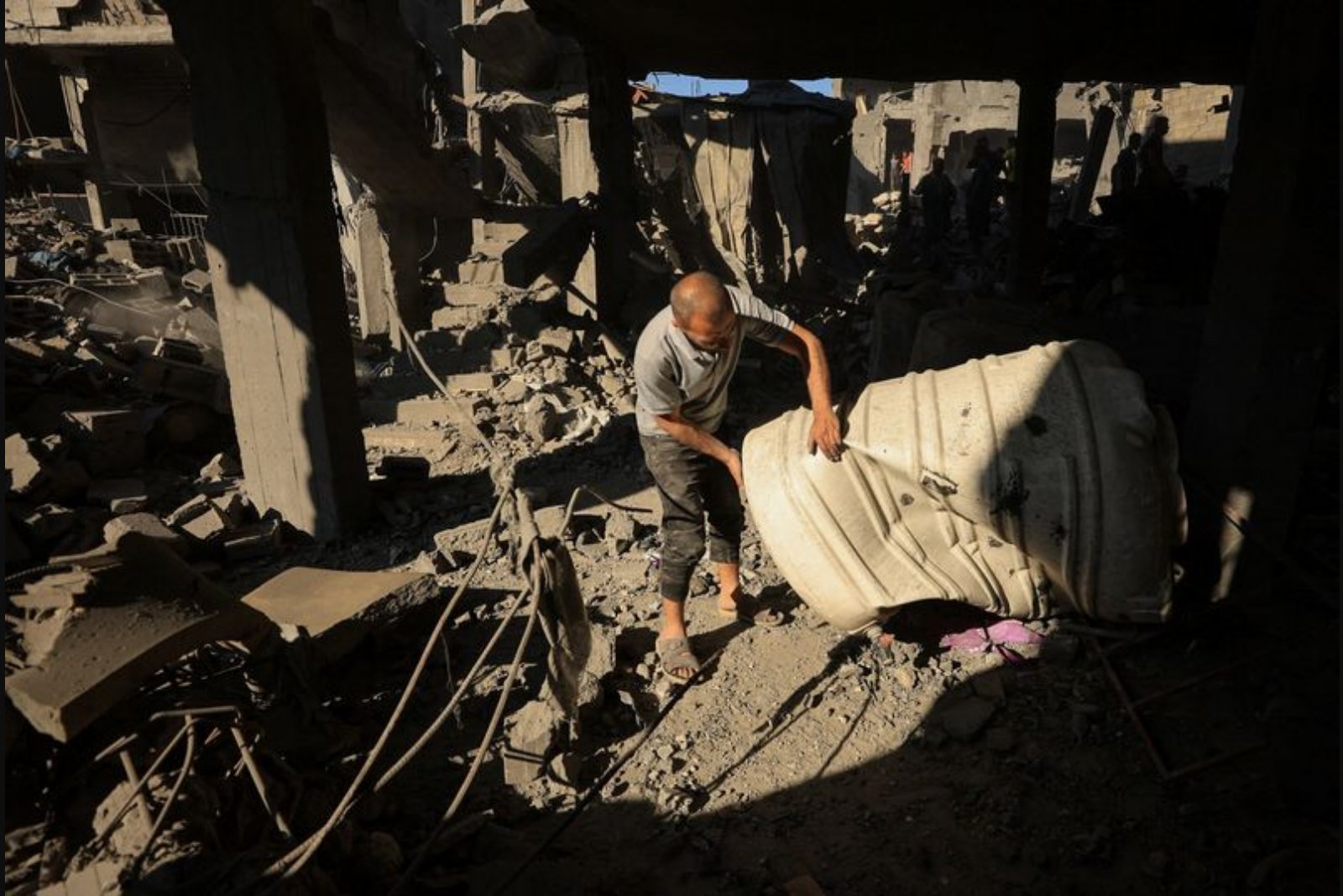
More than eight months into the ceasefire, and while international focus has shifted to fighting in Iran, Gaza’s core conflict remains unresolved. Despite the truce, Israeli strikes have continued and large portions of aid have not reached civilians. Humanitarian conditions are precarious: more than 2 million people live in the enclave, most of them displaced and concentrated in makeshift tent camps. Further reductions in territory available to residents could compound already dire living conditions.
Gaza has already seen an expansion of Israeli-controlled areas since the ceasefire was signed. The area Israel controlled under the ceasefire was demarcated by a "yellow line" as 53% of the territory, but the military has expanded operations up to roughly 64% by incorporating zones it has labelled as restricted on maps provided to aid groups. Any additional shrinkage of space in which civilians can live raises concerns among local residents and humanitarian organizations.
"Where do we go? To the sea? There is no space," said Mohammed al-Shagra, 72, who is displaced and living in Khan Younis, articulating the desperation felt by many Gazans facing further territorial contractions.
Last year’s ceasefire arrangement, brokered by U.S. President Donald Trump, created a Board of Peace to supervise a phased cessation of hostilities and was later ratified by the United Nations Security Council. However, the deal deferred resolution of several of the most contentious issues - including the disarmament of Hamas, a complete Israeli withdrawal, and the composition of a future Gaza government - to later stages of the process. Negotiators on the Board of Peace have engaged both parties about disarmament, but progress on the outstanding items has been limited.
Both Israel and Hamas have accused the other of violating the truce since it took effect. According to the figures cited under the ceasefire, Israeli strikes have killed more than 900 Palestinians since the truce began, while Palestinian militant attacks have resulted in the deaths of four Israeli soldiers. Attempts by Reuters to obtain further comment from Israel’s military and the prime minister’s office on Netanyahu’s latest statement went unanswered. The Board of Peace said it would not comment on the prime minister’s remarks.
Responses from foreign ministries were mixed or pending. Britain and France did not immediately provide comment when contacted. A German foreign ministry spokesperson said Germany was concerned about Israeli plans to take control of a larger portion of Gaza and opposed a permanent division of the Palestinian territory.
Analysts and political actors see multiple pressures shaping the timing of Netanyahu’s remarks. Facing elections this year and criticism at home over Israel’s inability to secure strategic objectives in conflicts in Iran and Lebanon, Netanyahu may be attempting to demonstrate a tougher posture to domestic voters. Max Rodenbeck, Israel-Palestine Project Director at the International Crisis Group, suggested the prime minister sought to appear resolute to the electorate and warned that absent clear pushback - particularly from Washington - the announcement carried a risk of renewed and severe violence.
Rodenbeck noted other measures Israel has taken that increase pressure on Hamas, including maintained aid restrictions into Gaza and continued strikes targeting particular Hamas figures. Those actions, alongside the declaration to expand control on the ground, shape the broader context in which Gaza residents and international observers view the ceasefire as fragile.
Inside Gaza, where most people were uprooted from their homes during the war and still remain in temporary shelters, the prospect of intensified Israeli military measures provoked alarm. "We see no ceasefire or anything and they keep advancing beyond the yellow line. For how long will the world stay silent?" asked Mohammed al-Jundi, a displaced man in Gaza City, reflecting local frustration and fear.
Within Israel, security-focused officials and analysts argue that renewed military pressure may be the only way to extract disarmament from Hamas and secure a more durable arrangement. Kobi Michael, a researcher at Israel’s Institute for National Security Studies and a former official in the country’s strategic affairs ministry, said the latest developments "look as if we are taking a step towards another collision," while voicing a belief that any new confrontation might be shorter and could open a path to a different future.
As these competing perspectives play out, the humanitarian situation in Gaza and the political calculations in Israel remain tightly linked. The declaration to increase Israeli control, issued without operational specifics, has heightened the uncertainty surrounding the ceasefire's stability and the immediate future for Gazan civilians.