
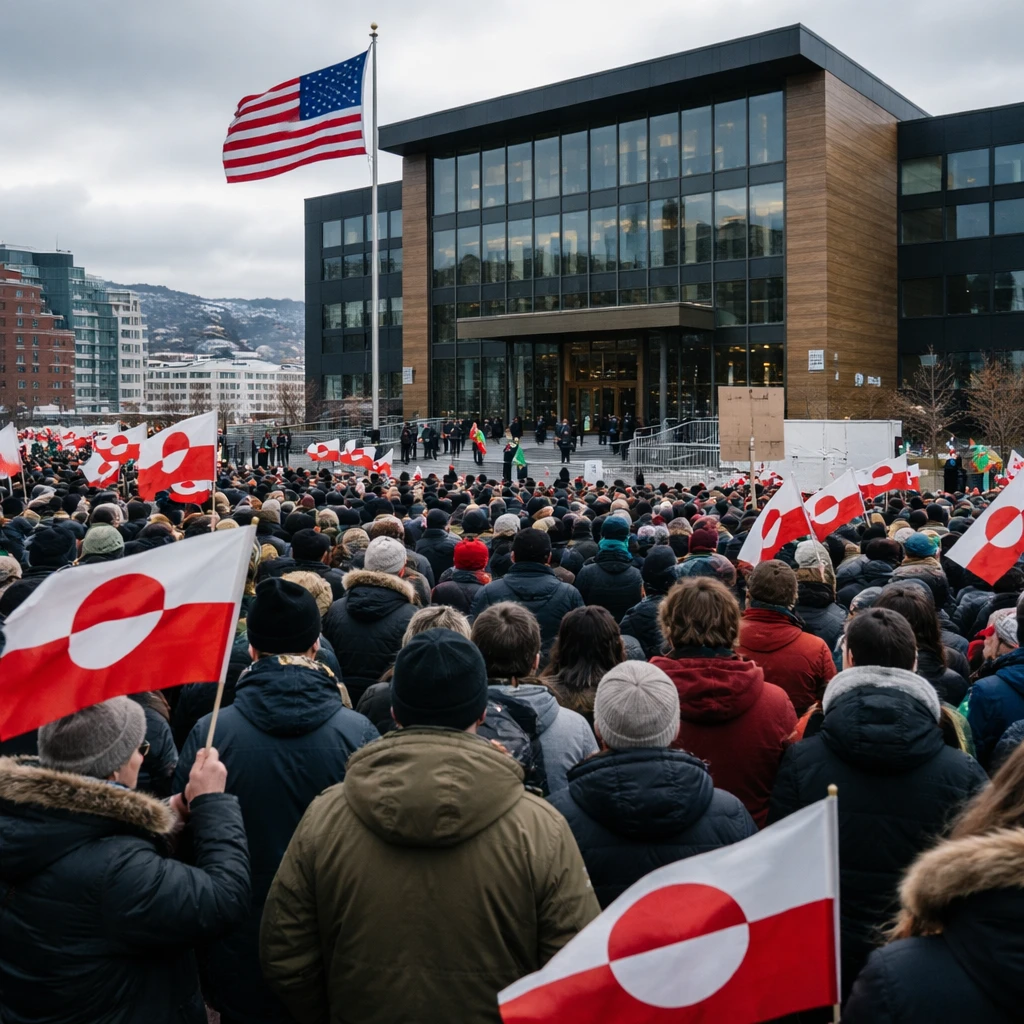
NUUK, May 21 - The United States opened a larger consular office in downtown Nuuk on Thursday, a move that drew visible public opposition and the absence of several Greenlandic ministers from the ceremony.
The new consulate replaces a modest wooden cabin located on the outskirts of the capital and occupies a more capacious downtown space. U.S. officials described the venue as significantly larger and well suited to expand diplomatic engagement in Greenland.
Several hundred people gathered outside the consulate during the opening. Demonstrators waved Greenland’s red-and-white flag and held posters bearing the words "USA, stop it." They chanted slogans including "No means no" and "Greenland belongs to the Greenlanders," signaling opposition to what protesters characterized as increased U.S. interest in the island.
Greenland’s Prime Minister Jens-Frederik Nielsen and a number of other politicians said they had declined invitations to attend the event. Nielsen told local daily Sermitsiaq: "We haven’t made a decision in principle, but I won’t participate." The absence of senior local officials underscored political sensitivities surrounding the U.S. presence.
A State Department spokesperson said the new venue has greater capacity and offers an outstanding space for U.S. diplomatic engagement in Greenland.
The opening took place against the backdrop of a broader dispute over U.S. interest in Greenland. In January, the White House said President Trump was considering how to acquire Greenland, including a potential use of the U.S. military, a proposal that later moved to a diplomatic track. Greenland’s government said on Monday that progress had been made in the high-stakes talks over the future of the territory amid U.S. threats of annexation, adding that the giant island belongs to its people and will never be for sale.
At the opening ceremony, U.S. Ambassador to Denmark Kenneth Howery said in a speech, according to Greenlandic public broadcaster KNR: "We will always be neighbours and stand by you, whatever future you decide for yourselves, as your allies and partners."
President Trump has described Greenland, home to about 57,000 people, as strategically important in countering Russia and China in the Arctic. The United States currently maintains one active military base on the island, a decline from roughly 17 facilities in 1945.
The inauguration of the larger consulate therefore illustrates competing dynamics: the U.S. intention to increase its diplomatic and strategic footprint, and local political and civic resistance to perceived encroachment on sovereignty. Demonstrators and absentee ministers signaled unease even as American officials framed the move as enhancing bilateral engagement.
Context limitations: Reporting in this piece is limited to statements and developments described by officials, local media and demonstrators. No additional assertions about future outcomes are made beyond those remarks and the events at the opening.