
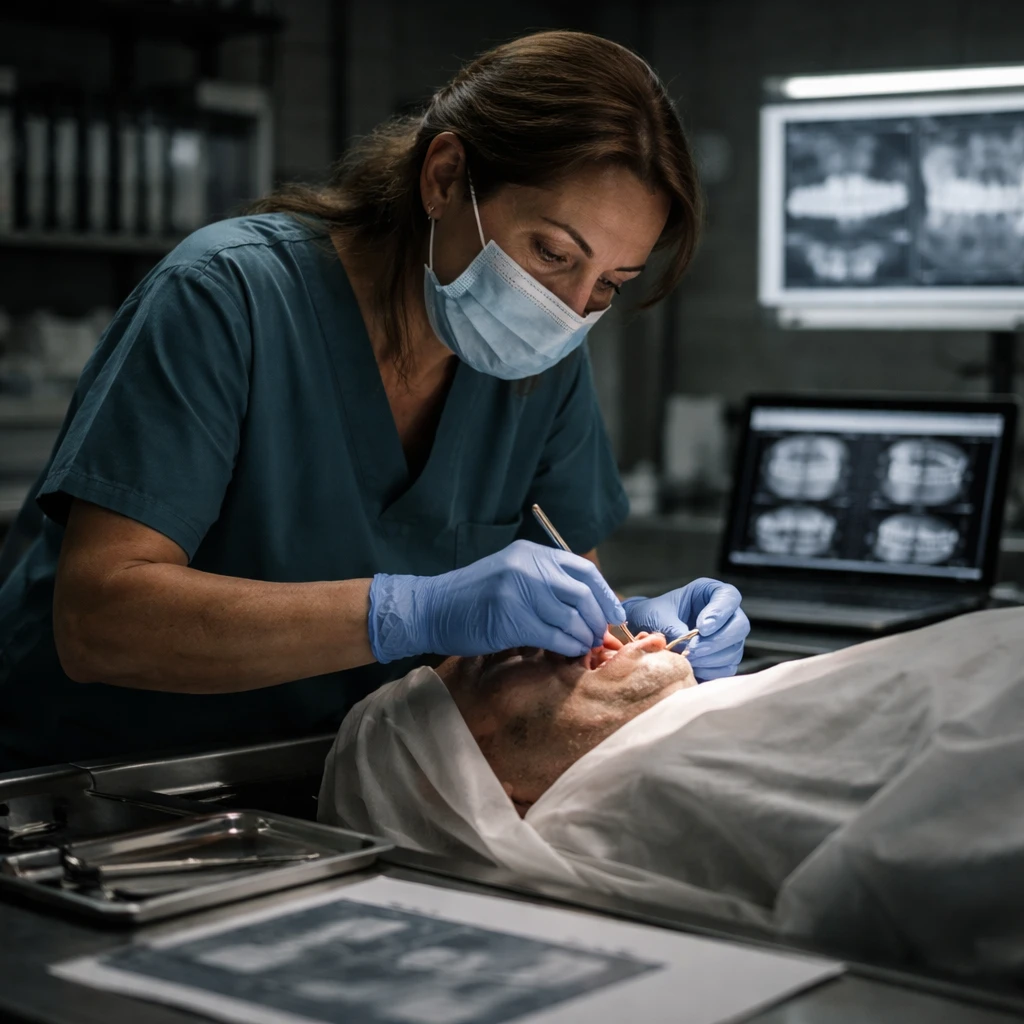
After completing the identification work that confirmed the remains of the last Israeli hostage recovered from Gaza, dentist Esi Sharon-Sagie had hoped to be finished with the grim task of naming those killed in more than two years of conflict. Instead, weeks later she was summoned back to perform the same painstaking work.
Sharon-Sagie returned to identification duty after a U.S.-Israel air assault in Iran on February 28 triggered a wider conflagration across the Middle East. On March 1 she was called to the aftermath of an Iranian missile strike on the central Israeli town of Beit Shemesh.
New scene, familiar demands
"We were informed that a missile killed nine people that weren’t able to get into a shelter in time. And the minute we heard that the disaster happened, we had to go to do the identification," Sharon-Sagie said. Among those killed in that strike were three siblings, aged 13, 15 and 16.
Sharon-Sagie has volunteered with the police since 2010, but she says the scale of the challenge changed dramatically after October 7, 2023. That day, an attack by the Palestinian militant group Hamas produced Israel’s deadliest single-day toll in recent memory. Health services were strained by the volume of fatalities; identification of roughly 1,200 people, some of whom had been badly burned, took many months to complete.
The role of forensic odontology
Forensic odontology - the use of dental records and dental anatomy to identify remains - becomes essential when bodies are too damaged for visual recognition or fingerprinting. Charred or decomposed remains can often be matched to past dental X-rays or records, allowing authorities to confirm identities when other methods fail.
Sharon-Sagie described long, exhausting shifts that sometimes left her physically spent but still responsible for final comparisons. On one occasion, after an hours-long duty, she was asked to examine another victim. She remembered seeing the woman’s slim hand and the rings on it, and addressed the woman silently.
"I spoke with her in my heart with no sound. I looked at her and I said: 'now you’re going to help me because I have no strength anymore. You’ll help me and I’ll help you. I’ll bring you back to your family'," Sharon-Sagie said.
High-profile identifications
A year after the October 7 attack, Sharon-Sagie took part in identifying one of the people Israel described as a mastermind of that assault. Yahya Sinwar, who at the time was the leader of Hamas, was killed by Israeli forces in southern Gaza in October 2024. His body was transferred to Israel, where authorities said medical records from a period when he had been held in an Israeli prison were on file.
"He had brain surgery in Israel many, many years ago. So we had all his information," Sharon-Sagie said, referring to the medical documentation that aided the identification process.
Final hostages and cemetery searches
For many Israelis, closure from the October 7 events depended on the recovery and identification of captives taken to Gaza. The remains of the last of 251 hostages were recovered on January 26. Sharon-Sagie worked as part of a team that examined bodies buried in a cemetery in northern Gaza during the search for Ran Gvili, a police officer who engaged militants at an Israeli kibbutz.
The identification process was emotionally complex for those involved. Sharon-Sagie recalled her reaction when the team concluded a match.
"I was surprised it was actually happening. I felt my hands trembling, I was very moved. When we did the identification and finished signing the report that this is him, at first I was happy but seconds after that I understood that it is over, he is not coming back to Israel alive," she said.
Sharon-Sagie’s work underscores the reliance on specialized forensic skills when conflicts produce casualties that cannot be identified by sight. As the region faces renewed hostilities, the demand for such expertise has returned, bringing with it both technical challenges and intense emotional weight for the professionals involved.