
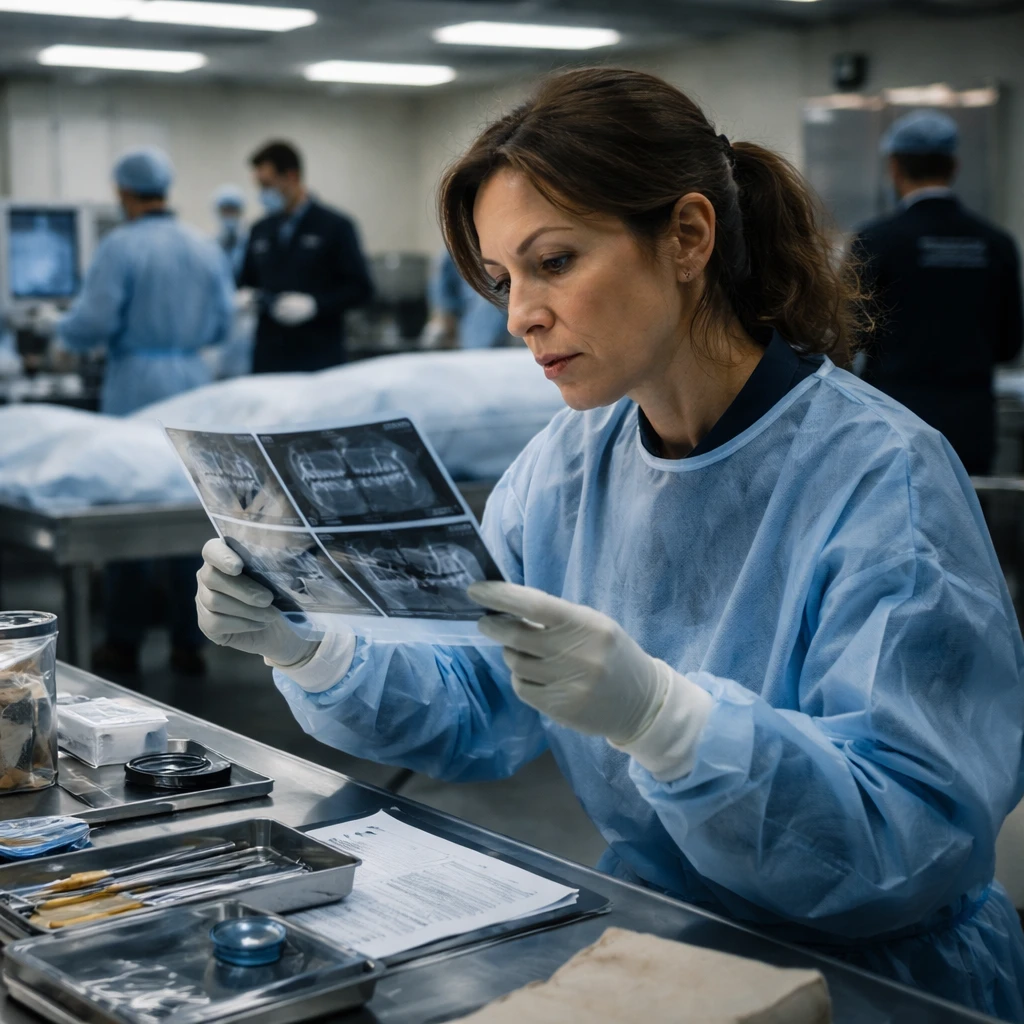
When forensic dentist Esi Sharon-Sagie believed her identification duties had concluded after the recovery of Israel’s last hostage from Gaza, she did not expect to be called back weeks later. On February 28, a U.S.-Israel air assault in Iran set off a conflict that has spread across the Middle East, and Sharon-Sagie was again mobilized to determine the identities of people whose bodies were too badly damaged for visual recognition.
On March 1, Sharon-Sagie was summoned to the scene of an Iranian missile strike on Beit Shemesh in central Israel. "We were informed that a missile killed nine people that weren’t able to get into a shelter in time. And the minute we heard that the disaster happened, we had to go to do the identification," she said. Among the victims were three siblings, aged 13, 15 and 16.
Forensic odontology as a tool of identification
Sharon-Sagie, who has volunteered with police since 2010, has specialized in forensic odontology - the practice of using dental records and X-rays to identify remains when other methods are not possible. She and her colleagues are called on when bodies are charred, decomposed or otherwise mutilated so that visual recognition or fingerprinting cannot be relied upon.
In those cases, X-rays of dental structures can be matched with existing dental records to establish identity. Sharon-Sagie has been on twenty-four-hour duty at times, often stretching herself through long hours to complete identifications that bring closure to grieving families.
At the end of an hours-long shift, she was once asked to assist with one more victim. She looked at the woman’s slim hand and rings and said: "I spoke with her in my heart with no sound. I looked at her and I said: ’now you’re going to help me because I have no strength anymore. You’ll help me and I’ll help you. I’ll bring you back to your family’."
October 7 aftermath and lengthy identification efforts
Sharon-Sagie says the scale of work changed after October 7, 2023, when Hamas carried out a surprise attack on Israel. Health authorities were overwhelmed by the hundreds killed on what has been described as Israel’s single deadliest day. The identification of roughly 1,200 fatalities included many who had been badly burned, and the process took many months to complete.
The task frequently required forensic teams to draw upon all available records and resources to match remains to identities. Months of work were necessary to process and confirm identifications in the wake of that attack.
High-profile identifications and evidence on file
In October 2024, Sharon-Sagie was part of the team that identified Yahya Sinwar, who had been the leader of Hamas. Sinwar was killed by Israeli fighters in southern Gaza and his body was transferred to Israel. Sharon-Sagie noted that Israeli authorities retained medical records from the period Sinwar was imprisoned in Israel, including documentation of brain surgery he had undergone many years prior, which aided the identification: "He had brain surgery in Israel many, many years ago. So we had all his information," she said.
Separately, Sharon-Sagie took part in the recovery and identification efforts for the last of the hostages whose remains were found in Gaza on January 26. She worked with teams that exhumed and examined bodies buried in a cemetery in northern Gaza in the search for police officer Ran Gvili, who fought militants at an Israeli kibbutz. The identification process produced a mix of emotions for those involved.
Reflecting on that moment, Sharon-Sagie said she was surprised it was happening and that her hands trembled. "When we did the identification and finished signing the report that this is him, at first I was happy but seconds after that I understood that it is over, he is not coming back to Israel alive," she said.
Ongoing demands on health and forensic services
The recent mobilization of forensic teams reflects how sudden escalations of violence create immediate demands on health authorities and law enforcement divisions that perform victim identification. Sharon-Sagie’s repeated call-outs underline that the work of returning names to the dead continues to be central to both investigative processes and family closure in the wake of attacks and missile strikes.