
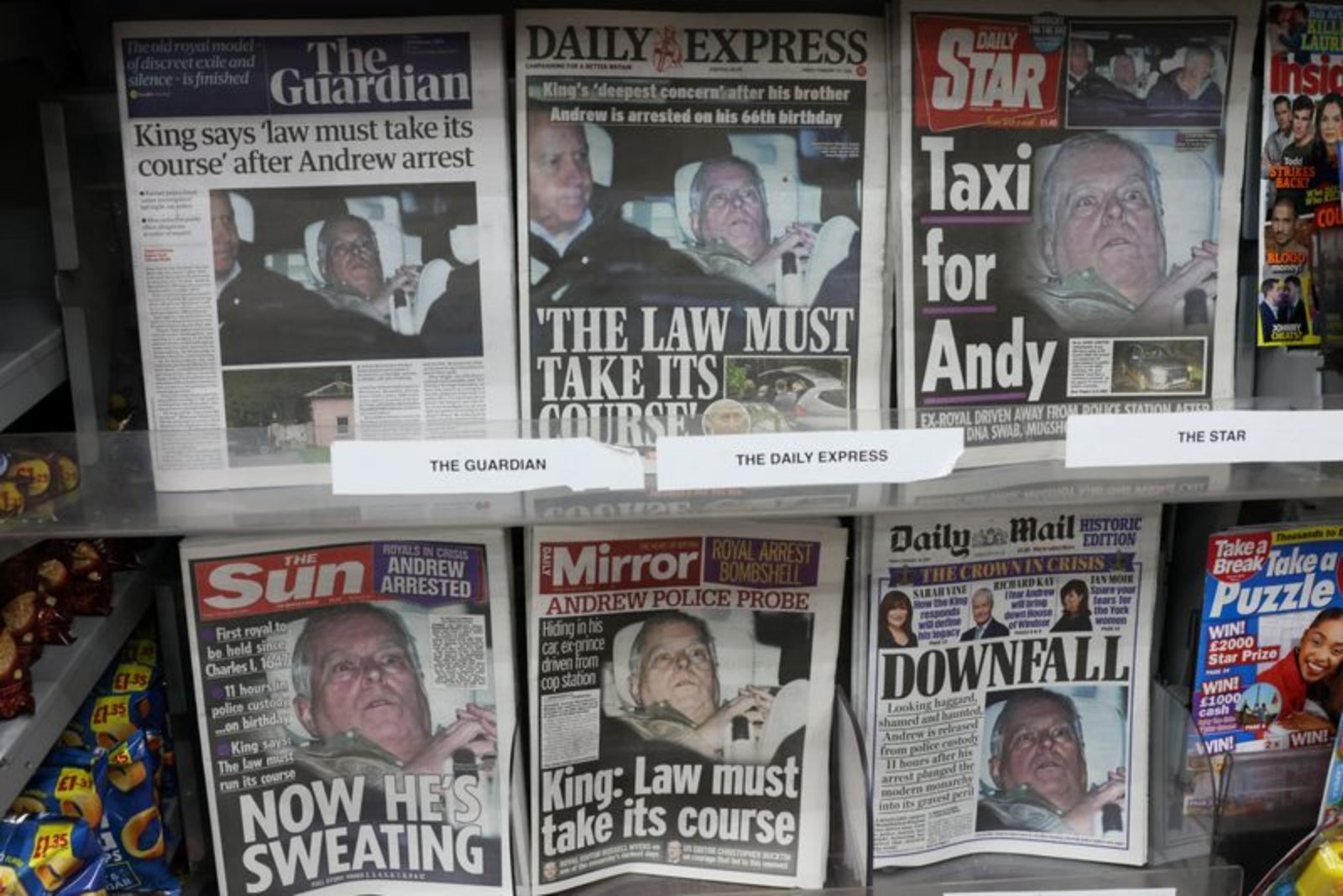
LONDON - Andrew Mountbatten-Windsor, the younger sibling of King Charles, was detained earlier this week on suspicion of misconduct in public office following allegations that he transmitted confidential British government documents to the late convicted U.S. sex offender Jeffrey Epstein. Detectives from Thames Valley Police conducted prolonged questioning of the former prince on Thursday before releasing him from custody later that day, and the investigation remains ongoing.
Police said they are examining claims that Mountbatten-Windsor provided documents to Epstein during the period when he served as a Special Representative for Trade and Investment. Among material made public by U.S. authorities, some files indicate that in 2010 Mountbatten-Windsor forwarded Epstein reports describing possible business prospects in locations he had visited in his official trade envoy capacity. The former prince, who turned 66 on Thursday, has consistently denied any wrongdoing connected to Epstein.
What the offence of misconduct in public office is
The charge of misconduct in public office is a common law offence, meaning it has been shaped by judicial decisions over time rather than codified in a single statute. Conviction can carry a maximum custodial sentence of life imprisonment. Authorities have previously cautioned that the offence can involve "particular complexities" requiring careful assessment, though they did not provide further detail when making that observation.
Britain’s top prosecutor, Stephen Parkinson, has said the law on misconduct in public office is "quite clear". At the same time, research from the campaign group Spotlight on Corruption noted last year that the charge has been more commonly used against lower-ranking police and prison personnel, and suggested prosecutors may face challenges when applying it to more complex situations.
In a past example cited by observers, a former police officer received a 10-month prison sentence in 2013 after selling a story to The Sun and attempting to sell another story to the now-defunct News of the World concerning the child of public figures.
The independent Law Commission recommended in 2020 that the offence be replaced, and legislation to effect that change is currently progressing through parliament. Any new law would not have retrospective effect.
What prosecutors must establish
Legal experts say misconduct in public office can be difficult to prove where senior figures or political appointees are involved. There are several elements prosecutors must satisfy to secure a conviction.
- Public office status: Prosecutors must show the individual was in a public office and was "acting as, not simply whilst, a public official" when the alleged misconduct occurred. Mountbatten-Windsor’s trade envoy role was unpaid, although he received free travel and accommodation; guidance from the Crown Prosecution Service states that remuneration is "not determinative," but the unpaid nature of the role may complicate arguments that he was acting as a public official.
- Wilful misconduct amounting to abuse of public trust: It must be demonstrated that the defendant wilfully misconducted themselves "to such a degree as to amount to an abuse of the public’s trust." The Court of Appeal has said the threshold is high and that the conduct must be "not merely negligent but ... an affront to the standing of the public office held."
- No reasonable excuse: The misconduct must have been without reasonable excuse or justification.
Possible next steps in the investigation and prosecution
Because misconduct in public office can be legally complex, police and prosecutors are expected to take several weeks or even months to reach a decision on whether to charge. Mountbatten-Windsor, who has denied any wrongdoing relating to Epstein and has not spoken publicly since further files were released, could be subject to further questioning as the inquiry continues.
If prosecutors decide to charge him, the former prince would first appear at a magistrates’ court. Misconduct in public office is an offence that can only be tried before a judge and jury, so any charge would be sent to the Crown Court, which handles the most serious criminal cases and would likely mean proceedings at a central London venue such as the Old Bailey.
The British criminal justice system is already affected by long-standing delays, and some trials are currently scheduled many years ahead. Reports indicate some matters are listed as far into the future as 2030, though any trial involving the king’s brother would most likely be prioritised to take place sooner.
Current status
Thames Valley Police have confirmed the arrest and subsequent release of Mountbatten-Windsor while the investigation proceeds. The specific evidential assessments prosecutors must undertake include verification of whether documents were passed and whether the legal tests for misconduct in public office are met. Given the multifaceted legal questions at issue, the investigation will unfold over time and may involve renewed police engagement and a formal charging decision at a later date.