
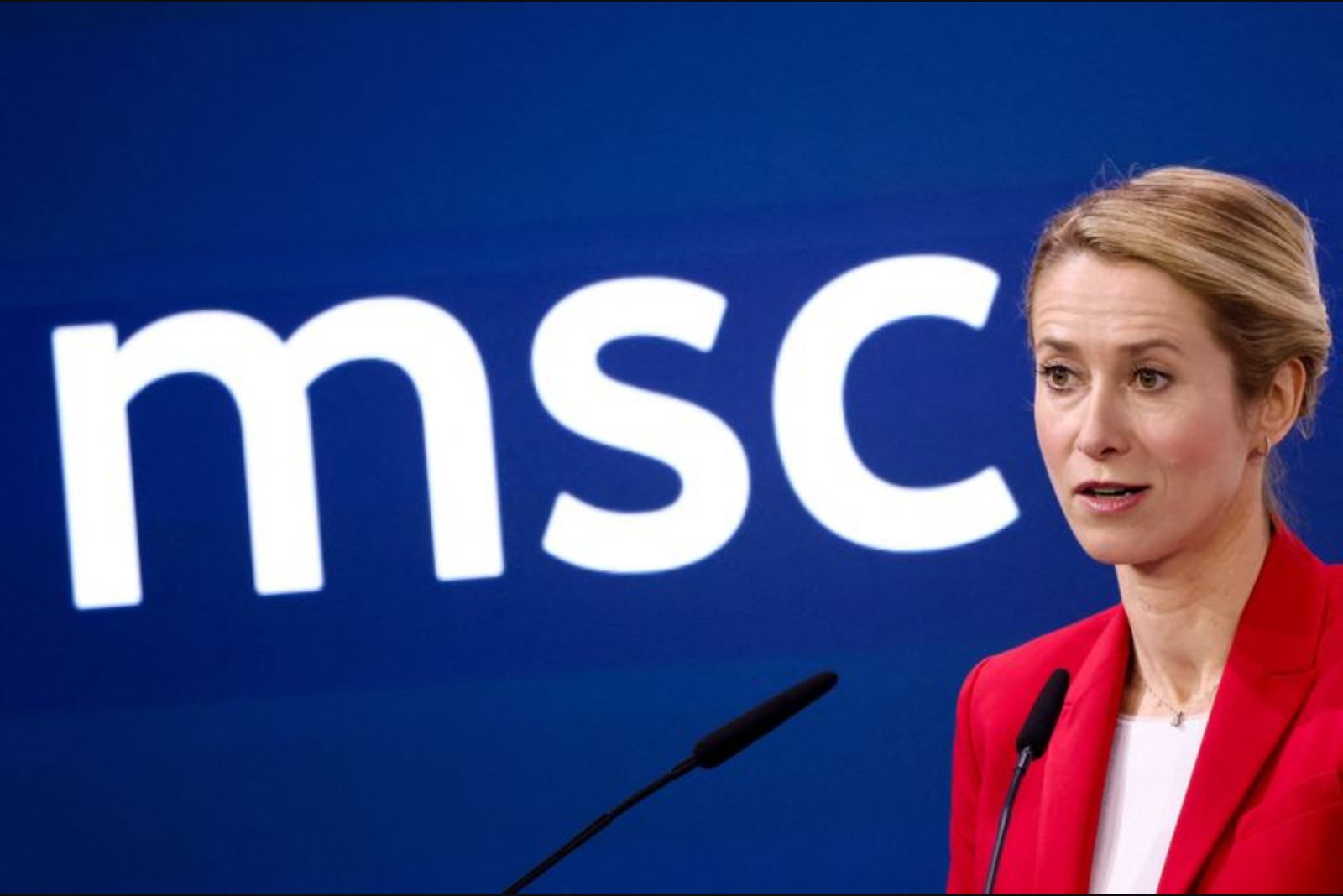
European Union foreign policy chief Kaja Kallas told a Munich Security Conference panel that her impression was EU governments were not prepared to assign a specific date for Ukraine's accession to the bloc, even as Ukrainian President Volodymyr Zelenskiy has pressed for a timeline to be embedded in security guarantees tied to a final peace package with Russia.
"My feeling is that the member states are not ready to give a concrete date," Kallas said. "There’s a lot of work to be done." She made the remarks while addressing conference attendees in Munich, where the issue of how and when Ukraine might enter the European Union remains a live debate among capitals.
In diplomatic discussions, Ukrainian membership in 2027 has been cited as part of a 20-point peace plan that the United States, Ukraine and the European Union have examined, according to diplomats. That proposed inclusion is intended, diplomats said, to help secure Ukraine's post-war economic prosperity. However, many EU governments regard any fixed calendar - including 2027 - as unrealistic, arguing that accession follows a merit-based process and advances only when candidate countries align their laws and standards with EU requirements.
Latvian President Edgars Rinkevics reflected a similar view. "Yes, we understand that we need Ukraine in the European Union and, yes, when talking with many heads of state I get the feeling there is no readiness to accept a date," he said. Rinkevics added that the EU has shown creativity in the past when a particular need arose and suggested the bloc could devise a suitable formula, but cautioned that any approach would have to take into account other aspirant countries such as states in the Western Balkans and Moldova, which have long sought membership.
Rinkevics also linked the accession timeline to the broader question of a peace settlement. "Like it or not it is very much tied to the peace deal. Will there be a peace deal or not? I don’t see that Russia is going to move, and if Russia is not moving, then we are not going to have a deal," he said.
Ukraine submitted its application to join the European Union days after Russia launched a full-scale invasion in February 2022, aiming to anchor itself politically and economically to the West. Since then, Kyiv has continued to press for progress on its EU bid despite the practical challenges posed by the war and explicit opposition from Hungary, which is blocking the start of detailed membership talks.
The comments in Munich underscore the gap between political calls for a clear accession timetable and the procedural realities of EU enlargement. While some participants in diplomatic planning have proposed a 2027 target as part of a peace framework, senior EU figures and several member states stress that accession remains contingent on meeting legal and institutional benchmarks rather than on a predetermined calendar.
Context and implications
The debate over a membership date reflects competing priorities inside the EU: the political desire to support Ukraine's future prosperity and security, and the institutional commitment to a rules-based accession process that requires legal and regulatory alignment. The positions voiced by Kallas and Rinkevics highlight the practical and political obstacles that must be addressed before any concrete timeline can be agreed.