
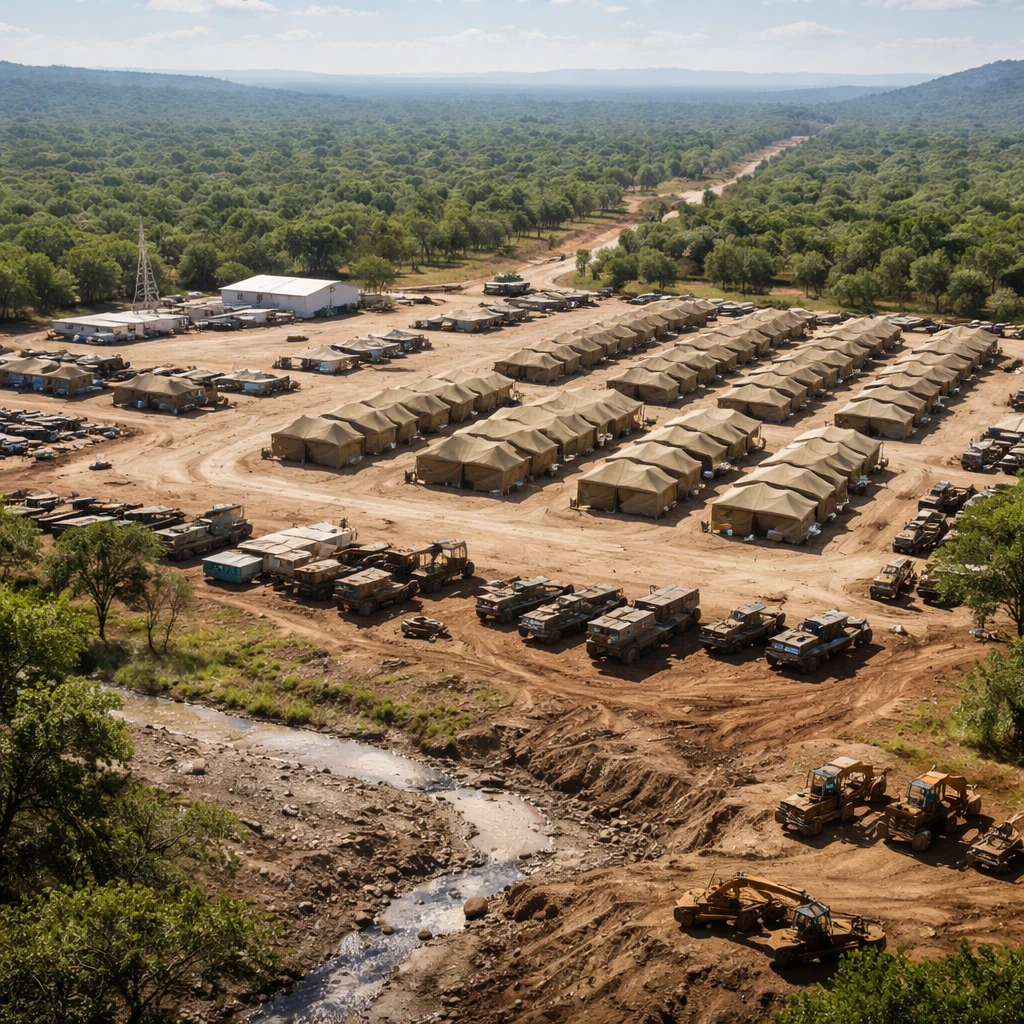
Evidence compiled from satellite imagery, internal security notes, diplomatic reporting and interviews with people familiar with the operation shows a newly established training camp in Ethiopia that is preparing fighters for the Rapid Support Forces paramilitary group in Sudan. The site sits in the remote western region of Benishangul-Gumuz, in a district called Menge roughly 32 km from the Sudanese border, and has drawn attention for its size, recent expansion and apparent ties to outside backers.
Work on the site began with forest clearing and construction activity in April, according to satellite images reviewed by sources, followed by a second wave of development in the latter half of October when tents and more substantial field infrastructure were added. Imagery from multiple providers shows a progression from metal-roofed buildings to the formation of a large encampment with rows of tents and heavy equipment present on site.
An Ethiopian internal security memo examined by sources states that as of early January some 4,300 RSF fighters were undergoing training at the compound and that "their logistical and military supplies are being provided by the UAE," language that mirrors reporting in a diplomatic cable also reviewed by the same sources. Eight people who spoke about the project, including a senior Ethiopian government official, attributed funding, trainers and logistical support to the United Arab Emirates. The UAE foreign ministry told a request for comment that it is not a party to the conflict and is "in any way" involved in hostilities.
The project has not been confirmed by independent on-the-ground reporting. Reviewers compared satellite imagery with details in the security memo and diplomatic cable, and two Ethiopian intelligence officials assisted by satellite images corroborated elements found in those documents. Nevertheless, some elements remain unverified: Reuters could not independently confirm the UAE's role in financing or operating the site, and the identities and exact numbers of people present at the camp could not be independently established.
Location and layout
The camp was established in an area of forested land in Menge, at a strategic junction close to the borders of Sudan and South Sudan. The diplomatic cable, dated November and reviewed by sources, described the camp as having capacity for up to 10,000 fighters and placed the start of major activity in October, when dozens of Land Cruisers, heavy trucks, RSF units and UAE trainers reportedly arrived.
Satellite imagery offers a timeline of construction and occupation. Imagery from Airbus Defence and Space indicates the initial ground clearance followed by the placement of numerous tents beginning in early November. A U.S. space technology firm's image taken on November 24 shows over 640 tents measuring about four metres square each. Analysis by a defense intelligence company concluded that with approximately four occupants and some equipment per tent, the site could hold at least 2,500 people, while the diplomatic cable and the internal memo suggest capacity for many more.
Heavy vehicles and convoy movements were observed in the region in mid-November. Two senior military officials described witnessing columns of trucks moving along dirt tracks into the area: on November 17 one convoy of 56 trucks reportedly carried trainees, with each truck estimated to hold between 50 and 60 fighters; two days later both officials saw another convoy of 70 trucks heading in the same direction. Satellite imagery dated November 24 shows at least eighteen large trucks at the camp location. The size and designs of the vehicles match models commonly used by the Ethiopian military and allied forces, although independent verification of what these trucks carried is not available.
In late January, imagery showed continued development at the site including new clearing, excavation in a nearby riverbed and dozens of shipping containers arranged around the camp, consistent with ongoing buildup. A senior Ethiopian government official said construction work was still continuing but did not outline further plans.
Command and procurement
An internal security note names General Getachew Gudina, the Chief of the Defense Intelligence Department of the Ethiopian National Defense Force, as the official responsible for establishing the training facility. A senior Ethiopian government official and four diplomatic and security sources corroborated Getachew's involvement in launching the project. Getachew did not respond to a request for comment.
Two officials also reported seeing trucks bearing the logo of an Emirati logistics company, identified in the reporting as Gorica Group, moving through the nearby market town of Asosa in October and proceeding toward the camp. The logistics company's representatives did not reply to requests for comment.
Recruitment and composition
Sources said the recruits at the camp are mainly Ethiopian nationals, with some citizens from South Sudan and Sudan also present. Among the Sudanese nationals alleged to be at the site were fighters associated with the Sudan People’s Liberation Movement-North, SPLM-N, a group that controls territory in Blue Nile state in Sudan. Six officials described the presence of these fighters, though Reuters was not able to independently confirm the identities or recruitment terms. A senior SPLM-N leader, speaking on condition of anonymity, denied his forces were present in Ethiopia.
Sources additionally said the recruits being trained at the camp are expected to join RSF operations across the border in Sudan's Blue Nile region. Two officials said hundreds of recruits had already crossed into Sudan in recent weeks to support RSF actions there. The internal security memorandum and diplomatic reporting both point to Blue Nile as an emerging front in the wider struggle for control in Sudan.
Wider infrastructure and air support
Construction and refurbishment at Asosa airport, located approximately 53 km from the camp, were noted in satellite imagery and by sources. Imagery shows a new hangar and paved apron areas near the runway, and what a military technology expert described as a UAV ground control station and a satellite antenna. Observers noted the drone support installations resemble those seen at two other drone bases in Ethiopia.
One senior Ethiopian government official and a senior military official indicated the Ethiopian military plans to designate Asosa airport as a drone operations center, in addition to at least five other drone centers they cited elsewhere in Ethiopia. A diplomatic source said the airport's refurbishment formed part of a broader Ethiopian military plan to reposition aerial bases along the country's western flank to address perceived new threats on the border with Sudan and to protect critical infrastructure such as the Grand Ethiopian Renaissance Dam. Regional officials and diplomats expressed concern about the camp's proximity to the dam, worrying the facility could be involved in or become a target if fighting spread. The camp is approximately 101 km from the dam.
Some sources said the May-to-August period of construction activity at Asosa airport began in August 2025, and that the refurbishment had benefited from external funding. A Western military analyst, a regional security expert and a senior Ethiopian official linked airport upgrades to the RSF's increased activity in the area and said the airport had become useful for supplying the RSF across the border. The senior Ethiopian official and a regional analyst also said the UAE had financed the airport refurbishment, a claim Reuters was not able to independently verify.
Regional context and reactions
Sudan's civil war, which began in 2023 following a power struggle between the Sudanese Armed Forces and the RSF ahead of a planned transition to civilian rule, has generated widespread displacement, famine and allegations of racially charged atrocities. Millions of refugees have fled into neighboring countries, including Egypt, Chad, Libya and South Sudan. Both the Sudanese Armed Forces and the RSF have benefited from international backers, and analysts and diplomats say external support has sustained and intensified the conflict.
In this context, the camp in western Ethiopia represents what sources described as the first direct evidence of Ethiopian involvement in the Sudanese civil war. The facility's apparent ability to produce trained personnel for the RSF would provide the paramilitary group with a steady supply of fighters as hostilities continue, particularly in southern Sudanese provinces such as Blue Nile which have emerged as active fronts.
Ethiopia's government spokesperson, the Ethiopian army and the RSF did not respond to detailed requests for comment on the camp's existence, operations or the allegations of foreign support. The Sudanese Armed Forces also did not reply to a request for comment. On January 6, UAE and Ethiopian authorities issued a joint statement calling for a ceasefire in Sudan and declaring ties that they said served the defense of each other's security, a posture that contrasts with allegations that Emirati funds and personnel have supported training activities for the RSF across the Ethiopia-Sudan border.
Historical ties and financial links
Officials noted a pattern of close relations between Ethiopia and the United Arab Emirates dating to the early term of Ethiopian Prime Minister Abiy Ahmed's administration in 2018. Abu Dhabi pledged significant aid and investments in the years following Abiy's rise, including a reported $3 billion in pledges split across several initiatives, among them a $1 billion deposit to Ethiopia's central bank to ease foreign currency shortages. In 2025, sources said, the UAE and Ethiopian air forces had signed a memorandum of understanding to develop air and defense capabilities, a move reported in news accounts at the time and mentioned by analysts working on imagery and regional security.
Limitations and verification
While satellite imagery and multiple sources provide a consistent picture of construction and occupation at Menge, gaps in independently verifiable on-the-ground reporting remain. Analysts who reviewed the images for signs of military activity noted that imagery alone cannot establish intent or fully determine the nature of training taking place. Defense imagery analysts concluded that tent counts and vehicle presence point toward a capacity for several thousand people, but also cautioned that their assessments could not independently ascertain whether the site was exclusively military.
Claims that the UAE financed the project and supplied trainers are supported in the internal security note and diplomatic reporting seen by sources, but the UAE's formal response rejects involvement in hostilities. In several instances, officials and analysts were explicit that they could not independently confirm specific supply lines, funding streams or the detailed composition of the people at the camp.
Conclusion
Sources, satellite imagery and internal documents collectively describe a major training site in Ethiopia's Benishangul-Gumuz region that has been used to prepare fighters associated with Sudan's RSF. The camp's construction and expansion, the movement of large convoys and the reported presence of trainers and logistical support attributed to an external state actor raise questions about the regionalization of the Sudan conflict. Ethiopian and Emirati officials have provided statements that either deny involvement in hostilities or emphasize calls for ceasefire, while security notes and diplomatic cables seen by sources present a contrasting account of active support for RSF training.
Key points
- Satellite imagery and multiple sources indicate a large training camp was established in Menge, Benishangul-Gumuz, Ethiopia, beginning with clearing in April and a major buildup from October onward. This development affects regional security and could influence defense, logistics and border stabilization sectors.
- An internal Ethiopian security memo and a diplomatic cable attribute funding, trainers and logistical support for the camp to the United Arab Emirates, a claim the UAE denies. Sectors tied to defense procurement and international military cooperation are implicated.
- The camp reportedly housed thousands of recruits as of early January, mainly Ethiopians but also citizens from South Sudan and Sudan, with expectations that many would be deployed to the Blue Nile front in Sudan. This movement has potential consequences for humanitarian, migration and infrastructure sectors in the region.
Risks and uncertainties
- Verification gaps remain - imagery and internal notes provide strong indications of activity but cannot fully confirm the identities, numbers and roles of people at the camp, leaving uncertainty about the scale and nature of operations. This affects intelligence assessments and defense planning.
- Allegations of external financing and logistical support from the UAE are disputed by Emirati officials and cannot be independently verified, creating ambiguity over international involvement and its implications for diplomatic and defense-related economic agreements.
- The camp's proximity to major infrastructure such as the Grand Ethiopian Renaissance Dam has raised concerns among regional officials about potential escalation or targeting, which could impact energy infrastructure and related economic sectors should hostilities spread.
Disclosure