
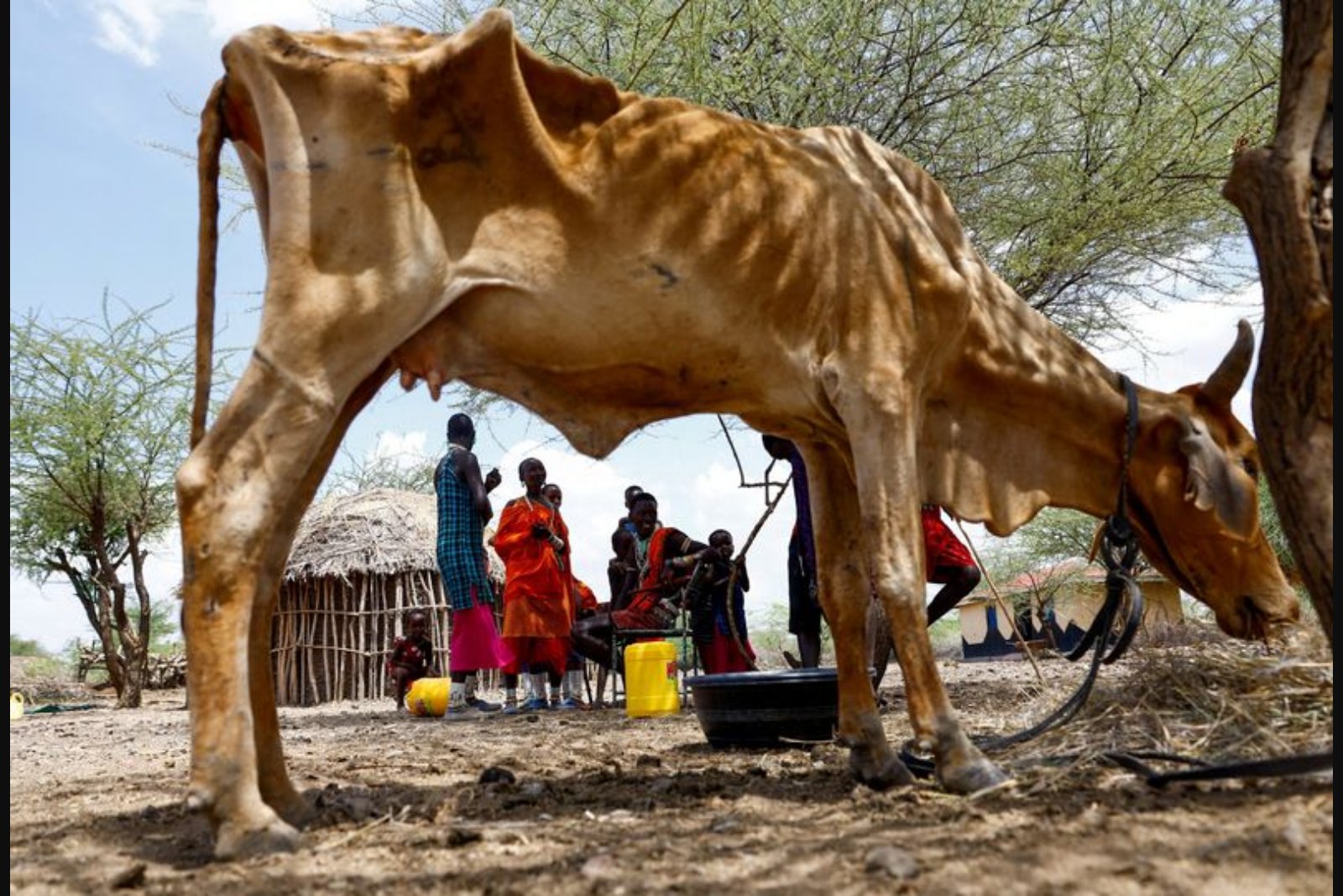
Dozens of carcasses of cows and goats around the compound of 24-year-old Maasai herder Maria Katanga provide a stark indication of how deeply the current drought is affecting pastoral households that depend on livestock for food and income. Katanga says that since August she has lost more than 100 cattle and 300 goats, and that the animals she still keeps are too emaciated to yield milk.
The losses she describes are not confined to areas traditionally regarded as Kenya’s drought belts. Drought impacts are spreading into Kajiado county - which borders the capital Nairobi - and into communities that have not typically borne such severe effects. As animals weaken, their monetary value has collapsed, intensifying financial pressure on families who depend on sales of livestock to meet basic needs.
"A cow that was being sold for 60,000 or 70,000 Kenyan shillings (before the drought)... is being sold for 5,000 shillings," said Katanga’s stepson, Emmanuel Loshipae, 19, describing distress sales made to buy feed where grazing is absent.
Local administration official Lemaiyan Samuel Kureko said that herding groups are now pushing further from home in search of pasture and water, with some even crossing into neighbouring Tanzania. "There have been droughts before in the region but this one is the worst," he said, reporting an unprecedented level of livestock mortality and movement.
Kenya’s National Drought Management Authority issued a warning last month that recurrent droughts are intensifying competition for limited resources and raising the risk of violent conflict. That assessment reflects concern about the social strains that follow when water and grazing become scarce and populations must travel farther to find them.
The crisis extends beyond Kenya. Somalia declared a national drought emergency in November after a sequence of poor rainfall seasons. The United Nations World Food Programme has said millions of Somalis are experiencing severe hunger, and warned that reductions in foreign aid have weakened non-governmental organisations’ ability to scale up responses to growing needs. "Malnutrition is also alarmingly high with almost half of all children malnourished and in need of urgent treatment," the WFP said in a statement.
In Kenya, seasonal forecasts offer little immediate relief for the affected communities. The Kenya Meteorological Department’s outlook for the March-May monsoon indicates that Kajiado is likely to receive rainfall that is near-average to below-average, leaving uncertainty about a timely recovery of pasture and water points in the county.
Government relief has targeted historically arid counties in the north. Last month the National Drought Management Authority said it had distributed cash assistance to more than 130,000 households in those areas to help cope with rising hunger linked to the drought. Those relief efforts did not extend to Kajiado, where officials and residents say the impacts are now severe.
Back in Kajiado, local administrators describe a community under acute stress. "No people have died yet, but the livestock are gone and the sun is getting hotter every day," Kureko said. "We have been weakened to such a level that we can only pray for God’s help." Those words convey a combination of physical depletion and a sense of limited options for rapid relief.
The unfolding situation in Kajiado illustrates how repeated drought events can shift the geography of vulnerability, pulling populations and markets into crisis even where such outcomes were once less common. Herders confronted with waning herd sizes and collapsing prices face immediate food and income shortages, while movements across borders and regions heighten pressures on pasture, water points and local services.
How the situation evolves will depend in part on whether forthcoming rains materialise, whether relief resources can be extended to newly affected counties, and whether support can stabilise markets and ease the need for distress sales. For now, households such as Katanga’s remain in a precarious position, nursing what remains of their herds and seeking options to survive until conditions improve.