
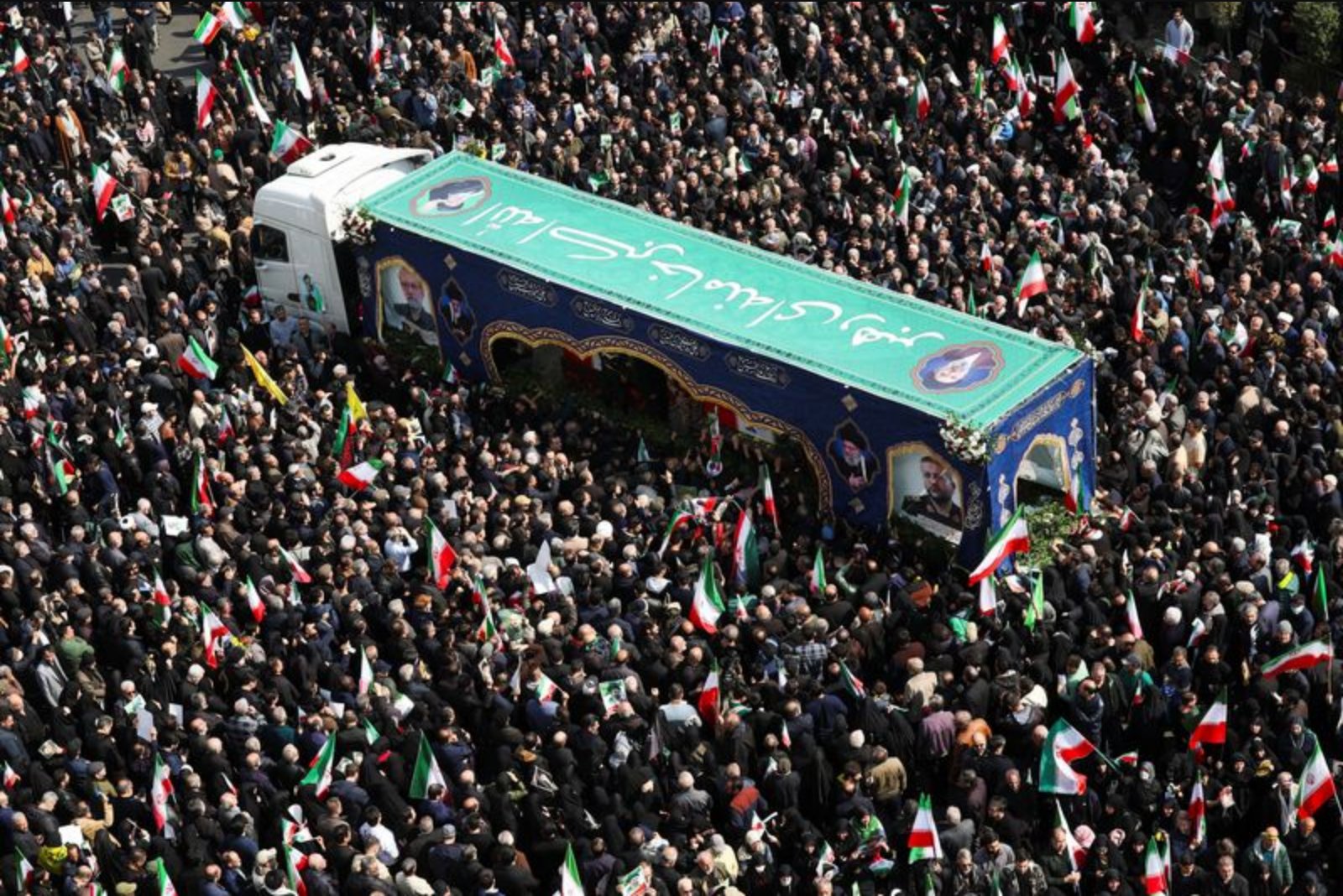
The killing of Ali Larijani has deepened the strain on the Islamic Republic's internal decision-making, reducing the number of experienced officials who can translate battlefield developments into coherent political strategy. Officials and analysts say the loss of Larijani - described by several senior Iranian sources as the most influential powerbroker inside the system - has moved Tehran into a more uncertain phase as the war continues.
Officials who spoke to Reuters and analysts in Washington and Israel portrayed a pattern in which targeted strikes against senior figures are eroding the institutional depth that has historically allowed Iran to manage both conflict and state affairs. Four senior Iranian officials told Reuters that there are few people remaining who combine the mix of clerical credibility and political experience that Larijani offered. That narrowing of skilled intermediaries, they said, creates a heightened risk of slower decision-making and weaker coordination across competing power centres.
Larijani's standing rested on two pillars, according to the officials: his clerical legitimacy, linked to his prominent religious family, and his long experience as a politician deeply connected to the Islamic Revolutionary Guards Corps - ties that helped him operate as a trusted broker in a system where clerics, security organs and political actors often jostle for influence. His unique positioning has been hard to replicate amid a campaign that has already claimed other senior commanders and officials.
Alex Vatanka, a senior fellow at the Middle East Institute in Washington, D.C., warned that Larijani's death and the removal of other senior figures will "obviously upset the political process in Tehran and might even jeopardise policy continuity or policy flexibility." Vatanka and several Iranian officials interviewed noted that while the Islamic Republic has structures designed to absorb the loss of senior personnel, the wartime context makes replacing a figure like Larijani substantially more difficult.
One official characterised the immediate impact not as a sign of systemic collapse but as disarray - the loss of central mediating figures risks making governance more fragmented and reactive rather than measured and coordinated. That dynamic, analysts say, favors a tilt toward security institutions as the leadership seeks to maintain control and prosecute the war.
Analysts argue that a shift in emphasis toward the security apparatus would tighten control at the expense of flexibility. Ali Vaez, director of the Iran project at the International Crisis Group, said Larijani's removal "would deprive it of yet another senior figure capable of exercising prudence at a dangerous moment" and cautioned that each assassination moves Iran further from prospects of democratic opening and closer to either praetorian rule or state collapse.
Officials who provided insight into Tehran's calculus emphasised that the regime's primary objective remains survival. Vatanka noted that the system has long been anchored to expediency and survival - ideological conviction coexisting with pragmatic decisions aimed at sustaining the state. Analysts have dismissed the notion of an imminent collapse of clerical rule or of a Guards-led military coup, pointing instead to a tightening of wartime decision-making by the Guards even as they have lost senior commanders.
Vaez said a coup is unnecessary because, in his view, the Guards are already exercising full control over wartime decisions. One official confirmed publicly stated commitment by the Guards to the system of velayat-e faqih, or guardianship of the Islamic jurist, underscoring the regime's intent to maintain the clerical framework that underpins its authority. A senior reformist former official estimated that roughly 12 million core supporters remain aligned with the clerical establishment, in part because many believe in governance led by a religious figure.
Absent a ready replacement for Larijani's unique blend of credentials and relationships, attention has turned to a narrower set of figures who retain both military and political profiles. Parliament speaker Mohammad Baqer Qalibaf is frequently cited as one of the few remaining officers with comparable influence. A former commander with close ties to the Guards and connections to the new Supreme Leader, Qalibaf has long projected himself as a strongman who could centralise control.
Sima Shine, a former chief Mossad analyst and researcher at Israel's Institute for National Security Studies, described a concentration of influence around Qalibaf and the security establishment. "We assume that the IRGC and Qalibaf are the most important people now ... It will be Qalibaf on the level of a decision, and the IRGC on the practical level of pushing the button," Shine said. Even so, she and other observers note that Qalibaf does not possess the same clerical pedigree or as extensive ties within the religious hierarchy as Larijani, a deficit that could complicate efforts to reconcile the system's competing factions.
For the moment, the war appears to have strengthened internal rallying around the leadership even as it removes key figures who helped knit Iran's political fabric. Analysts warn, however, that this balance may not be sustainable indefinitely. If the leadership concludes that its survival is genuinely threatened, some observers say it may become more willing to consider compromise. Shine suggested that existential risk could shift calculations because survival of the regime would become the overriding priority.
In sum, the targeted killing of Larijani has both immediate and structural consequences for Tehran. In the short term, officials and analysts describe disarray and a shrinking set of actors capable of mediating between military operations and political strategy. Over the longer term, the attrition of seasoned intermediaries may steer the system toward narrower, security-centric governance - a move that could tighten control but reduce room for strategic and political flexibility during a protracted conflict.