
Cuban officials on Friday provided additional detail about a lethal exchange of gunfire at sea earlier this week, saying a commando of Cuban exiles who attempted to enter Cuban waters by speedboat was armed with almost 13,000 rounds of ammunition and a cache of firearms and equipment.
Authorities said the group included 10 Cuban nationals who arrived from the United States and opened fire on a Cuban border guard vessel. Cuban forces returned fire, killing four of the assailants and wounding six others, who were subsequently taken into custody.
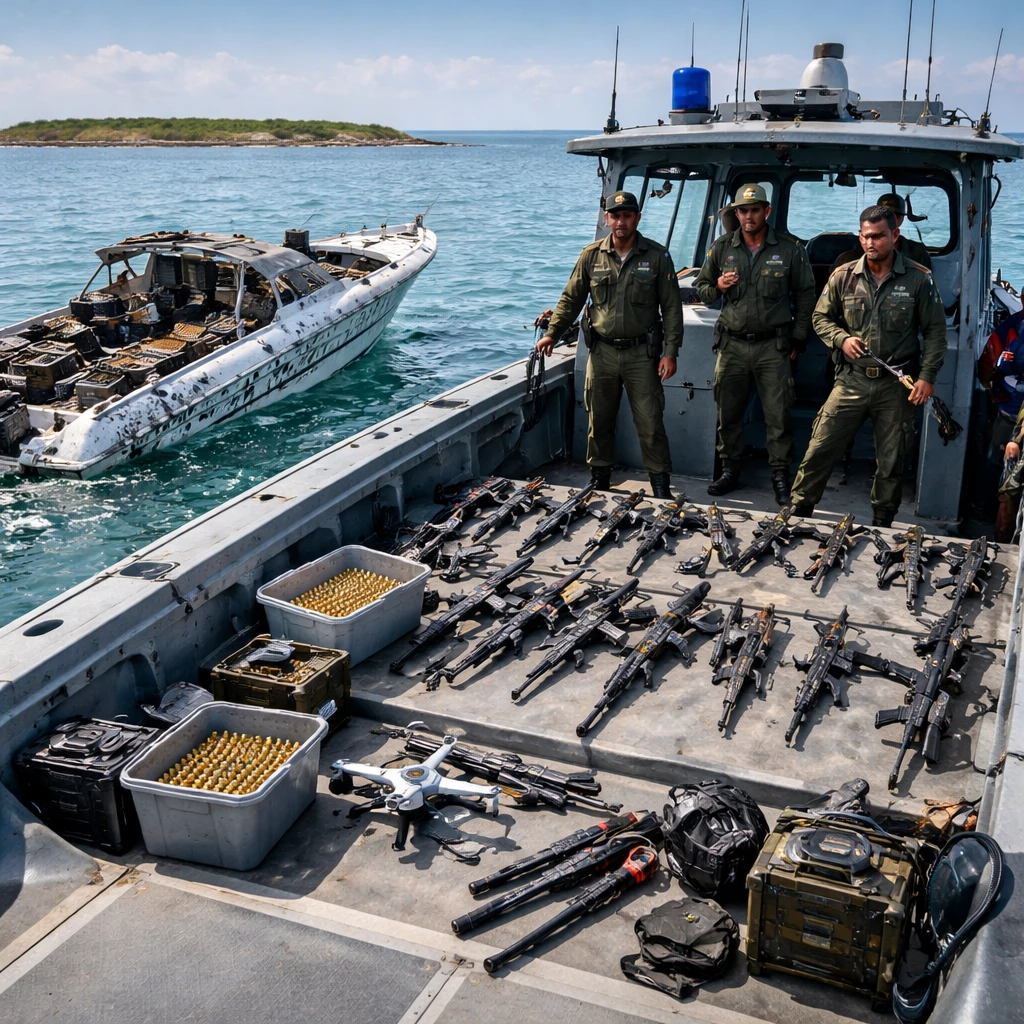
To substantiate their account of Wednesday's confrontation, senior officers from the Interior Ministry presented the seized materiel during a special television program. The items shown included bins containing at least some of the 12,846 rounds of ammunition the government said it recovered, along with 13 rifles and 11 pistols.
On the broadcast, officials also displayed photographs of the boats involved. The images showed each vessel peppered with bullet holes, which officers said resulted from fighting at a close range of roughly 20 meters (66 feet). They said the engagement began at a farther distance, with the attackers initially firing from about 185 meters.
Colonel Victor Alvarez of the Interior Ministry characterized the mission of the group as an infiltration aimed at provoking public disorder and attacking military units. "The intent of this group is to infiltrate, to promote public disorder. To incite the people to unite. To carry out something violent. Attack military units in order to incite social unrest and to unite the people in order to steal the revolution. That has been duly proven," he said on the program.
The clash occurred at a tense juncture in relations between Washington and Havana. Cuban officials framed the episode against a backdrop of pressure from U.S. policy toward the island, citing actions by U.S. President Donald Trump to impose what they described as a virtual oil blockade after his government captured and ousted Venezuelan President Nicolas Maduro on January 3.
U.S. politicians have expressed skepticism about Havana's version of events. Secretary of State Marco Rubio said his government would carry out an independent inquiry while also asserting that the operation was not conducted by the U.S. government and that no U.S. personnel were involved.
Cuban officers said the infiltrators departed from Marathon in the Florida Keys on two vessels. One of those boats was allegedly abandoned during the voyage because of technical problems, and the remaining personnel consolidated onto a single speedboat. A U.S. official cited by Cuban authorities said that speedboat had been reported stolen in Florida.
In addition to the ammunition and firearms, Cuba reported recovering a number of other items from the attackers: a drone, radios, knives, a portable power generator described as a portable power plant, bolt cutters and other equipment. Authorities also said they found emblems linked to the November 30th Movement and People’s Self-Defense, two anti-communist groups opposed to the Cuban government.
Cuban accounts say a five-member patrol of border guards aboard a 9-meter boat sighted the incoming vessel shortly after 7 a.m., with some members of the incoming crew already in the water. The encounter took place roughly one nautical mile off a cay along Cuba's northern coast, a location Cuban officials placed about 100 miles (160 km) from Marathon.
According to the Interior Ministry, the attackers opened fire from 185 meters, hitting the captain of the Cuban patrol boat in the abdomen. Despite severe bleeding, the wounded captain remained at the helm and steered toward the attacking vessel, bringing the boats within 20 meters and precipitating a close-range firefight.
Interior Ministry Colonel Ybey Carballo defended the government response as proportional, saying it reflects a defensive posture that typically avoids the use of firearms but will employ them in measured response to the threat posed. "It is a defensive model that practically never uses firearms, and the use of firearms is proportional to the type of action being carried out against our force," he said.
Prosecutor Edward Robert Campbell, speaking on the same program, said the detained Cuban nationals were receiving medical care and enumerated the charges they face. Those charges include armed aggression, illegal entry into national territory, crimes associated with terrorist acts and arms trafficking.
Campbell outlined potential penalties associated with the alleged crimes, saying the defendants could receive prison terms of 10 to 15 years for lesser offenses and 20 to 30 years - or, for the most serious counts, the death penalty.
Key developments:
- Authorities displayed 12,846 rounds of ammunition, 13 rifles and 11 pistols recovered after a maritime shootout.
- Ten Cuban nationals who came from the United States were involved; four were killed and six were captured and wounded.
- Officials recovered additional equipment including a drone, radios, knives, a portable power plant and bolt cutters, and found emblems of anti-government groups.