
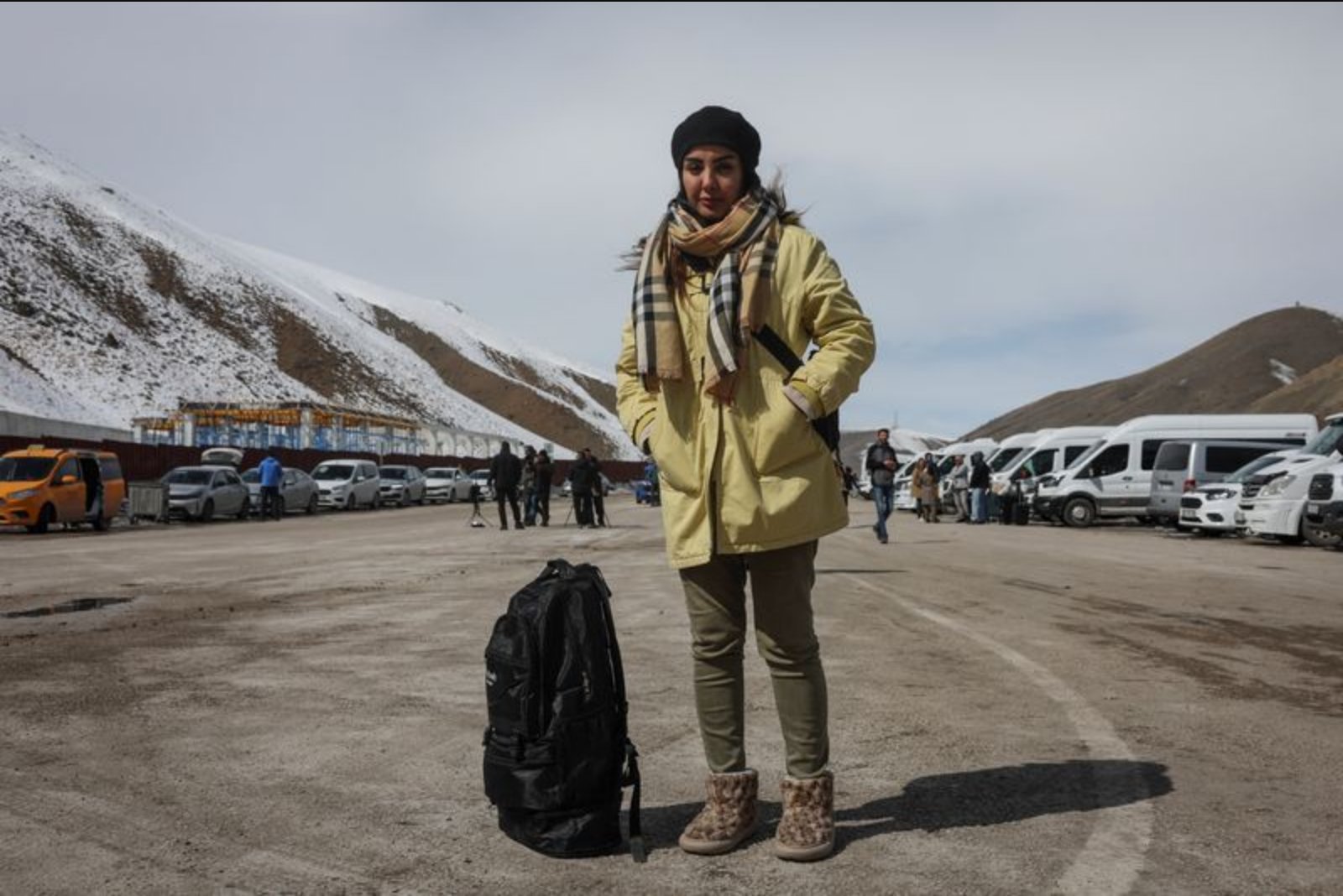
KAPIKOY, Turkey - At the snow-lined Kapikoy frontier in eastern Turkey, people arriving from Iran carry visible traces of a gruelling, uncertain week - fatigue, fear and, in many cases, relief. The mountain pass in Van province has seen hundreds move across recently, with a steady flow both into Turkey and back toward Iran as the U.S.-Israeli war with Iran widens its reach.
The border scene is a patchwork of family groups and lone travellers. Many emerge from the Iranian side after prolonged ground journeys - trains, cars and taxis - taken when flights were cancelled and communications were unreliable. New arrivals typically have little more than a small suitcase, a phone without a local SIM card and the urgent questions that accompany the end of a punishing route: How do I get to Van, two hours away? How can I contact loved ones? How do I reconnect to the outside world?
Journalists and others at the gate frequently hand over their phones so those arriving can call and reassure family members that they are safe. The motives for leaving Iran vary: some cite bombs falling on their cities, others point to a loss of contact with relatives, and still others say economic activity dried up and work disappeared.
Waiting and wanting change
Ebrahim Eidi, 61, who has lived in the Netherlands for 34 years and works with asylum seekers and refugees in camps, had recently been in Tehran. He described an atmosphere in which many people are waiting to see if the government will be weakened enough for protests to take hold. He said some Iranians see opposition figure Reza Pahlavi as a potential focal point should large demonstrations begin.
"People are waiting for something to happen, for some change. They want the government to change completely, and many people say they are waiting for Reza Pahlavi," Eidi said. He added that while many chose to remain in Iran out of hope for the country, they worried their own efforts might not be sufficient to alter the government and feared a broader deterioration.
"People are afraid to go to the streets. They are not afraid of America. Unfortunately, they are afraid of their own government," he said.
Choosing to return despite danger
Not everyone at the frontier is attempting to leave Iran for good. Leila, 45, was heading back into Iran after losing contact with family in Shiraz. Based in Istanbul where she sometimes assists academics associated with a German historical research institution, she said her concern for relatives - including a brother in a coma - made returning preferable to waiting abroad.
"How can I be safe when I feel my family maybe they are in danger?" she said, explaining that being physically with family, even amid risk, felt more bearable. "I cannot guard them against bombs. But when I feel I can be with them together, maybe we die together, or I can help them as long as we are alive." She plans to remain in Iran until the war is over.
Flights cancelled, long overland journeys
The disruption to aviation has been a common trigger for land travel. Mohammad Soltanzadeh, who lives in Hamburg and had been visiting relatives in Mashhad, said cancelled flights pushed him onto a sequence of long journeys: a 24-hour train ride, four hours by car and a final leg by taxi.
He described life in Mashhad as calm in the immediate aftermath of the wider turmoil. "People were a bit saddened and mourning but they were not stressed. The shops were open, the markets and shopping centres were open and people were continuing their activities. Life was going on," he said.
Families displaced, consular and visa uncertainties
Some travellers are in limbo awaiting help from foreign authorities. Hamid Shirmohammadzadeh, 35, who had been building a life in Tokyo and worked for an import-export firm, returned to Iran after his visa lapsed and fled Tehran with his wife and two children when the city came under attack.
"The day before the war started I was in Tehran… Then the bombs started falling. We saw the war had begun, so we came to Turkey," he said. His wife and two children, aged 9 and 10, wait near the border while he seeks assistance from Japanese authorities to obtain visas for them. "I worked in Japan, paid my taxes and followed the rules. I don’t understand why they are not helping me now," he said, adding: "In times like this we should help each other. I need help now because my country is at war."
Work disruption and returning migrant labour
The movement includes foreign workers who had been employed in Iran. Egyptian factory worker Mohammad Fauzi, 46, crossed from Iran without a Turkish SIM card, local currency or language skills. He had contacts for two Egyptian friends in Ankara and Izmir and hoped to reach Cairo.
Fauzi said he had seen work grind to a halt during three months in Iran working in the marble and granite sector, with many factories closing. "The situation is very difficult and working has stopped. I can’t work, I can’t stay because the situation is dangerous now, so I want to go to my home, my country," he said.
Plans conditional on peace
For some who fled, return remains a possibility if conditions change. Jalileh Jabari, 63, left Tehran because "bombs are falling" and the situation had become unbearable; she was travelling to Istanbul to see a daughter who studies there. "If things become good there, if Iran becomes good, I will come back. If there is peace, I will return," she said.
Two sisters, Shaylin, 9, and Celine Azizour, 11, crossed with their mother from Tehran and are bound for Istanbul with hopes of eventually reaching London. When asked about conditions in Tehran, Shaylin replied: "It’s not so good." Yet despite the journey, she smiled: "I’m so happy."
Yasna, 63, and her husband crossed into Turkey with one daughter and are travelling to Antalya to visit another daughter who lives there with her family. She said she preferred not to comment on Iran’s political situation. "I don’t know what to say about the situation in Iran because we will be back to Iran," she said. She was chiefly focused on family: "I came to see my daughter - I haven’t seen her for six years. She has children there and I have two grandchildren."
Practical questions at the crossing
The mix of stories at Kapikoy underscores a range of short-term needs: transport to the nearest city of Van, arrangements for onward travel to Istanbul, Antalya or beyond, consular and visa assistance for families with foreign ties, and ways to re-establish communications after blackouts and lost SIM connectivity. Journalists and others at the gate have been pressed into service as temporary lifelines for people who need to tell relatives they are alive.
Across the accounts collected at the border, common threads run through decisions to leave or return: immediate safety concerns prompted by reported bombings, the cancellation of flights forcing long overland alternatives, the closure of workplaces and factories reducing income and the breakdown of communications that leaves people unsure where relatives are and whether to stay or move.
Implications for markets and services
While the border movement is primarily a humanitarian and personal story, its contours have implications for sectors tied to labour mobility and trade. The accounts on the ground explicitly point to halted production in sectors such as marble and granite processing where factories have closed and to disrupted employment for migrant workers. Transportation services - flights and long-distance rail - have been affected by cancellations that redirected travellers onto longer, more arduous land routes. The demand for consular support, visa processing and short-term shelter and transport services has risen immediately where families and workers converge at the frontier.
These dynamics are unfolding within a larger, fluid environment in which people weigh leaving against staying, and where access to communications and consular assistance can become pivotal to outcomes for families and for professionals whose livelihoods span countries.
Reporting from the Kapikoy crossing in Van province gathered accounts from travellers arriving from Iran in the days after cross-border conflict escalated.