
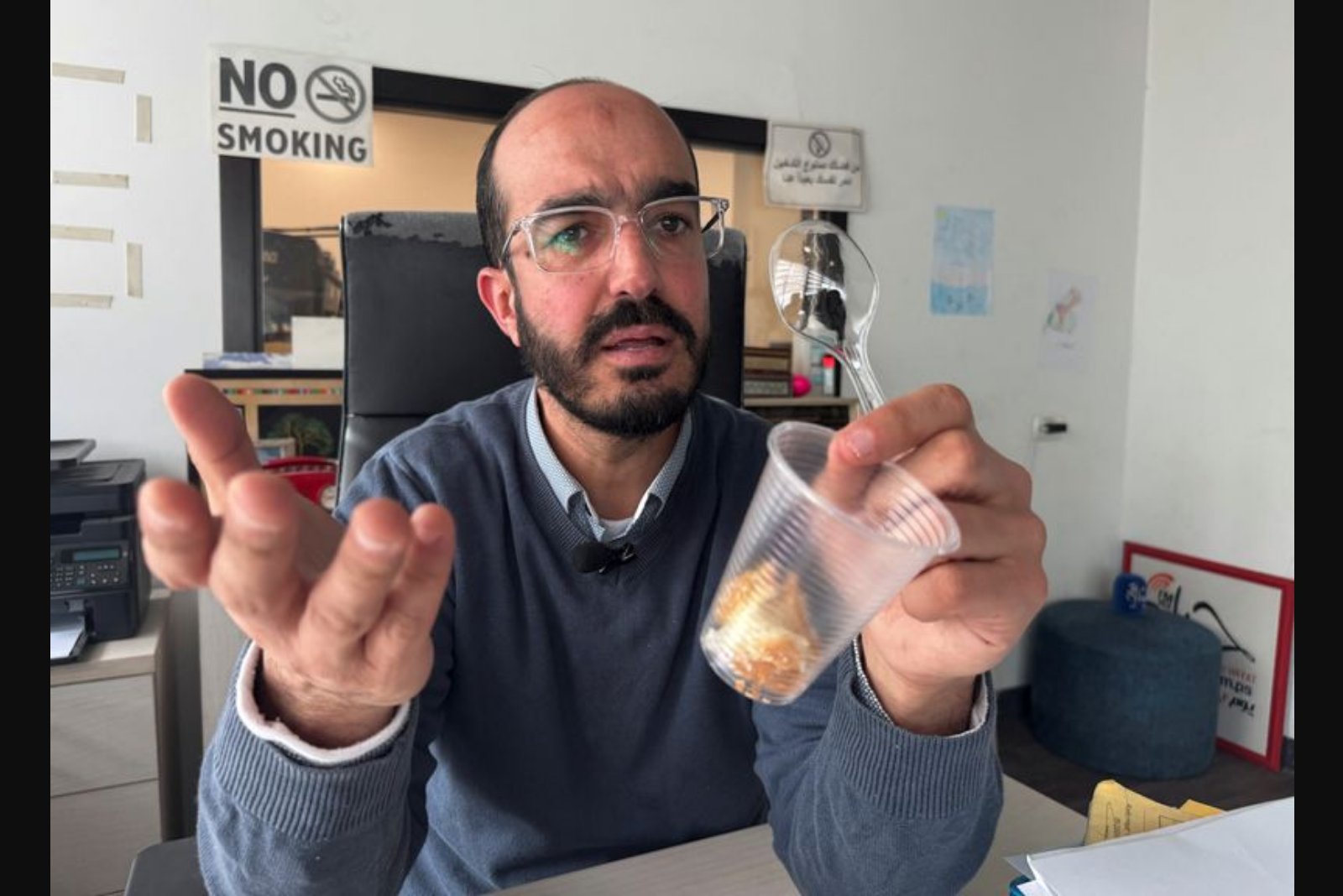
Five months after a Supreme Court directive instructed prison authorities to improve nourishment and other conditions for Palestinian detainees, former inmates continue to describe extreme hunger and weakened health upon release.
Samer Khawaireh, 45, who was held in Megiddo and Nafha prisons, said his daily food amounted to ten thin pieces of bread, supplemented occasionally with a small serving of hummus and tahini and, twice weekly, some tuna. Khawaireh said he was detained in his home city of Nablus last April and released a month ago. He reported losing 22 kg (49 pounds) over nine months in custody and said that when he returned home on January 7 he was covered in scabies sores and so gaunt that his nine-year-old son did not recognise him.
Khawaireh, who worked as a journalist at a Nablus radio station before his arrest, said he was not informed of the reason for his detention and was held without charge. He has resumed work since his release but remains thin, even though he has regained some weight.
Independent verification of the full scale of food shortages inside Israel’s prison system was not possible. It could not be determined how many prisons experienced restricted food supplies or how many of the roughly 9,000 Palestinian detainees reported similar conditions. Investigators also could not independently verify Khawaireh’s account of his diet in custody, the precise causes of his weight loss, or how widespread such experiences are across the detainee population.
Nevertheless, the accounts that emerge from released prisoners and reports by lawyers after visits to detention facilities align with Khawaireh’s description. A review of 13 reports compiled during prison visits in December and January found that 27 prisoners complained of insufficient food, and most of those said provisions had not changed since the court ordered improvements.
Rights groups and legal action
The Association for Civil Rights in Israel (ACRI), which participated in the court case that led to the ruling, has accused the government of maintaining a "policy of starvation" in its prisons. ACRI says the prison service has failed to comply with the order to improve conditions and has sought further court remedies.
ACRI has petitioned the Supreme Court to permit visits by the International Committee of the Red Cross (ICRC) to Palestinian detainees and has also asked the court to hold the prison service in contempt for not implementing the September ruling. The group says the situation has not meaningfully changed since the order.
Noa Sattath, executive director of ACRI, said there was little evidence of improvements. "All the indications that we’re getting are that not much has changed," she said. "The prisoners are not getting more food if they ask for it. There hasn’t been any medical examination of the situation of the prisoners, and the prisoners are still hungry."
Prison service response
The Israel Prisons Service declined to comment on Khawaireh’s specific case, stating broadly that it "rejects allegations of 'starvation' or systematic neglect." In a written response, the service said nutrition and medical care are provided according to professional standards and operational procedures, and that it "operates in accordance with the law and court rulings." It said complaints are investigated through official channels and that basic rights - including access to food, medical care, and adequate living conditions - are provided by professionally trained staff.
Access and oversight limitations
Since the start of the Gaza War, independent monitoring of detention conditions has become more restricted. Visits by the ICRC, which traditionally has monitored detainee welfare in conflicts, were barred after the onset of the war. This restriction has complicated attempts by rights groups and lawyers to obtain independent assessments of conditions and to verify claims of inadequate food and medical care.
ACRI’s legal filings ask the court both to allow Red Cross access to Palestinian detainees and to consider sanctions against the prison service for alleged non-compliance with the earlier ruling.
Political context and policy changes
The number of detainees rose sharply following the Hamas-led attacks on October 7, 2023, and subsequent operations in Gaza and the occupied West Bank, although hundreds of detainees were released under a ceasefire the following October. The Security Minister, Itamar Ben-Gvir, who oversees the prisons service, has publicly contrasted the treatment of Palestinian detainees with the condition of Israeli hostages who were released from Gaza in a state of severe hunger.
Ben-Gvir has criticised judicial oversight and described efforts by courts to mandate enhanced treatment for prisoners as inappropriate. After returning to government office at the end of 2022, Prime Minister Benjamin Netanyahu placed the prisons under Ben-Gvir’s authority. Among Ben-Gvir’s early measures was the closure of prison bakeries where Palestinian detainees had previously been permitted to bake their own bread. He framed that move as an effort to remove what he called "benefits and indulgences".
Ben-Gvir has publicly said he would ensure that detainees receive only minimal provisions. He denounced the court case as out of touch and criticised judges for discussing the quality of food provided to prisoners, saying he was "here to make sure the terrorists get the bare minimum." He has also mocked judicial intervention in the matter and resisted efforts to expand detainee privileges.
Ben-Gvir has not publicly answered requests to clarify whether policies changed in response to the court ruling or whether the prison service has substantially increased food or medical examinations for detainees in line with the order.
Health consequences documented
Medical and legal advocates say prolonged inadequate food intake has left detainees highly vulnerable to illness. Physicians for Human Rights Israel (PHRI) reports that at least 101 Palestinians have died in Israeli custody since the start of the Gaza war. Among those deaths cited by rights groups is that of Walid Ahmed, 17, who died in March after collapsing and hitting his head in prison. His lawyers attribute his collapse to illness resulting from malnutrition. According to his legal team, an autopsy found "massive weight loss - loss of muscle mass, fat, weakened immune system," and said that once he developed an infection his body could not fight it.
The autopsy listed prolonged malnutrition and noted starvation, infection and dehydration as potential contributors to his death. The prison service declined to comment on Ahmed’s care in custody or on the cause of death.
Naji Abbas, director of the prisoners and detainees department at PHRI, said chronic hunger has made the detainee population more susceptible to other ailments. "When people are being starved, their immune system is weak. So every medical problem, even the simplest one, can become serious," he said.
Amani Sarahneh, director of media and documentation at the Palestinian Prisoners Society, who has reviewed hundreds of detainee cases and maintains continuous contact with detainees, described hunger as having both physical and psychological effects. She said the desire to be full becomes a dominant concern for detainees and that hunger is used as a tool with both physical and psychological consequences.
Personal coping and collective behavior in detention
Khawaireh described how detainees sometimes pooled or saved food rations to create a fuller meal once a week. He said that he and others would save up half of their bread ration for Saturday. "We want to feel, one day, that we are full - even once a week, we want to feel full, we are never full," he said. Such practices indicate the extent to which food occupies the minds of detainees and how they modify behaviors to try to achieve sporadic satiety.
Khawaireh’s personal phone contained images that he says show his appearance before detention and the fall in his weight during imprisonment. Those images depict a marked change: before detention he appeared of normal weight, and by the time of his release he was emaciated.
Khawaireh also described skin afflictions upon release, saying he suffered scabies. He reported being released a month ago and returning to work on January 7. Though he has regained some weight, he continues to look thin.
Legal process and public dispute
The Supreme Court has issued rulings intended to secure improved conditions for detainees, but rights groups and lawyers report limited implementation on the ground. ACRI says right-wing criticism of the courts has amounted to a smear campaign aimed at intimidating the judiciary. The Supreme Court publicly protested against posters put up by activists that were critical of judges.
ACRI’s petitions ask the court to take further steps to ensure compliance and to restore independent monitoring. The group argues that without access by outside monitors and without transparent investigations, it is difficult to ensure that the court’s orders have been carried out.
Scope and limitations of evidence
Available documentation includes lawyers’ reports following prison visits and accounts by released prisoners. A review of 13 lawyers’ reports from December and January found 27 detainees raising complaints about inadequate food, and most of those detainees said conditions had not changed following the court order. Beyond these reports and individual testimonies, investigators were unable to determine the full extent of the problem across the prison system.
Restrictions on independent oversight since the outbreak of the Gaza War have made broader, impartial assessments difficult to obtain. The Red Cross has traditionally served as an independent monitor in conflicts, and its absence has narrowed the ability of outside actors to corroborate detainee accounts and official statements.
Concluding observations
Months after a top court attempted to ensure detainees received sufficient food and medical care, released prisoners and legal monitors report continuing shortages and health harms. Accounts of dramatic weight loss, skin disease and psychological effects of chronic hunger are consistent across multiple sources: individual testimonies, lawyers’ reports, and medical observations cited by human rights groups. The prison service maintains that it meets professional standards and complies with the law and court rulings, but rights groups seek further court intervention and independent monitoring to verify compliance and address ongoing concerns.