
In the remote desert regions of northwestern China, new construction has produced a sprawling, hardened network of installations that analysts say strengthens Beijing’s capacity to sustain and operate its land-based strategic forces.
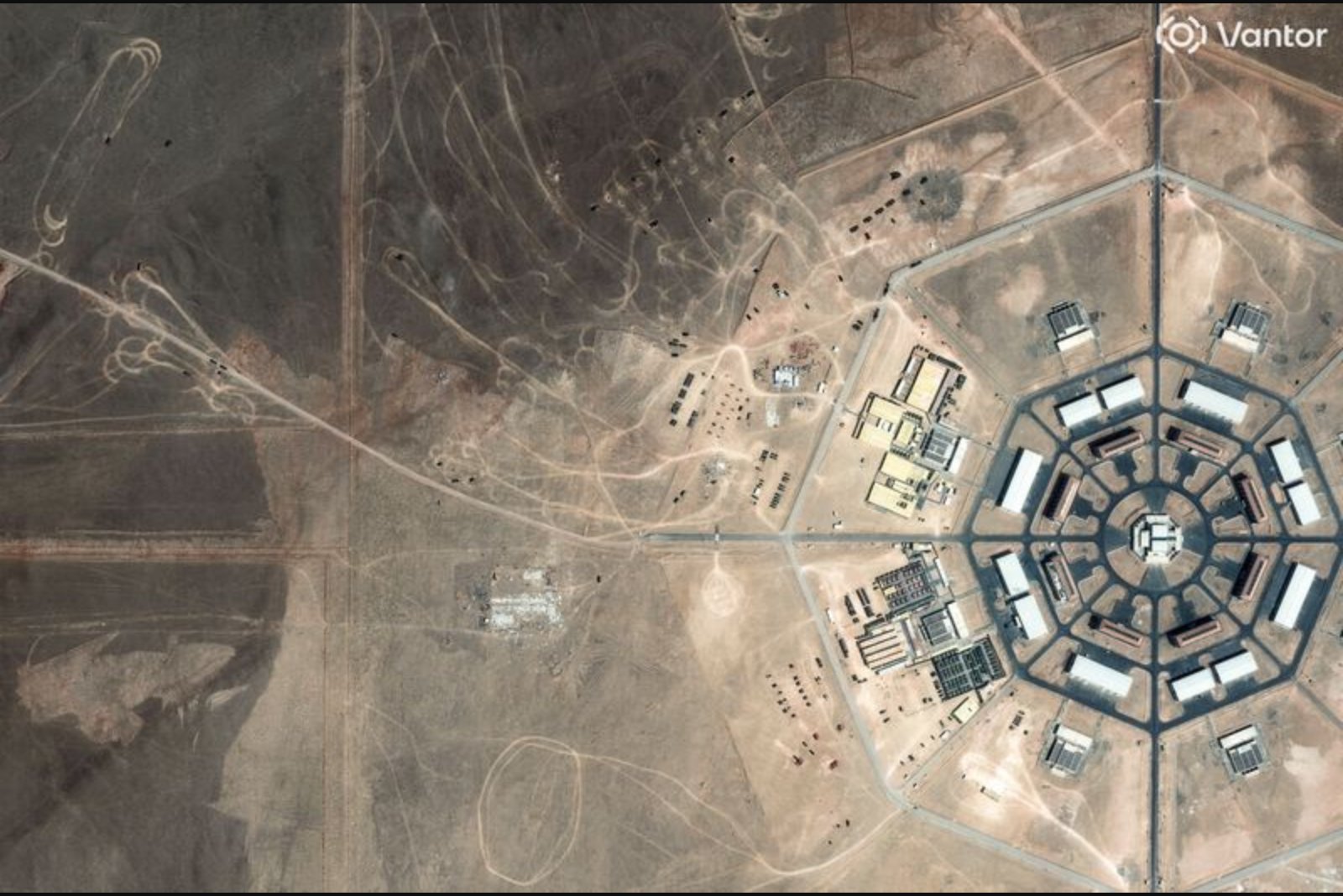
High-resolution satellite images reviewed by multiple security analysts show more than 80 concrete pads dispersed across thousands of square kilometers of desert around the established silo fields that hold China’s longest-range intercontinental ballistic missiles. The imagery also shows two large octagon-shaped installations, armored bunkers, weapons storage areas, airfields, railheads and what appear to be communications and electronic-warfare nodes.
What the imagery shows
The most prominent features in the imagery are two octagonal complexes built over the past six years in eastern Xinjiang. Both lie to the southwest of the Hami nuclear silo fields - one roughly 140 kilometers away, the other about 230 kilometers away. The octagons each contain personnel housing and space for sizable military vehicles. They are flanked by armored shelters and fortified storage zones, and are linked to the silo fields by a network of roads, railheads and other logistical routes.
Around the northern octagon, the images document military exercises involving large vehicles that took place in April and again this month. Nearby areas show large tents and features that two analysts identified as camouflaged launch sites cut into the desert surface, some accompanied by air-defense missile batteries.
Beyond the octagons, the imagery reveals a dense web of dirt roads and conduits radiating outward and connecting to dozens of concrete pads placed among rocky outcrops and dry creekbeds. Three security scholars who assessed the imagery told analysts these pads could be used for a variety of functions - from deploying mobile air-defense systems and electronic-warfare nodes to hosting road-mobile ICBM launchers from some of the larger sites.
Analysts' assessments and remaining unknowns
Five security scholars interviewed for this analysis agreed that, in broad terms, the infrastructure could support China’s nuclear program while also serving other military purposes. They cautioned, however, that key details remain unclear. Important unknowns include the specific weapons or systems that might be deployed on the pads and whether any of the octagon complexes are configured to host truck-mounted ballistic missiles or facilities for fitting nuclear warheads.
Hans Kristensen, director of a nuclear information project, said that while the precise operational use of each installation is difficult to determine from imagery alone, the scale of the construction in a harsh environment makes it hard to discount a wide range of missions. Alexander Neill, an adjunct fellow at a policy forum, described the infrastructure as being constructed on a grand scale and covering thousands of square kilometers beyond the silo fields. Depending on their capabilities, he said, the installations represent a considerable enhancement and diversification of China’s strategic nuclear deterrent.
At the northernmost octagon, three analysts pointed to the presence of satellite dishes and two large towers as indicators of a space or microwave communications facility under construction. Some analysts suggested the conduits linking pads to the octagon hubs could contain fiber-optic cables to support command-and-control and communications.
Tong Zhao, a senior fellow in nuclear policy, said there is a real possibility that the octagonal structures and the towers are tied to command, control and communications - as well as to maintenance and storage activities related to operations at the Hami ICBM silo site.
Wider context within China’s nuclear posture
The silo fields in Xinjiang and in neighboring Gansu province have been identified as core elements of China’s land-based nuclear forces. They sit alongside other delivery platforms in China’s broader strategic posture, which includes submarine-launched and air-launched nuclear systems. The ability to protect and sustain silo-based weapons is central to China’s declared objective of maintaining a minimal but credible deterrent that can respond if it is struck first.
China has publicly maintained a policy of no first use of nuclear weapons. Nevertheless, some Western diplomats and analysts say China might employ nuclear coercion to limit outside intervention in a conflict over Taiwan. In recent diplomatic exchanges, Xi warned the U.S. President that mishandling differences over Taiwan could lead to a dangerous situation. Taiwan’s government rejects China’s claim to the island.
China’s defense ministry did not provide comment in response to questions about the developments visible in the imagery. The Pentagon declined to comment on intelligence-related matters.
Links to recent Chinese disclosures and U.S. assessments
Chinese state displays have shown nuclear-capable systems publicly. During a parade in Beijing last September marking the 80th anniversary of the end of the Second World War, the People’s Liberation Army exhibited both silo-based and truck-mounted intercontinental ballistic missiles.
U.S. officials and arms-control analysts say China is expanding and improving its nuclear capabilities faster than any other country. A recent U.S. defense assessment concluded that overall warhead production in China has slowed in pace but that Beijing remains on track to field 1,000 warheads by 2030. That same assessment estimated that China is likely to have loaded about 100 ICBMs across its three main silo fields as of the December reporting period.
The United States has also described enhancements to China’s early-warning forces, noting deployment of Huoyan-1 satellites that underpin a system capable of detecting an incoming ICBM within 90 seconds of launch and alerting a command center within three to four minutes. According to the U.S. defense assessment, that timeline would provide sufficient time for China to launch silo-based weapons before they could be struck.
Additional installations and test ranges
Imagery also shows a third octagon-shaped installation south of the Lop Nur nuclear test facilities that appears less developed than the two in eastern Xinjiang. Analysts described characteristics of the site that suggest it is being used as a target range. The area displays pock-marked earth, damaged buildings and what a commercial imagery provider identified as mock-ups of Western jet fighters.
Comparison with other nuclear powers
Observers note that the scale and defensive focus of the network near China’s silos could distinguish Beijing’s approach from that of other major nuclear powers. The United States and Russia, whose deployed warheads remain far greater in number and whose silo inventories are different in design and geographic distribution, have historically relied on a combination of sheer numbers, relative isolation and hardened silo construction for deterrence rather than on a broad perimeter of defensive installations.
For many analysts, the sheer scope of the construction across a remote and inhospitable expanse has been striking. One expert said he had not seen anything quite like it and called the effort extraordinary.
Implications for planners and markets
From a military planning perspective, the dispersed pads, redundant communications nodes and protected hubs improve options for sustainment and survivability of land-based forces. They also complicate adversary targeting calculations by increasing the number of potential launch or support points. For industry, the developments underscore demand drivers for capabilities that support hardened communications, tactical mobility, early warning, and integrated air and missile defense.
That said, analysts emphasize significant gaps in open-source visibility. Imagery can indicate shape, placement and movement, but cannot, on its own, reveal the precise armaments or the full operational intent behind each construction decision.
Key takeaways
- Satellite imagery shows a broad defensive and operational network around China’s long-range silo fields, including more than 80 concrete pads and two major octagon hubs.
- Analysts say the infrastructure could support mobile missile launchers, air-defense batteries and electronic-warfare and communications nodes, but critical details on weapons and specific missions remain uncertain.
- China’s recent public displays of nuclear-capable systems and U.S. assessments of Beijing’s force expansion frame the developments as part of an accelerating modernization effort with implications for strategic stability.
Note on limitations: Imagery and expert assessment provide strong indicators of the nature and scale of the construction, but they do not offer definitive proof of the precise weapons systems or functions of every facility. Analysts interviewed for this article cautioned against drawing firm conclusions about specific deployments in the absence of additional corroborating information.