
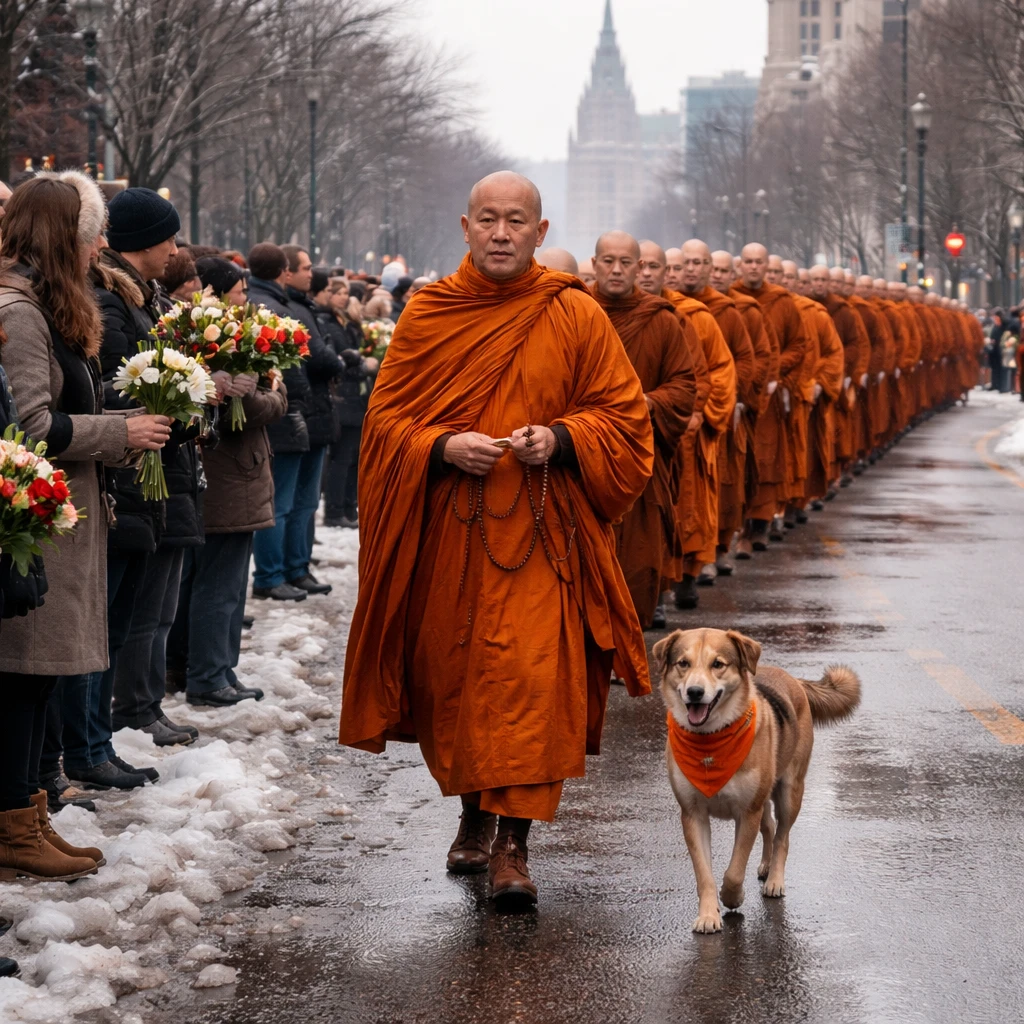
A small contingent of Buddhist monks, identifiable by their burnt-orange robes, are due to finish a 2,300-mile Walk for Peace in Washington, D.C., on Tuesday following a self-described spiritual trek across nine U.S. states. The group, numbering about two dozen, began their journey in Texas more than three months ago and traveled north and east across a broad swath of the country.
The marchers say their purpose is to raise "awareness of peace, loving kindness, and compassion across America and the world." Their path took them through Texas, Louisiana, Mississippi, Alabama, Georgia, South Carolina, North Carolina and Virginia before reaching the nation’s capital.
During a stop in Richmond on February 3, Bob Anderson, 74, of Gloucester County, Virginia, described why he came out to greet the walkers. "I feel like in our country and in our world right now that you have to show your support for peace in every possible way you can," Anderson said. "And so this is a great way to do so. That’s why I’m here." Supporters have gathered at multiple stops along the route, often braving snow and rain to meet the group and present flowers.
The monks have at times walked in frigid winter conditions and sometimes with bare feet, a detail they highlight as part of their commitment to the walk. They continued despite a powerful winter storm that swept a paralyzing mix of heavy snow, sleet and freezing rain from the Ohio Valley and mid-South to New England, a storm that was compounded by bitter, Arctic cold gripping much of the United States.
Accompanying the group is Aloka, a rescue dog who has traveled with the marchers. The Walk for Peace takes place against a backdrop of heightened tensions in the United States, which organizers and observers have noted. Those tensions are in part attributed in the public discussion to President Donald Trump’s immigration policy, which the article says has included the deployment of National Guard troops to some U.S. cities and has coincided with incidents in which both American citizens and immigrants were killed by federal agents.
Bhikkhu Pannakara, identified as the spiritual leader of the Walk for Peace, described the intent of the journey. "We walk not to protest, but to awaken the peace that already lives within each of us," he said. "The Walk for Peace is a simple yet meaningful reminder that unity and kindness begin within each of us and can radiate outward to families, communities, and society as a whole."
On social media the walk has drawn millions of messages of support from people who shared the monks’ progress and encouraged their mission. The marchers have been met by crowds of thousands along the way, and the movement’s online following amplified invitations for supporters to come out during inclement weather to greet them.
In North Carolina, state governor Josh Stein publicly thanked the monks for their message, saying during their stop that "You are inspiring people at a time when so many are in need of inspiration." The organizers have said the monks expect to meet with spiritual, municipal and other leaders upon arrival in Washington. Planned activities in the capital include a visit to the National Cathedral and a meditation retreat.
Not all moments on the road were without peril. While passing through Dayton, Texas, a truck struck the monks’ escort vehicle, injuring several people, according to local media cited in reports about the group. Two monks suffered serious injuries from that incident and one of those injured had to undergo an amputation of a leg. Despite the collision and the resulting injuries, the group pressed on, saying they would continue to walk to honor their original message of peace and to honor their injured brothers.
The Walk for Peace is framed by its organizers as a spiritual practice rather than a political demonstration. The route and incidents along the way, including the weather and the crash, have been part of a larger narrative the monks and supporters describe as an effort to promote kindness and unity in communities across the United States.
Summary
A contingent of roughly two dozen Buddhist monks will conclude a 2,300-mile Walk for Peace in Washington, D.C., after traveling through nine states and facing severe winter weather and a serious vehicle collision that left some participants injured. The effort, accompanied by a rescue dog and supported by crowds and social media, aims to promote peace, loving kindness and compassion while meeting spiritual and civic leaders in the capital.