
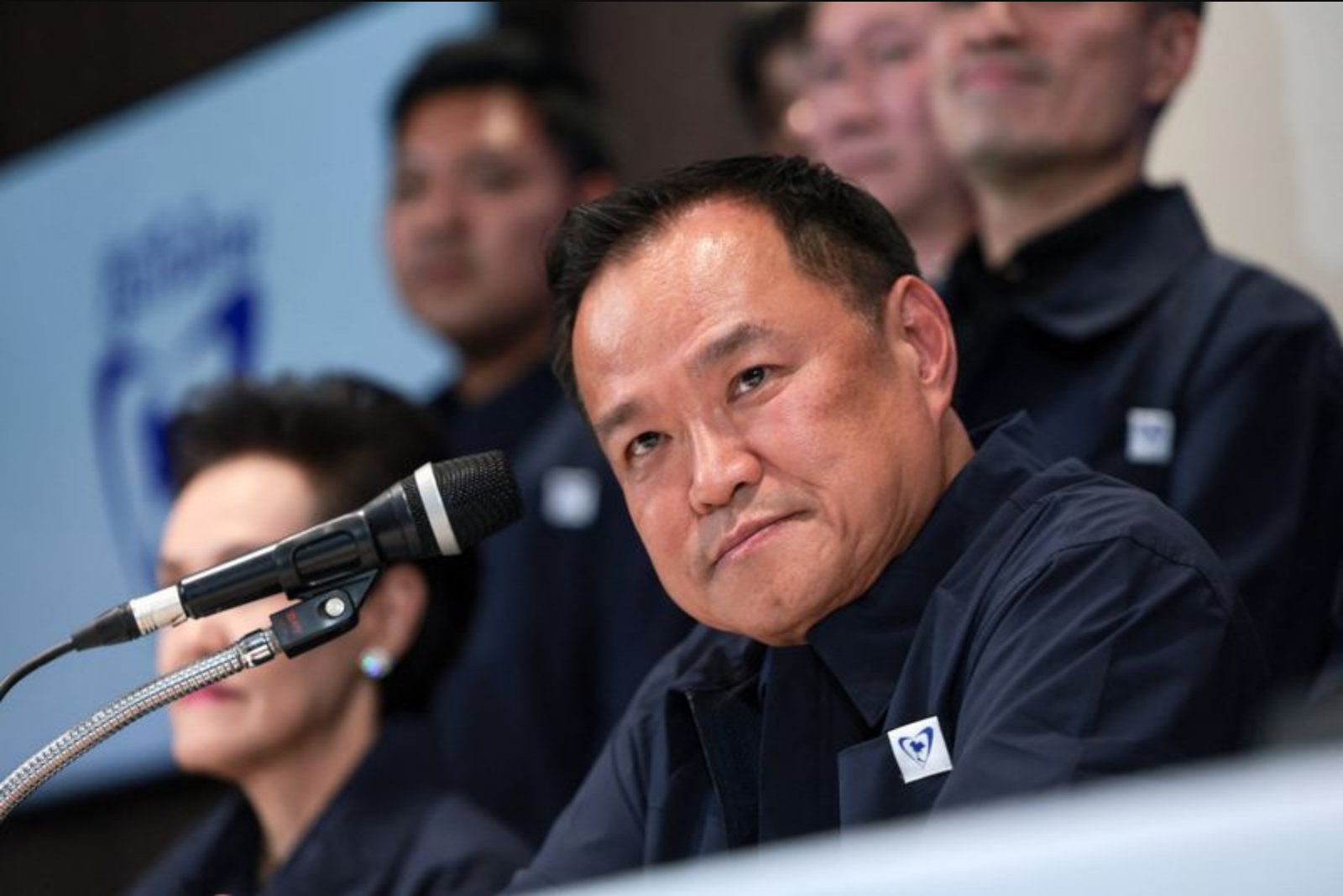
(Corrects paragraph 1 to add dropped letter 'r' in leader's name) Thailand’s Bhumjaithai Party emerged from last weekend’s general election with a decisive advantage, positioning its leader Anutin Charnvirakul as a leading candidate to return to the premiership. The outcome marks a reversal of expectations that had favoured the liberal People’s Party.
Bhumjaithai established an early and sustained lead in vote tallies. According to Reuters calculations using election commission figures, the party led with about 192 of 500 parliamentary seats from nearly 95% of polling stations. That is a marked increase compared with its previous results of 51 seats in 2019 and 71 in the 2023 contest.
The party expanded its presence in the south and captured seats in the vote-rich northeast, a region that had been held for nearly two decades by the Shinawatra family’s formerly dominant Pheu Thai. Bhumjaithai also made a clean sweep of Bangkok in the counting, while the People’s Party finished as a distant second with 117 seats and Pheu Thai recorded 74 seats, representing its weakest electoral performance.
How the election unfolded
Opinion polls prior to the vote had indicated stronger support for the People’s Party, but as counting progressed Bhumjaithai widened its margin. Leaders of the People’s Party, along with those of Pheu Thai, conceded early as the party’s lead became clear. The shift in vote patterns included gains in areas long associated with the Shinawatra political network.
Coalition dynamics and Anutin’s prospects
Although Bhumjaithai’s 192 seats fall short of the 251 needed for an outright majority, the result affords Anutin substantial leverage at the negotiating table. The People’s Party announced it would not form a rival alliance, removing one potential obstacle to coalition building.
Beyond the three largest parties, around a dozen smaller parties are poised to occupy roughly 117 seats in the new parliament. These range from Kla Tham, projected to hold 57 seats, down to Palang Pracharat with 5. Even a coalition including some of these smaller parties could yield Anutin a narrow majority, and a Pheu Thai-Bhumjaithai collaboration remains a possibility despite Anutin’s efforts last year to distance himself from that former governing party.
The path to a viable administration may be assisted by Anutin’s reputation as a dealmaker. After abandoning the coalition of the former ruling party last year, he became premier following a court’s sacking of predecessor Paetongtarn Shinawatra. With his party ascendant and a profile that appeals to conservative and royalist constituencies, Anutin is likely to attract defectors and form partnerships with multiple smaller groups.
Implications for governance and stability
Bhumjaithai’s substantial seat gain could consolidate governing authority in ways that enable more effective policymaking - provided Anutin can manage a faltering economy and reconcile the interests of large business groups and influential institutions. The party’s strengthened position may also draw support from Thailand’s establishment and military, actors who have been central to a prolonged power struggle that, according to the reporting, thwarted two progressive forerunners of the People’s Party and toppled in coups and court rulings six populist prime ministers from, or backed by, the Shinawatras.
How durable any resulting government will be depends on Anutin’s ability to convert parliamentary advantage into a stable coalition that can govern coherently across economic and institutional fault lines.
Why Anutin’s campaign worked
Observers point to several strategic moves that helped Bhumjaithai and its leader. Anutin’s decision to dissolve parliament amid heightened tensions with Cambodia coincided with months of nationalist sentiment, and he campaigned on defending national sovereignty while portraying political rivals as insufficiently patriotic. Though Anutin had been premier for fewer than 100 days before the election, he brought technocrats into his administration and attracted respected politicians from other parties, which allowed him to project competence on economic management against a less proven People’s Party and a Pheu Thai that critics said had fallen short.
Next steps and parliamentary timetable
Formal procedures will follow once the election commission certifies the result. The commission has up to 60 days to complete certification. After that occurs, parliament must convene to elect a speaker and select a new prime minister within 15 days.
Any party holding more than 25 seats can nominate a candidate for prime minister. To assume office and form a cabinet, a candidate must secure the support of more than half of the 500 lawmakers. If no candidate achieves that majority, the house is required to reconvene and repeat the nomination and voting procedure until a prime minister is chosen.
Summary: Bhumjaithai’s strong electoral performance gives Anutin Charnvirakul a commanding negotiating position to assemble a governing coalition, but forming a majority government and converting electoral gains into stable governance will depend on coalition choices and parliamentary approval.