
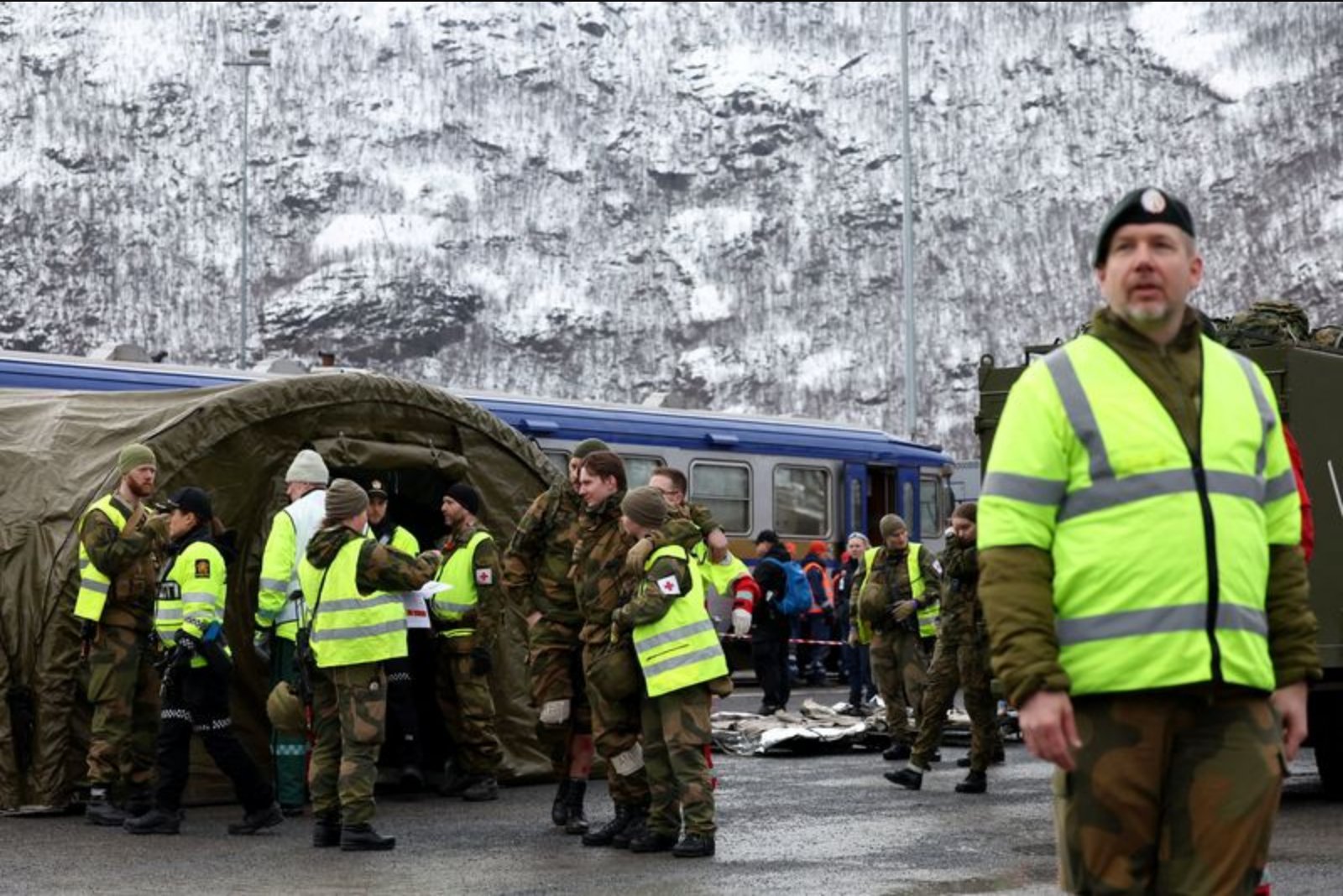
NARVIK, Norway, March 12 - Dozens of volunteer "casualties" were unloaded from a train into Narvik harbour as local health officials staged a triage and ambulance transfer operation designed to simulate wartime medical evacuations.
Thomas Hultstedt, the city’s chief medical officer, observed the scene as part of an exercise embedded in NATO’s biennial Cold Response drills, which began on Monday and this year place additional emphasis on how civilians, businesses and public institutions would support the alliance during a war. The specific scenario rehearsed in Narvik envisions a conflict erupting in Finland, with U.S. and Norwegian soldiers on front lines and civilians being evacuated to Norwegian medical facilities for treatment.
Organizers say the simulation is intended to represent a larger movement of people: under the exercise plan, roughly 1,200 individuals would be transported to Narvik over a 10-day period. The actual field activity staged in Narvik on Thursday, however, lasted one day and included about 100 volunteers - many of them students - playing wounded or otherwise affected civilians.
"I have never done this type of exercise before," Hultstedt said in the minutes before the train arrived at the quay. "It is good in the sense that you prepare yourself for things that are out of the ordinary. This is very different from normal life. This is a war situation." The volunteers were processed at the harbour and then moved by ambulance to civilian hospitals in the surrounding region; in a real operational setting, the plan would be to send patients on to southern Norway or abroad for further care.
The train used for the drill had travelled from Finland via Sweden to Narvik. That rail connection - from Narvik to Kiruna in Sweden and further east to Finland - is identified by planners as the principal corridor for moving equipment and personnel between east and west across Arctic Scandinavia.
Hultstedt noted how the security context has shifted in recent years. "I have never done this type of exercise before... Then Sweden and Finland were not part of NATO... Now Norway has to step up. We must get equipment in and the injured out," he said, underscoring a recalibration of national and regional responsibilities as the Nordic states alter their defence postures.
Finland and Sweden joined NATO in 2023 and 2024, respectively, following Russia’s full-scale invasion of Ukraine on February 24, 2022. Norway, by contrast, has been a member since 1949 as a founding member. While NATO training scenarios avoid naming Russia directly, the exercise assumes an aggressor approaching from the east. The article notes that Russia lies roughly 600 km to the east, as the crow flies, and that Moscow has repeatedly dismissed suggestions that it might attack a NATO member as baseless and fear-mongering.
Narvik is described as an industrial port town set between a 1,006-metre snow-capped mountain and the Ofot fjord. NATO planners regard the town as a strategic landing point on Norway’s coast should Finland, Sweden or Norway itself come under attack.
The site also has historical resonance: Narvik was the scene of an early World War Two battle in 1940, when Norwegian, British, French and Polish forces initially pushed back Nazi Germany before withdrawing as Germany moved against France.
As part of a broader national effort to strengthen resilience, Norway has declared 2026 the year of "total defence". Elisabeth Aarsaether, the outgoing director of the Norwegian Directorate for Civil Protection, emphasized the need to bring civil society and military planning closer together.
"It is very important to narrow the gap between military forces and civil society because in a really critical situation - war - there is a need for a lot of resources," she said.
Aarsaether added that while national planners judge most households to be better prepared than in the past, local government capacity is a concern. Authorities are preparing new guidelines aimed at improving municipal readiness, she said. "We would really like to help them," she added.
The Narvik exercise illustrates multiple operational challenges: integrating civilian hospitals into surge capacity plans, coordinating cross-border rail and road logistics for mass evacuations, and advancing local government preparedness. The live drill brought together medical personnel, transport planners and volunteer role-players to test procedures for triage, ambulance transfer and short-term hospital reception in an Arctic environment.
For healthcare systems and regional logistics providers, the exercise put a spotlight on the need to scale capacity quickly and move patients safely over long distances. For civil authorities, it highlighted gaps in municipal readiness that national agencies are now working to address through updated guidelines and planning support.
As NATO’s Cold Response continues, the Narvik scenario stands as a practical rehearsal of how military and civilian systems could interact under acute pressure, and as a barometer of preparedness for a set of contingencies that planners characterize as originating from the east.