
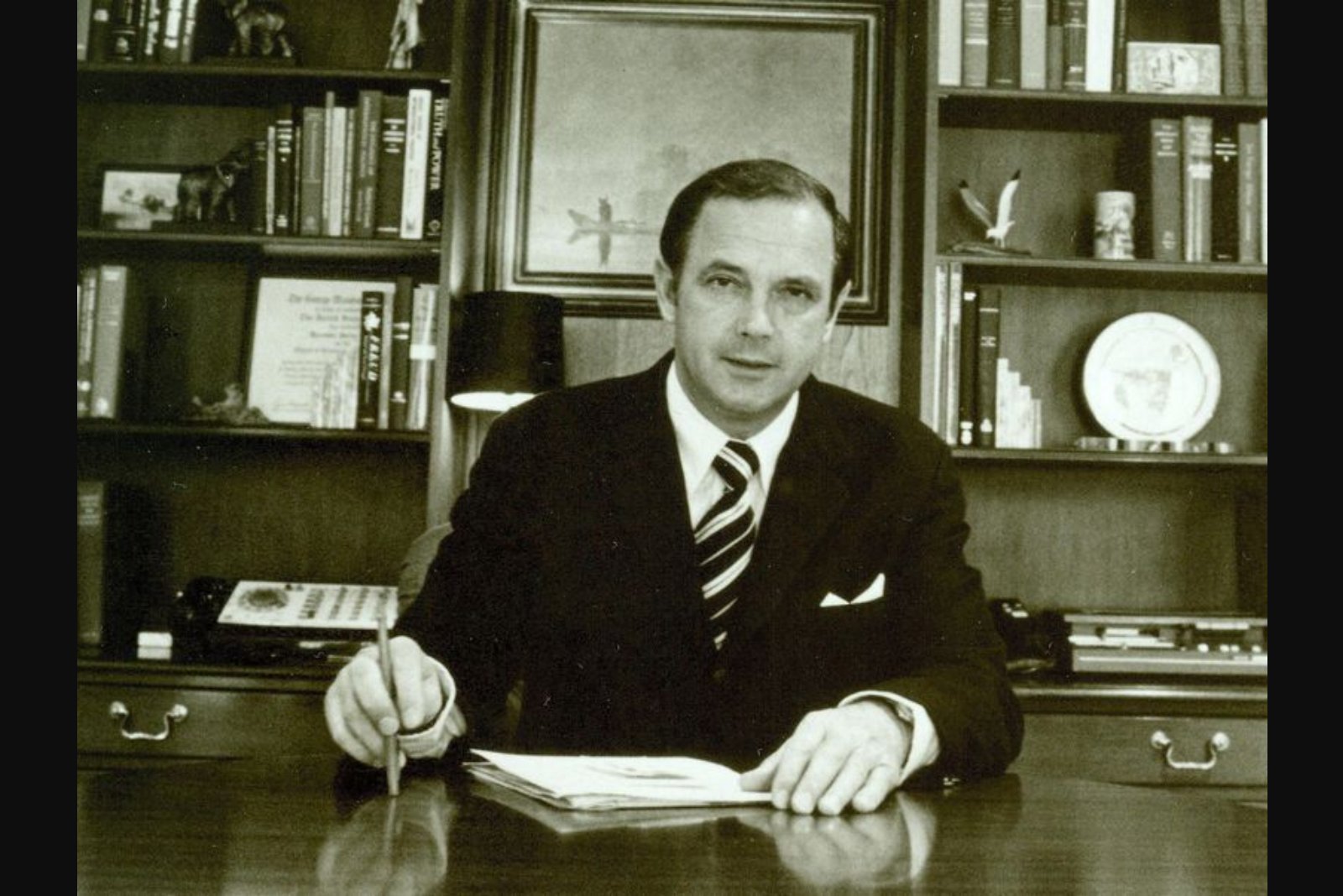
Alexander Butterfield, the White House aide whose admission that the Nixon White House operated a voice-activated taping system produced the crucial recordings that exposed the administration's efforts to thwart the investigation into the 1972 Watergate break-in, has died at age 99. His passing, at his home in the La Jolla area of San Diego, occurred about one month before what would have been his 100th birthday; no cause of death was disclosed.
Butterfield's disclosure became a turning point in the Watergate saga because it established the existence of a contemporaneous record of conversations and meetings inside the executive offices. That record ultimately produced what became known as the "smoking gun" tape - a recording that demonstrated President Nixon's awareness of plans to impede the investigation into the June 17, 1972 break-in at Democratic Party headquarters in the Watergate complex.
Butterfield, who grew up in California after being born in Pensacola, Florida, attended UCLA before joining the U.S. Air Force in 1948. He served as a combat pilot during the Vietnam War, commanding a tactical reconnaissance squadron, and later worked as a military assistant to a senior Pentagon official. That role provided him exposure to White House affairs and helped position him for later service on the presidential staff.
Leaving the Air Force, Butterfield joined the White House staff as deputy to H.R. Haldeman, who had been a college friend from UCLA and served as President Nixon's chief of staff. One of Butterfield's responsibilities in the White House was maintaining a historical record of the presidency. That responsibility included supervising the installation of a voice-activated recording system that captured conversations in several key locations - the Oval Office, Nixon's office in the Executive Office Building, the Cabinet room - and on four White House telephones. Butterfield characterized the recordings' stated purpose as historical archiving.
By the time the Watergate break-in spawned a widening probe, Butterfield had moved on from the White House to become administrator of the Federal Aviation Administration. As the congressional investigation intensified, he was summoned to be questioned by the Senate committee formally known as the Select Committee on Presidential Campaign Activities. The committee was then conducting closed-door preliminary interviews; Butterfield had resolved privately neither to lie nor to volunteer information when he learned he would be questioned.
During a private session, a Republican staff attorney asked Butterfield if the White House had a recording system; Butterfield acknowledged that one existed. Three days later, on July 16, 1973, he repeated that revelation publicly during a televised session of the Senate committee. When Fred Thompson, then the committee's Republican counsel, put the question to him again, Butterfield paused and then said, "I was aware of listening devices, yes, sir." The admission signaled to the nation that a documentary record of what the president had said and to whom had been maintained.
The existence of the tapes precipitated an intense legal conflict over the scope of presidential privilege. The White House asserted executive privilege to resist turning over recordings subpoenaed by the investigative panels. The dispute culminated in a decision from the U.S. Supreme Court that rejected the claim of absolute privilege and required the surrender of the subpoenaed tapes to investigators. One tape - recorded six days after the Watergate break-in - proved pivotal because it captured Nixon agreeing to a plan to halt the investigation on national security grounds. The content of that tape eroded Nixon's remaining political support and led him to resign on August 9, 1974 rather than face impeachment and a Senate trial.
Butterfield was not implicated in the break-in or in the cover-up and was never charged in the scandal. However, several of his former colleagues, including Haldeman, were convicted and imprisoned for their roles in the Watergate affair.
Over time Butterfield grew uncomfortable with being reduced to the role of the man who announced the tapes' existence. He told journalist Alicia Shepard that he disliked how that perception suggested he had "eagerly and breathlessly" revealed the system to investigators. In other statements, he reflected in measured terms on Nixon and the consequences of the scandal. In a 1975 interview he said the president often forgot the recorders were running and had disregarded advice to destroy tapes, having apparently not expected the investigation to reach the point where he would be forced to surrender them. "I'm sure that he hates me as much as anyone can," Butterfield said of his former boss, who died in 1994. He also said he thought Nixon should have resigned earlier and added, "I don't feel awful about the president's resignation. Not at all."
Butterfield maintained involvement in public life in varied ways after leaving government. He worked as an adviser to the filmmaker Oliver Stone on Stone's 1995 film "Nixon" and even appeared in the movie in a brief cameo as a White House staffer. He also provided extensive cooperation to journalist Bob Woodward, supplying thousands of documents he had removed from administration offices and participating in interviews that informed Woodward's 2015 book focused on Butterfield's role in the drama.
The documents and interviews Butterfield provided helped paint a picture he described as a "cesspool" inside the Nixon administration, characterizing the administration's internal climate as hostile and often resentful. Butterfield said he was frequently the target of hostility from loyalists consistent with that portrayal. He recounted, for example, that Rose Mary Woods, Nixon's longtime secretary who said she accidentally erased 18 1/2 minutes of White House tape, had called him a "son of a bitch" and accused him of having "destroyed the greatest leader this country ever had."
On the personal front, Butterfield's first marriage to Charlotte Maguire ended in divorce in 1985. He had also previously dated Audrey Geisel, the widow of the children's author and illustrator Theodor Seuss Geisel, better known as Dr. Seuss.
Butterfield's decision to speak to investigators about the taping system and the subsequent public disclosure changed the trajectory of the Watergate inquiry. His testimony set in motion legal and political processes that tested the limits of presidential privilege and ultimately brought forward recorded evidence that played a central role in ending a presidency.
Key takeaways
- Butterfield's disclosure of the White House recording system provided documentary evidence that directly influenced the course of the Watergate investigation and the outcome of President Nixon's tenure.
- The revelation sparked a major legal contest over executive privilege that culminated in a Supreme Court ruling requiring the president to hand over subpoenaed tapes.
- Although Butterfield was never charged in the scandal, several senior Nixon aides were convicted and imprisoned for their roles in the cover-up.
Contextual note - Sections above summarize Butterfield's role, his background, how he came to reveal the taping system, the consequences of that disclosure, and subsequent aspects of his life as described by him and by published interviews and accounts.