
Hook & thesis
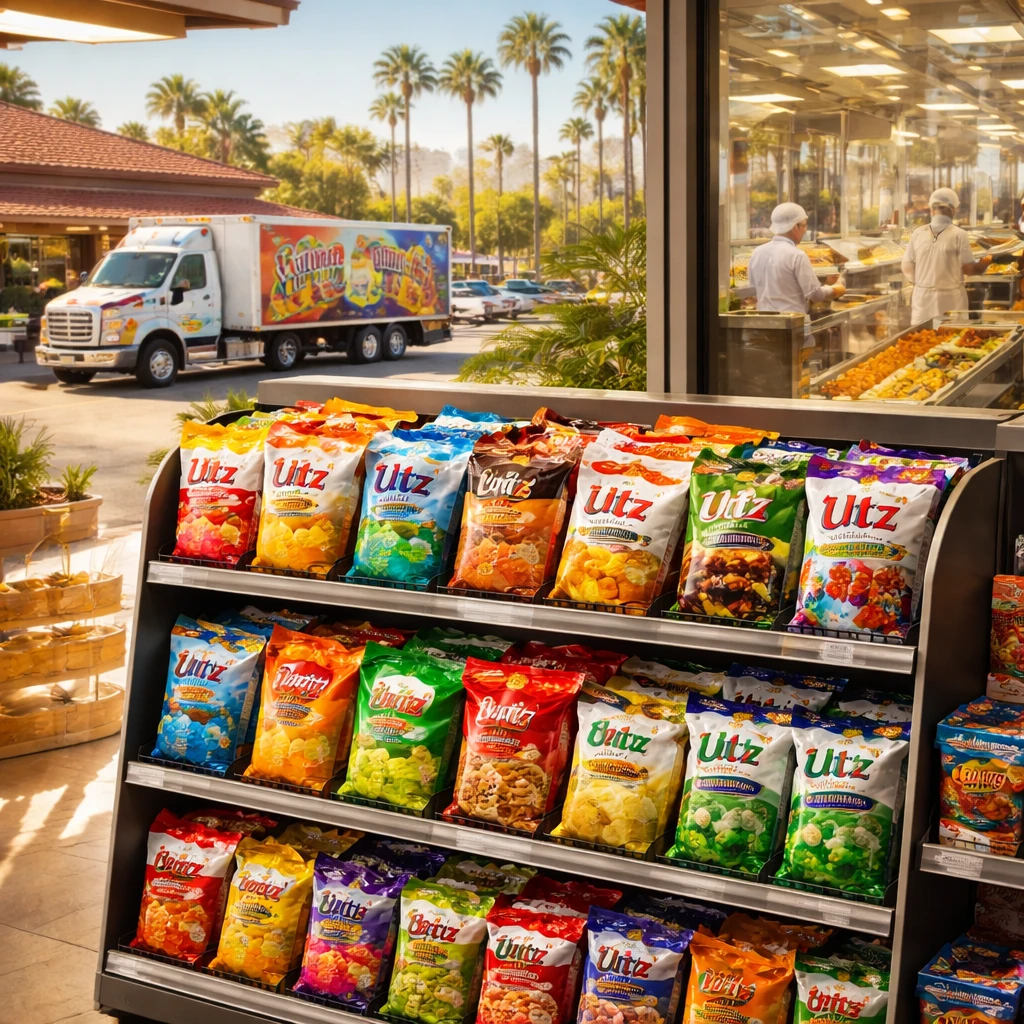
Utz Brands is executing a logical next step: deeper distribution and merchandising in California, one of the biggest snack markets in the U.S. The company already owns a collection of regional-to-national snack brands (Utz, Zapp's, Boulder Canyon, ON THE BORDER, Golden Flake) that should resonate in large West Coast grocery, convenience and foodservice channels. At the current price near $9.60 the market is pricing in slow growth and margin pressure; I think California distribution can change that setup modestly but materially over the coming months.
My trade: a mid-term long with a clearly defined entry, stop and target that captures upside from increased shelf presence, SKU rationalization and operating leverage as fixed costs get spread across higher volumes. This is not a binary takeover bet - it’s a volume-and-efficiency play on a known brand set trading at a valuation that leaves room for improvement.
What the company does and why the market should care
Utz Brands manufactures, markets and distributes salty snacks: potato chips, tortilla chips, pretzels, cheese snacks, pork skins and mixes. The firm’s portfolio includes recognizable regional favorites and national names: Utz, ON THE BORDER Chips & Dips, Golden Flake, Zapp's, Boulder Canyon, Hawaiian Brand and TORTIYAHS!. That mix gives Utz both broad appeal and the kind of targeted SKUs that can expand rapidly once a distribution foothold is established.
Why California matters: it is one of the largest single-state grocery markets in the U.S., with high per-capita snack consumption in urban centers and heavy foodservice demand. If Utz can convert a meaningful number of shelf facings and local distribution agreements into repeat sales, the revenue lift will be visible in upcoming quarters because incremental freight and warehousing costs should be smaller than the gross-margin contribution of higher branded sales.
What the numbers say
Recent reads show Utz is not a momentum darling but is not a broken company either. Q2 2025 revenue came in at $366.7 million, a small beat to consensus and evidence the branded snack engine is still running. The business has faced margin pressure from higher input costs and investments in operations - an issue management has acknowledged - but revenue growth in branded snacks remains the primary fundamental lever.
Valuation and balance sheet discipline are central to the case. Market capitalization sits around $1.38 billion while enterprise value is roughly $1.60 billion. On a price-to-sales basis the stock trades near 0.59x, and EV/sales is ~1.11x. Those ratios feel modest for a branded snack play, especially given the company generates free cash flow (reported at about $9.4 million) and pays a dividend yield in the mid-single digits (about 2.56%).
That said, profitability metrics show headwinds: trailing EPS is effectively $0.01 and the reported price/earnings ratio is extremely elevated (over 1,000x), which reflects compressed near-term earnings. Leverage is material: debt-to-equity sits around 1.22, so the firm is not asset-light here. EV/EBITDA runs near 17.2x, implying the market wants either faster growth or margin normalization to justify a higher multiple.
Technically, the stock is nearer its 52-week low ($8.715 on 02/13/2026) than its high ($14.67 on 07/23/2025). Current market price is roughly $9.60, the 10-day simple moving average is close to $9.67 and the 50-day SMA sits around $10.21. Momentum indicators are mixed - RSI ~44 and MACD showing slightly bearish momentum - meaning there’s room for a momentum turn if company-level catalysts materialize.
Valuation framing
Two ways to look at valuation: relative to sales the stock is cheap (0.59x P/S), which matters for branded consumer names where incremental distribution often unlocks outsized revenue. On an absolute fair-value basis, analysts’ average 12-month price target sits notably higher (the dataset summary lists an average target near $22.33), which implies the sell-side expects meaningful recovery in earnings or accelerated growth over the next year.
That said, the street’s target looks optimistic relative to current profitability. A more conservative path to upside is re-rating from distribution-driven revenue growth and modest margin improvement that moves EV/EBITDA down from ~17x to high-teens on higher EBITDA. If management turns incremental volumes in California into improved gross margins and a modest reduction in SG&A per unit, the stock should re-rate toward the mid-teens.
Catalysts to drive the trade
- Rollout and merchandising wins in California retail chains - incremental shelf placements and localized promotions that show up as improved point-of-sale data.
- Quarterly results that demonstrate branded snack growth offsetting input cost pressure - a repeatable beat in revenue and margin expansion.
- Operational scale benefits: improved factory utilization or distribution synergies that lift gross margin and free cash flow above the current $9.4M run rate.
- Visible inventory turns and improved velocity in large Western distributors/foodservice partners.
- Short-covering events after a positive earnings print - short interest has been non-trivial and spikes in short volume create asymmetric upside on better-than-expected results.
Trade plan (actionable)
I propose a mid-term trade: go long Utz at an entry of $9.60. Set a protective stop loss at $8.50 to keep downside limited if the CA execution falters or macro-led retail weakness accelerates. Primary target is $14.00, which captures a move back toward the prior 52-week high region and reflects a sensible re-rating for improved distribution and margin recovery.
Horizon: mid term (45 trading days). I expect that a coordinated push into California, combined with one quarter of improved point-of-sale data or an earnings beat, can produce a re-rating within roughly two months. The 45-trading-day window allows enough time for merchandising dynamics to show up in weekly sell-through and for the market to re-assess the company’s growth trajectory.
| Action | Price | Horizon |
|---|---|---|
| Entry | $9.60 | mid term (45 trading days) |
| Stop loss | $8.50 | Protect capital if execution fails |
| Target | $14.00 | Capture re-rating and distribution-driven volume lift |
Why this risk/reward makes sense
From $9.60 to $14.00 is ~46% upside. Downside to the stop at $8.50 is ~11.5%. That asymmetry is attractive if the California initiative meaningfully increases velocity and margins. The stock’s valuation (0.59x P/S and EV/sales ~1.11x) implies the market is assigning limited upside to expansion; a modest success story in California should move that needle.
Risks and counterarguments
- Execution risk: Retail distribution deals are one thing; converting distribution into sustained sell-through is another. If Utz fails to achieve repeat purchases in California, incremental costs could hurt margins further.
- Input-cost and margin pressure: The company has already cited margin headwinds from higher costs and operational investments. If commodity prices or freight costs accelerate, earnings could remain compressed, making the stock’s re-rating harder to achieve.
- Balance sheet leverage: Debt-to-equity near 1.22 is not trivial for a consumer business with thin short-term earnings. A prolonged slowdown or need for additional investment could stress free cash flow and force trade-offs between growth and dividends.
- Macro/retail environment: Slower consumer spending or accelerated retailer delisting (if velocity disappoints) would undermine the CA play. Grocers and convenience chains are sensitive to margin and assortment; Utz must prove fast SKU turnover.
- Counterargument: Even if California gains are modest, the market may continue to focus on weak near-term EPS (trailing EPS approximately $0.01), keeping the P/E extremely elevated. That could limit upside until a series of quarters show consistent margin recovery.
What would change my mind
I will upgrade conviction if quarterly reports show: (1) clear, repeatable sell-through improvements in California and other new distribution areas; (2) sequential gross-margin improvement as scale benefits offset cost pressures; and (3) free cash flow rising meaningfully above the current ~$9.4M run rate. Conversely, I will close the position and re-evaluate if Utz misses revenue targets tied to the California rollout, if leverage creeps higher without clear return-on-capital improvement, or if management signals larger-than-expected operational setbacks in production or distribution.
Conclusion
Utz Brands is a pragmatic growth-with-structure story: strong regional brands, a clear pathway to incremental distribution in a huge market, and a valuation that does not assume much upside. The California expansion is not a guarantee, but it is a sensible lever that could deliver materially better revenue and margin outcomes if executed well. For traders comfortable with mid-term, event-driven consumer exposure and willing to manage risk closely, the proposed long at $9.60 with a stop at $8.50 and a target of $14.00 offers an asymmetric trade with defined downside and meaningful upside should the rollout succeed.
Key milestones to watch over the next 45 trading days:
- Store-level merchandising announcements and new retail partner wins in California.
- Weekly sell-through or distributor pull-through data released or discussed on earnings calls.
- Quarterly results showing branded snack growth and any margin inflection.
- Short-interest and short-volume trends that could influence near-term price action after positive news.