
Hook / Thesis
The market threw out the baby with the bathwater last week. Broad AI-driven headlines - notably Anthropic's Claude Cowork - sparked a cascade of selling across SaaS names. Toast, Inc. (TOST) got knocked down with the pack, but this is not a single-function tool that AI will casually replace. It is a vertically integrated restaurant operating system that bundles terminals, payments, software, and professional services into mission-critical workflows.
That distinction matters. Toast is trading near its 52-week low at $26.11 after a fast pullback. Fundamentals still show a mid-single-digit free cash flow yield, a sizeable installed base, and operational leverage that AI point solutions are unlikely to dislodge quickly. For traders and patient investors willing to accept execution and macro risk, this is a tactical long with defined risk parameters: entry $26.11, stop $23.00, target $38.00, horizon - long term (180 trading days).
What Toast Does and Why the Market Should Care
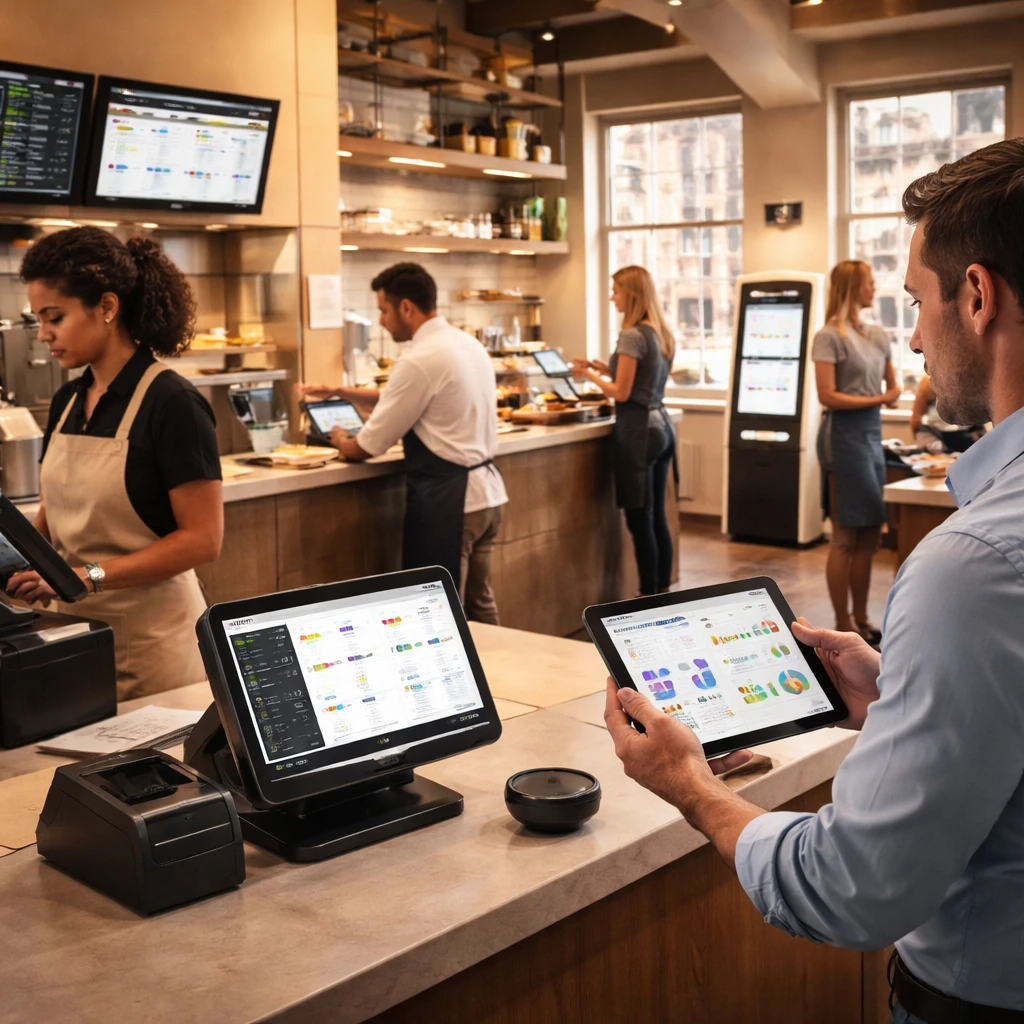
Toast builds the operating layer for restaurants. The company sells hardware (terminals, kiosks, guest-facing displays), point-of-sale software, online ordering, delivery integrations, kitchen display systems, reporting and analytics, and payments. For restaurants, these are not optional widgets; they touch every order, every check, and back-of-house workflows that drive throughput and margin.
Why that matters now: when vendors own the transaction layer and payment flow they gain revenue diversity (software + payments + hardware + services) and stickiness that’s far higher than a single-function AI tool. Even if restaurants adopt AI features — for menu recommendations, voice ordering or automated scheduling — those features are most likely to be embedded into the POS ecosystem rather than replace it wholesale.
Numbers That Anchor the Argument
Use the math, not just the narrative. Toast's market capitalization is about $16.3 billion and its price-to-sales ratio is roughly 2.8x, which implies trailing revenue in the neighborhood of $5.8 billion. Free cash flow is $564 million, meaning implied FCF yield on market cap sits around 3.5%. Enterprise value is approximately $15.1 billion with EV/sales near 2.58x and EV/EBITDA around 37.6x. The company also holds about $1.49 billion in cash and shows healthy liquidity ratios (current ratio ~2.74, quick ratio ~2.62).
From a market-technical standpoint, Toast is oversold on momentum indicators. RSI is about 29, and the 10/20/50-day moving averages all slope down, which is consistent with recent panic selling. Short interest sits near ~29 million shares with days to cover around 3, which suggests limited raw short squeeze potential but also indicates professional presence on the short side.
Valuation Framing
At $26.11 the stock trades at a high multiple on earnings (P/E in the 60x range per recent comps) but a more modest multiple on sales (2.8x). That gap tells the story: profitability is improving but still uncertain relative to sales growth expectations. The company is not cheap on an earnings basis, but its integrated payments stream and recurring software revenue justify a premium to pure-play SaaS peers - provided growth and margin expansion continue.
Put differently, Toast's valuation is a bet on durable share-of-wallet capture from restaurants. If management keeps growing software and payments mix while converting more of its installed base to higher-margin services, the multiple can re-rate higher. Conversely, if macro pressure or competitive deceleration hits revenue growth, the current valuation will look stretched.
| Metric | Value |
|---|---|
| Current Price | $26.11 |
| Market Cap | $16.3B |
| Implied Revenue | ~$5.8B (implied from P/S) |
| Free Cash Flow | $564M |
| EV / Sales | ~2.58x |
| RSI | ~29 (oversold) |
Catalysts (2-5)
- Re-acceleration in restaurant spending and labor normalization - better top-line comps could quickly re-rate the multiple.
- Product integrations with voice and AI partners (e.g., voice ordering partnerships) that increase per-location revenue and reduce churn.
- Earnings beats and margin expansion as hardware sales normalize and software+payments mix increases.
- Contract wins with multi-unit chains and franchise rollouts (professional services case studies are already in market).
- Any sign of multiple compression reversal among mission-critical SaaS names could lift Toast disproportionally due to its payments annuity.
Trade Plan (actionable)
- Entry: Buy at $26.11. This is the current level where selling pressure has compressed upside risk and provides a clear level to size the trade.
- Stop: $23.00. A break below $23 would signal that the downside momentum has shifted materially away from a recovery path and would protect capital. This stop sits meaningfully below the 52-week low area and gives room for intraday volatility.
- Target: $38.00. This target sits roughly 45% above entry and would represent a re-rating toward a more normalized multiple as growth stabilizes and margins expand. If catalysts materialize earlier, consider scaling out incrementally.
- Horizon: Long term (180 trading days). Expect this position to take time; re-rating tied to quarterly execution, product rollouts, and macro stabilization typically unfolds over several quarters.
Why long term (180 trading days)? Two reasons: first, re-pricing after a panic takes time as analysts update models and institutional investors re-enter. Second, product-led improvements (software mix, payments growth) show up over multiple quarters, not days. For shorter-term traders, a mid term (45 trading days) swing could be attempted with tighter stops, but expect higher variance.
Risks and Counterarguments
- AI consolidation could attack the POS layer: If large AI platforms bundle point-of-sale-like features with deep wallet-share integrations (payments, fraud, compliance), some lower-end merchants could migrate away from specialized vendors. This is the main bearish thesis behind recent selling.
- Competition and pricing pressure: Players in payments and commerce stacks (including incumbent payment processors and cloud POS competitors) could pressure margins or win share via lower fees or bundled discounts.
- Macro weakness in dining out: A slowdown in consumer spending or a shift to lower-margin dining formats would hit transaction volumes and services revenue.
- Execution risk on hardware and service delivery: Toast still runs significant hardware deployment and professional services; supply-chain or rollout problems could compress margins.
- Valuation sensitivity: With P/E north of 60x, any revenue miss or slowdown in margin expansion could lead to sharp multiple contraction.
Counterargument to our thesis
A reasonable bearish counterpoint is that AI copilots and composable platform vendors will accelerate consolidation: large cloud and AI players could bundle checkout, ordering and analytics into a single platform, undercutting specialized vendors like Toast. If that happens faster than anticipated, Toast could lose pricing power and volume in lower-tier restaurants that prioritize cost. This scenario is plausible and is the root of the recent volatility.
Why I still favor a tactical long
Even if AI features become widespread, the migration cost for full-store replacements (hardware swaps, payment migrations, franchise agreements) is high. Toast already integrates payments, hardware, and analytics into a single commercial relationship; that creates switching friction. Additionally, Toast's free cash flow of $564 million and roughly $1.49 billion in cash provide optionality to invest in AI features or partnerships rather than be displaced. A measured re-rating is the base case if management continues to grow software and payments mix.
What Would Change My Mind
I would reconsider this long if any of the following occur: a) consecutive quarter revenue misses or meaningful churn uptick in multi-unit customers, b) a material strategic partnership where a major cloud/AI vendor announces a bundled vertical POS that undercuts Toast on fees, or c) signs that payments economics deteriorate (e.g., margin compression from interchange changes or regulatory actions). Conversely, a materially better-than-expected quarter with accelerating software revenue and improving gross margins would reinforce the bullish thesis and justify more aggressive sizing.
Bottom line: The market panic in SaaS is a tailwind for tactical, well-defined trades. Toast is not a horse to be ridden by every new AI tool; it is the restaurant operating system that AI will likely augment. Enter at $26.11 with a $23 stop and a $38 target, and give the trade time to play out over the next 180 trading days while watching the four key risk markers listed above.
Key signals to monitor post-entry
- Quarterly revenue and software subscription growth rates - acceleration would be a green light.
- Payments margin trends and take-rate disclosures - compression would be a red flag.
- Customer retention and average revenue per location - improvements validate the upsell story.
- Announcements of meaningful AI integrations or partnerships that expand functionality without replacing the core POS.
Trade with position sizing that respects the stop. A disciplined approach gives a skewed risk-reward: downside limited by the stop below structural support, upside unlocked by re-rating and execution. The next several quarters will separate firms that win the restaurant OS battle from those that merely chase AI headlines.