
Hook / Thesis
TTM Technologies (TTMI) is one of the more interesting ways to play non-software exposure to the AI hardware cycle. The company manufactures printed circuit boards, backplanes and RF components that sit squarely in the supply chains for data-center computing, networking and mil-aero electronics. Recent results and investor activity suggest the market is pricing in sustained AI-driven demand: roughly 36% of sales are already tied to data-center and AI customers, and institutional buying has accelerated into that narrative.
That said, valuation is demanding. At roughly $100.75 a share (market cap near $10.6B), TTMI trades at a P/E of about 59-60 and EV/EBITDA near 26. This trade idea is a tactical long with explicit entry, stop and target: it’s a conviction trade on growth, index flows and product momentum — but only with disciplined risk control.
What the company does and why the market should care
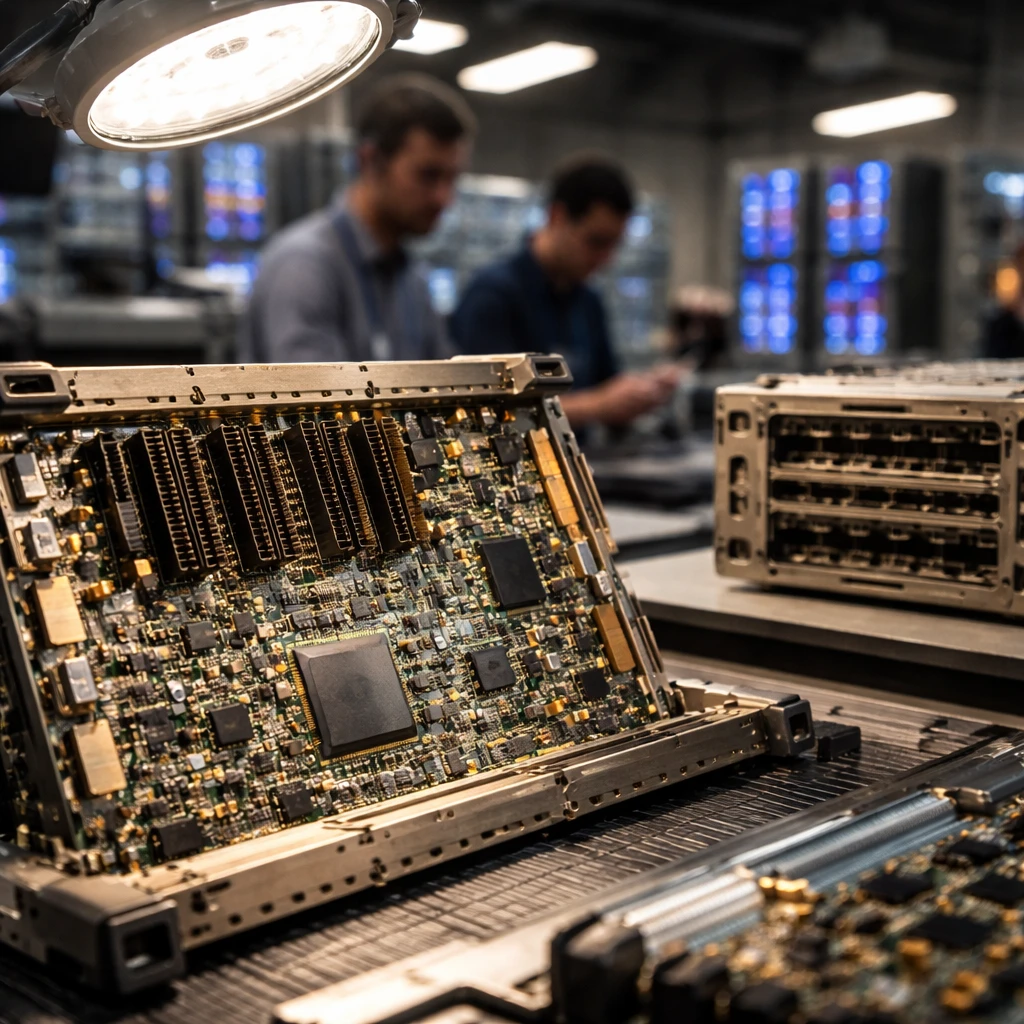
TTM Technologies manufactures printed circuit boards and assemblies, including backplanes, integrated circuit substrates and RF components. The business is split between traditional PCB production and RF & subsystem components used in telecom, test-and-measurement, medical, industrial, aerospace and defense. Those end markets are where the AI and defense growth arguments come together: high-performance computing racks need complex PCBs and backplanes, while mil-aero and COTS defense electronics demand RF and ruggedized subsystem capability.
Why now? A few concrete drivers are worth highlighting:
- AI / data-center demand is material: roughly 36% of sales are attributed to data-center computing and AI customers. That concentration means continued growth in AI infrastructure could directly lift TTMI’s top line and margins.
- Expectations of strong sales growth: investors have noted 19% revenue growth recently and management projects 15-20% sales growth for 2026 — a number that could support current multiples if executed.
- Index inflows and institutional interest: TTMI was promoted to the S&P MidCap 400 in early 2026 (effective 01/30/2026 and 02/02/2026 in staggered actions). Promotions typically create a one-time demand surge as index funds rebalance. Separately, Neo Ivy added roughly $7M in Q4 2025, signaling active institutional accumulation (02/13/2026).
Key fundamentals and valuation framing
Here are the numbers that matter for this idea:
- Current price: $100.75.
- Market cap: ~$10.63 billion.
- P/E: ~59-60. Price-to-sales: ~3.57. EV/EBITDA: ~26.
- Profitability: ROE ~10.07%, ROA ~4.62%; those suggest decent returns on capital but not runaway margins.
- Balance sheet: debt-to-equity ~0.52 and current/quick ratios of ~1.93 and 1.67 respectively; overall liquidity looks reasonable for capital-intensive PCB manufacturing.
- Free cash flow: a small negative figure is reported (~-$683,000), which bears watching if capex or working-capital needs rise with growth.
How to think about valuation: the multiple is elevated versus broad industrials, but TTMI is not a commodity PCB maker — it's a supplier into high-growth, higher-margin pockets (AI data center and defense). If management hits mid-teens top-line growth and can expand operating margins modestly, the P/E can be justified. That said, the P/E and EV/EBITDA imply the market already expects continued expansion and re-rating; the stock is vulnerable to any deceleration or margin pressure.
Technicals and market structure
Momentum indicators are mixed. Short-term moving averages (10/20/50) are bullishly sloped (10-day SMA ~$94.42, 20-day ~$96.26, 50-day ~$84.64) and RSI sits near ~60, reflecting constructive momentum without clear overbought conditions. MACD shows a negative histogram (-1.03), flagging some near-term bearish momentum that could create a pullback opportunity. Short-interest has generally trended down, with settlement data showing ~3.74M shares short as of 01/30/2026 (days-to-cover down to ~1). However, recent short-volume prints indicate active short participation in intraday flows — keep an eye on volatility around earnings and index rebalances.
Catalysts (2-5)
- AI/data-center ordering cycles: continued capex from hyperscalers or an uptick in GPU/accelerator shipments that require advanced PCBs/backplanes.
- Index inclusion effects: S&P MidCap 400 inclusion (effective 01/30/2026 and 02/02/2026) can sustain demand from passive funds and rebalancers in the coming weeks.
- Product wins in RF and mil-aero: securing design wins or production contracts for defense programs can create multi-year revenue streams and justify higher margins.
- Operating leverage: if ramping volume improves factory utilization, management could convert revenue growth to outsized margin expansion.
Trade plan (actionable)
Trade stance: Long TTMI.
Entry price (exact): $100.75 (market entry at the time of publishing). Target price (exact): $115.00. Stop loss (exact): $90.00.
Horizon: long term (180 trading days). Rationale: the thesis depends on multi-quarter revenue growth (15-20% guidance) and the conversion of AI/data-center demand into sustained bookings and margin expansion. That typically plays out over months rather than days, so give the trade up to ~180 trading days for catalysts (product ramps, further institutional buying, results) to materialize. If the stock reaches $115 within that window, lock partial gains and re-evaluate the remaining position based on fresh results.
Position sizing: because valuation is rich, size this trade modestly — this is a tactical allocation within a diversified portfolio. Use the $90 stop to limit downside; at $100.75 entry and $90 stop, risk per share is $10.75. The target at $115 yields $14.25 upside from entry, a roughly 1.3:1 reward-to-risk; consider taking incremental profits at $108 and re-anchoring the stop to breakeven after a 30-35% move.
Risks and counterarguments
- Demand cyclicality: AI and data-center capex can be lumpy. If hyperscaler spend cools, the high revenue concentration to that end market (36%) will amplify downside to TTMI.
- Rich valuation: P/E near 60 and EV/EBITDA ~26 price in continued growth and margin improvement. Any miss in sales or margins risks multiple compression and a fast drawdown.
- Free cash flow and working capital: reported free cash flow is slightly negative (~-$683,000). Rapid growth can increase working-capital needs and capex, pressuring cash conversion if not managed tightly.
- Supply chain and geopolitical exposure: TTMI operates fabrication plants in China and elsewhere; trade friction, tariffs or export restrictions could disrupt revenue, especially for defense-related contracts.
- Short-term volatility from short sellers: active short volume has appeared in recent prints; that can amplify intraday swings and produce sharp pullbacks ahead of catalysts.
Counterargument: One reasonable counterargument is that the market has already priced in the AI upside and index inclusion, leaving little room for upside beyond modest multiple expansion. If growth disappoints or margin expansion stalls, the stock could revert sharply despite favorable end-market trends. In that scenario, the prudent response is to respect the stop and redeploy capital elsewhere.
What would change my mind
I would downgrade this trade (or move to neutral/short) if any of the following occur within the next two quarterly reports:
- Revenue guide materially below the 15-20% management target or visible contraction in data-center bookings.
- Margins compress meaningfully due to higher input costs, poor factory utilization or adverse product mix.
- Free cash flow turns materially negative and management signals persistent working-capital pressure tied to growth.
- Loss of a major customer, or regulatory/geopolitical actions that impede production in key facilities.
Conclusion
TTM Technologies offers a concentrated way to play the AI hardware cycle and defense electronics: meaningful exposure to data-center compute (+36% of sales), a clearer revenue growth outlook (management projecting 15-20% in 2026), and near-term support from index inclusion and institutional buying. Those positives are balanced against a demanding valuation, mixed near-term technicals and real execution risks around cash conversion and margin expansion.
For traders who accept those trade-offs, a disciplined, risk-managed long entry at $100.75 with a $90 stop and a $115 target across a long-term horizon (180 trading days) is a reasonable way to participate. Keep position sizes modest, watch upcoming order and margin commentary closely, and be prepared to tighten the stop or exit should revenue or margin guidance disappoint.