
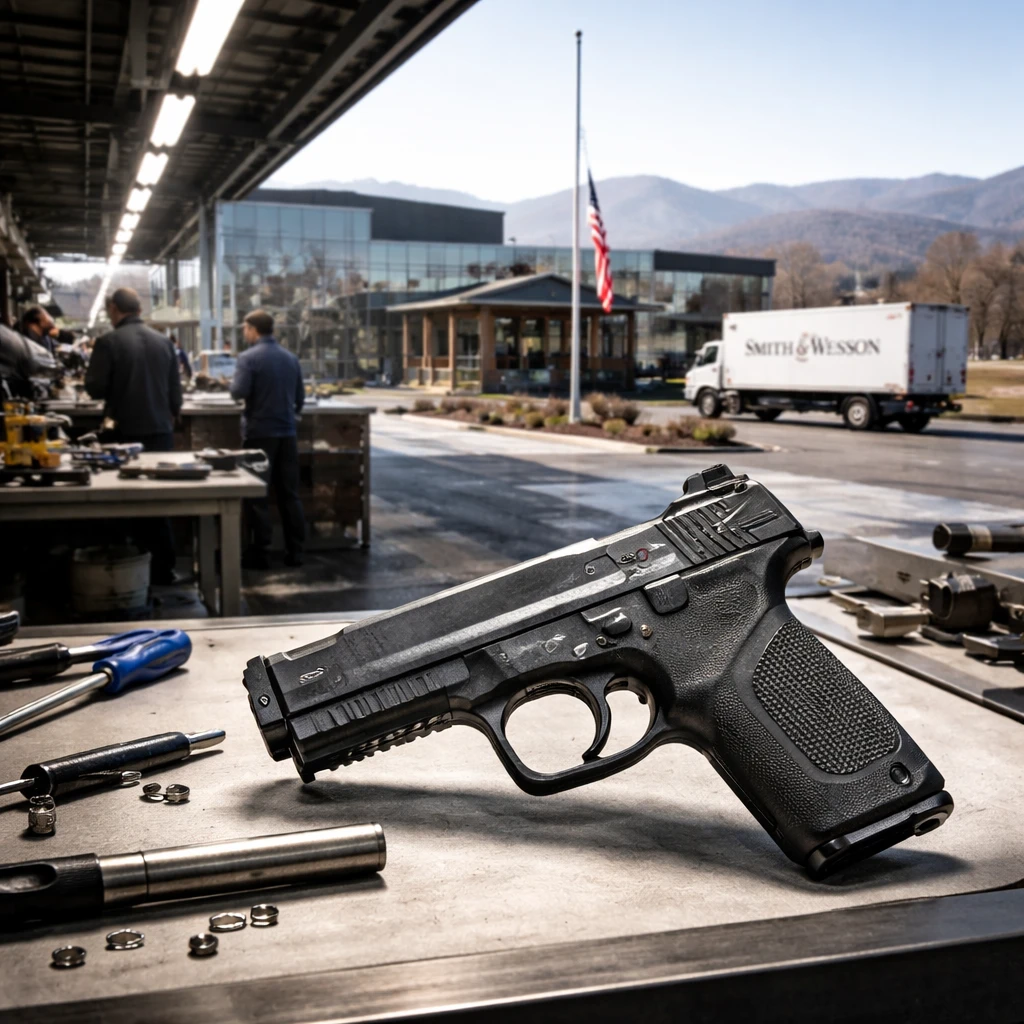
Hook & thesis
Smith & Wesson (SWBI) is a pragmatic trade right now: the company completed its relocation and reorganization, free cash flow has returned, and the balance sheet looks manageable. The market cap sits around $527M and management has shown the business can generate non-trivial free cash flow - $21.3M most recently - even through a soft top-line patch. Those two facts alone change the risk profile versus the high-volatility era when production and logistics were the primary hurdles.
My tactical stance: take a controlled long at the current price with an explicit stop. The combination of a healthy dividend yield (4.43%), improving operational cadence, and product/training initiatives gives an asymmetric payoff if demand stabilizes and margins normalize.
What Smith & Wesson actually does and why the market should care
Smith & Wesson Brands, Inc. is a legacy firearms and accessories manufacturer with brands including Smith & Wesson, M&P, Thompson/Center Arms and Gemtech. The company's product mix spans handguns, long guns, suppressors and ancillary law-enforcement products. For investors, two things matter: the cyclical nature of civilian firearm demand and the ability to convert revenue into free cash flow.
The market cares because the firearms sector has demonstrated both episodic demand spikes and long stretches of normalization. A company that can consistently return cash to shareholders and show margin resilience will trade differently than one that only benefits from episodic demand. Smith & Wesson, at its current free cash flow of $21.3M and an enterprise value of roughly $621M, now looks like a cash-generative niche industrial with payout potential and upside if product cycles accelerate.
Supporting data points
- Current price: $11.855, 52-week high: $12.05, 52-week low: $7.73.
- Market cap: $527M; enterprise value: $621M.
- Recent results: Q1 fiscal 2026 net sales were $85.1M (a 3.7% decline year-over-year) with continued strength in handgun shipments and new product activity reported on 09/05/2025.
- Free cash flow: $21.3M (most recently reported). Price to free cash flow: ~24.5x; price to cash flow: ~10.4x.
- Balance sheet and coverage: debt to equity ~0.34, cash per share metric shown in filings is small but net leverage is moderate. Dividend yield: 4.43% with ex-dividend date 12/18/2025 and payable date 01/02/2026.
- Valuation context: P/E ~52.8x on EPS of $0.22; price-to-sales ~1.12x, EV/sales ~1.33x. High P/E reflects compressed earnings and noisy demand; the cash flow metrics provide a better anchor.
Why now? The relocation tailwind and cash conversion
Management has indicated the relocation and facility move are complete, which removes a recurring operational headwind that pressured throughput and margins. That matters materially: when a capital-intensive manufacturer finishes a move, two things typically happen - production becomes more reliable and one-time costs fade from the income statement. Smith & Wesson is showing that pattern: sales were soft in Q1 2026 at $85.1M (reported 09/05/2025), but the company is shipping handguns and bringing new products and training assets online, such as a newly launched training academy in Tennessee.
Free cash flow of $21.3M is concrete evidence that the company is converting sales into cash. Even if revenue growth is choppy, the ability to generate cash supports the dividend, capital allocation optionality and lowers the probability of balance-sheet distress.
Valuation framing
At a market cap near $527M and enterprise value of about $621M, Smith & Wesson is not a large-cap growth story; it's a small-cap industrial with meaningful cash generation. EV/sales of 1.33x and price-to-sales of 1.12x sit in a middle ground: not dirt-cheap but attractive if cash flow stabilizes and margins recover modestly. The headline P/E of ~52.8x looks high but is distorted by transient margin compression and low trailing EPS ($0.22). Investors valuing the business should focus on cash-flow multiples and the dividend yield as a form of yield support while waiting for improved top-line visibility.
Trade plan - actionable specifics
Entry: $11.85
Stop loss: $10.80
Target: $15.50
Direction: Long
Horizon: long term (180 trading days) - expect the trade to last roughly six months to give time for product rollouts, seasonal demand improvements, and evidence of consistent quarter-to-quarter margin recovery.
Rationale: Entry near the current price provides entry at the consolidation area above the 50-day moving average ($10.81). The stop at $10.80 is technically and structurally meaningful - a break below that level would suggest the recent improvement is not holding and that downside risk could accelerate toward the low end of the range. Target $15.50 reflects priced-in improvement in margins and a recovery in earnings and multiple expansion off depressed EPS; it implies roughly 31% upside from the entry.
Risk/reward and sizing guide
From $11.85 to $15.50 is about +31%; downside to $10.80 is about -8.9%. This asymmetry is attractive for a disciplined sizing plan. Given the company's mid-cap scale and sector volatility, size the position modestly (for example 1-3% of portfolio initially) and build on evidence of margin improvement or stronger-than-expected shipments.
Catalysts to watch (2-5)
- Quarterly results showing margin stabilization and sequential revenue improvement - next reports and conference commentary.
- New product ramp and consistent handgun shipment growth per quarter.
- Training academy commercialization and recurring revenue/adjacent services ramp.
- Any buyback or dividend increases that signal capital allocation confidence.
- Macroeconomic or regulatory developments that either boost civilian demand or constrain it.
Risks and counterarguments
Every trade has risks. Below are the main ones, plus a counterargument to the bullish thesis.
- Regulatory risk: Changes in federal or state firearm regulations could materially reduce civilian demand and pressure sales and margins.
- Legal and governance risk: There is active litigation interest; public reports in early 2025 prompted a shareholder-side investigation into board actions. That could lead to distractions, settlement costs or governance overhang.
- Demand cyclicality: Civilian firearms demand is inherently lumpy. Q1 fiscal 2026 sales declined 3.7% year-over-year to $85.1M, and a sustained weak cycle could compress earnings further.
- Valuation sensitivity: Trailing P/E of ~52.8x is high; if earnings remain suppressed, the multiple could re-rate lower even if cash flow is positive, compressing the stock.
- Execution risk: If the benefits from the relocation fail to materialize in higher margins or if new product launches miss expectations, the thesis breaks down.
Counterargument - The skeptic's view is straightforward: even with relocation done, the underlying demand environment remains uncertain and margin recovery is not guaranteed. If sales remain pressured and EPS stays low, the market can and will apply a lower multiple. That leads to downside even with steady cash flow, because the market prizes earnings momentum and predictable growth for small-cap industrial names.
What would change my mind
I will reconsider this long thesis if one of the following happens:
- Consecutive quarters of declining free cash flow or a meaningful downward revision to guidance that indicates the relocation benefits were temporary.
- Material adverse legal outcomes or a settlement that materially reduces free cash flow or forces cash-funded restructuring.
- Evidence of sharp demand deterioration across core handgun categories that is not cyclical but structural.
Conclusion
Smith & Wesson is a tactical long based on the combination of completed relocation, returned free cash flow, and an attractive dividend yield that supports downside while waiting for operational improvements. At a market cap near $527M and free cash flow of $21.3M, the stock is better risk-managed than during past operational upheavals. The trade uses a clear entry ($11.85), stop ($10.80) and target ($15.50) with a 180 trading-day horizon to allow time for catalyzing results. Size the position conservatively and watch the next couple of quarters for evidence that margins and shipments are trending in the right direction.
| Metric | Value |
|---|---|
| Current price | $11.855 |
| Market cap | $527M |
| Enterprise value | $621M |
| Free cash flow (most recent) | $21.3M |
| Price / Earnings | ~52.8x |
| Dividend yield | 4.43% |
Bottom line: Smith & Wesson is a measured, tactical long. The relocation is behind the company and cash flow is back - that combination warrants a small, disciplined position with a defined stop and a half-year timeframe to allow fundamentals to play out.