
Hook / Thesis
Shake Shack (SHAK) is not a broken story — it is a profitable, growing quick-service restaurant chain that the market priced for perfection in 2025 and then re-rated. Today the stock sits in the low $90s, offering an actionable buying opportunity for traders who accept a mid-term horizon and strict risk controls. The setup: durable cash generation, a sensible enterprise value relative to sales, and a technical base that has room to run if catalysts arrive.
My trade thesis: buy near $94 with a tight stop at $84 and a target of $120 over a mid-term horizon (45 trading days). The trade captures a rebound if operational momentum or sentiment improves and limits downside exposure if the broader consumer environment or company-specific headwinds persist.
What Shake Shack does and why the market should care
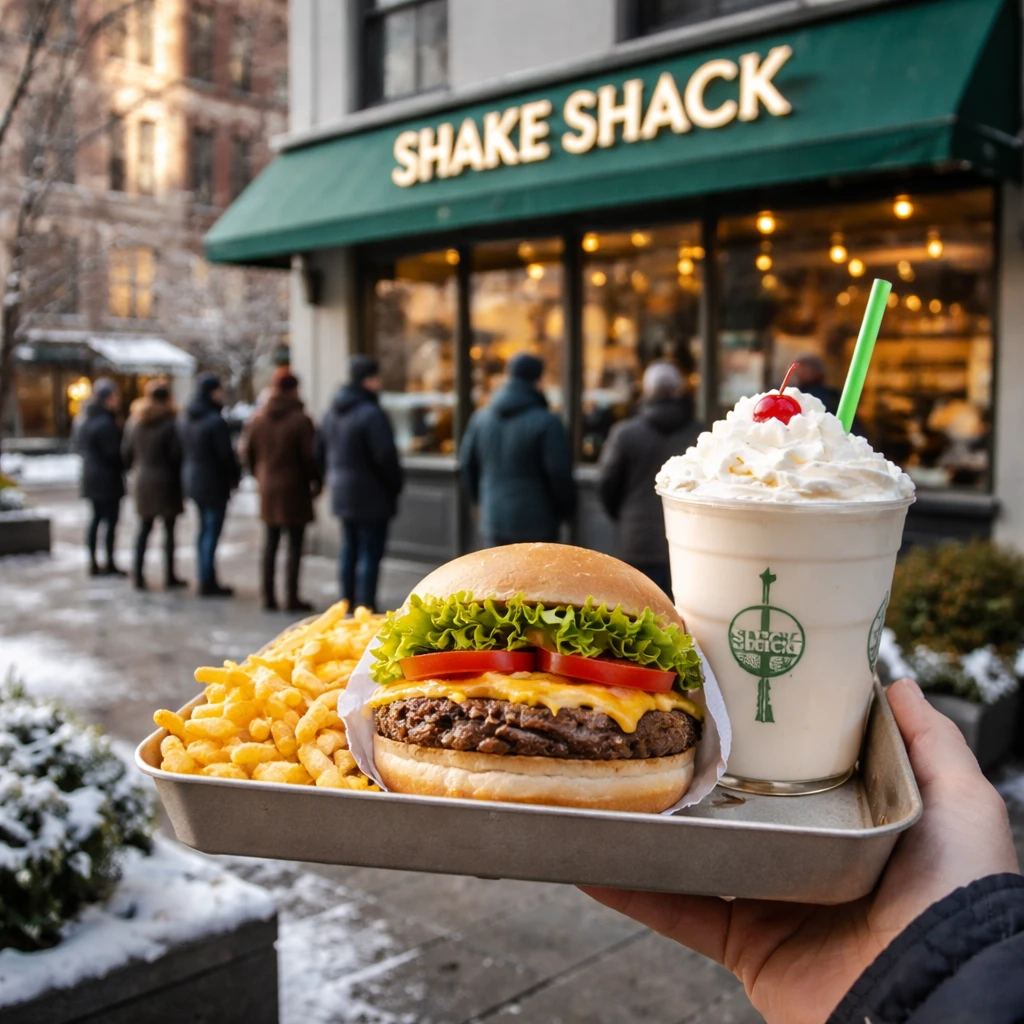
Shake Shack operates and licenses restaurants that sell burgers, hot dogs, crinkle-cut fries, shakes, frozen custard, beer and wine. It has scaled into a recognizable premium fast-casual brand with steady expansion opportunity across the United States and internationally. For investors, the key attractions are: unit-level economics that can drive margin expansion as new stores mature, free cash flow generation, and a brand that can capture spending from consumers favoring convenience and quality.
Why now? The stock is roughly 35% below its 52-week high of $144.65 (07/10/2025) but comfortably above its 52-week low of $72.93 (04/07/2025). At the current price of $94.37 the technical picture is mixed but improving: the 10-day simple moving average is $90.80 and the 20-day SMA is $93.53, so price is testing short-term resistance while the 50-day SMA sits lower at $87.48. Momentum indicators are not overbought (RSI ~58) but MACD shows recent bearish momentum, suggesting the stock needs a catalyst to re-accelerate.
Key numbers that matter
| Metric | Value |
|---|---|
| Last price | $94.37 |
| Market cap | $4.21B |
| Enterprise value | $3.66B |
| P/E | ~88.5 |
| Price / Sales | 2.75 |
| Free cash flow (most recent) | $62.9M |
| Average daily volume (30d) | ~1.57M |
| Float | ~38.35M shares |
| Short interest (01/15/2026) | ~5.98M shares - days to cover ~3.3 |
Valuation framing
The stock looks expensive on an earnings multiple (P/E ~88.5), reflecting high expectations for margin expansion and continued same-store sales growth. On other fronts the picture is less demanding: price-to-sales is 2.75 and enterprise value to sales is 2.66, which is reasonable for a differentiated premium quick-service operator with unit growth optionality. Free cash flow of $62.9M versus a market cap of $4.21B implies a FCF yield near 1.5% today, so the market is pricing significant growth or re-rating to justify current multiples. If Shake Shack can re-accelerate sales and margin recovery, the stock can re-rate toward higher EV multiples; if not, the earnings multiple will remain stretched.
Supporting operational context
Shake Shack has proven it can monetize a strong brand: it consistently generates positive free cash flow and maintains healthy liquidity (current ratio ~1.84 and quick ratio ~1.81). Debt levels are moderate with a debt-to-equity ratio near 0.49. Those balance-sheet metrics give management flexibility to invest in store development and drive returns. The market’s biggest gripe is valuation relative to near-term earnings — reflected in the high P/E — and sensitivity to consumer spending shifts.
Technical backdrop
Short-term technicals show a stock consolidating after a run higher in 2025. Price sits above the 10-day and 20-day SMA, and the 50-day SMA is below current price, which supports a constructive technical case if momentum flips positive. However MACD histogram is slightly negative and there is elevated short activity: recent daily short volume has been a material portion of total volume, signaling tangible bearish interest. That’s why a disciplined stop is essential for this trade.
Catalysts to push SHA K higher (2-5)
- Quarterly results that beat consensus on same-store sales and margin expansion - a direct re-rating trigger given current expectations priced into earnings.
- Management commentary that accelerates unit development guidance or improves visibility into unit-level margins.
- Macro tailwinds in consumer discretionary spending or a rotation back into growth stocks that lifts premium QSR names.
- High-profile investor interest or insider buying that signals confidence in longer-term growth.
Trade plan (actionable)
Entry: Buy at $94.00. The entry is within cents of the current price and offers a clear risk/reward profile versus the stop and target below.
Stop: $84.00 - a defined level below the 50-day SMA ($87.48) and recent intraday support. If price breaks and holds below $84, it suggests the consolidation has failed and downside can extend toward the recent low.
Target: $120.00. This target is realistic for a mid-term recovery and sits well below the 52-week high of $144.65, giving room for multiple re-rating plus some operational improvement.
Horizon: mid term (45 trading days). I expect the move to play out within the next 45 trading days if a near-term catalyst (earnings beat, guidance bump, or improvement in consumer data) arrives. If the catalyst is delayed but the stock stabilizes and fundamentals improve, I would consider holding into a long-term opportunity (180 trading days) but would tighten risk management and re-assess at interim checkpoints.
Position sizing & risk: Limit allocation to a portion of trading capital that permits a loss to the stop without exceeding your risk tolerance (e.g., risk no more than 1-2% of total portfolio value on this single trade). Use the stop at $84 — do not move it wider unless you add to the position with clear fresh conviction.
Risks (balanced, at least 4)
- Macroeconomic slowdown or a pullback in discretionary spending that hits same-store sales and margins.
- Valuation risk: P/E near 90 requires continued growth; any earnings miss would likely trigger a sharp multiple contraction.
- Sentiment risk from high short interest and elevated short-volume days — this can amplify volatility and pressure price in the near term.
- Execution risk: expansion missteps, higher labor or input costs, or weaker-than-expected unit economics would pressure margins and FCF generation.
- Event risk: large holders selling (noted liquidation by an institutional holder in late 2025) could weigh on price if similar moves reoccur.
Counterargument to the trade thesis
One reasonable counterargument: the stock is priced for perfection on growth and margin expansion and the company’s free cash flow is modest versus market cap, leaving little margin for error. If management cannot sustain revenue growth or margins compress due to macro pressure, the P/E multiple could contract sharply and the stock could revisit recent lows. That outcome would invalidate the trade, which is why the stop at $84 is non-negotiable for this plan.
What would change my mind
I would abandon the bullish mid-term stance if Shake Shack reports a material earnings or comparable-store sales miss, raises guidance conservatively, or if price convincingly breaks below $84 on high volume. Conversely, I would grow more bullish if the company posts consecutive quarters of margin expansion, early returns on new-unit economics improve materially, or if a significant re-acceleration in same-store sales appears.
Conclusion - Clear stance
This is a tactical, medium-risk buy-the-dip trade with clearly defined upside and downside. The reward here is a re-rating and recovery toward $120 if Shake Shack delivers incremental operational beats or broader sentiment turns positive for premium QSR names. The principal danger is a high-PE valuation with modest current free cash flow relative to market cap; for that reason, strict stops and prudent sizing are essential. Buy at $94.00, stop at $84.00, target $120.00, and re-evaluate progress inside the 45 trading day horizon.
Note: Track short interest and daily short-volume readings closely. Elevated short activity can create sharp intraday moves; keep stops in place and avoid adding into clear technical breakdowns.