
Hook / Thesis
Toast is getting punished as the sell-off in software broadens: the stock hit an intraday low of $24.99 and trades well below its 50-day and 20-day averages. That drop is noisy market action, not a change in the underlying unit economics. I am reiterating my buy rating because Toast is not a one-off SaaS utility; it is a vertically oriented operating system for restaurants with high switching costs, steady free cash flow, and enough liquidity to ride out a cyclical pullback.
Measured on cash generation and balance-sheet strength, Toast looks attractive here. The company reported $608 million of free cash flow last reported, carries roughly $1.4 billion in cash on the balance sheet, and shows conservative leverage metrics. Those are the anchors that matter as investors reset multiples across the software sector.
What Toast does and why the market should care
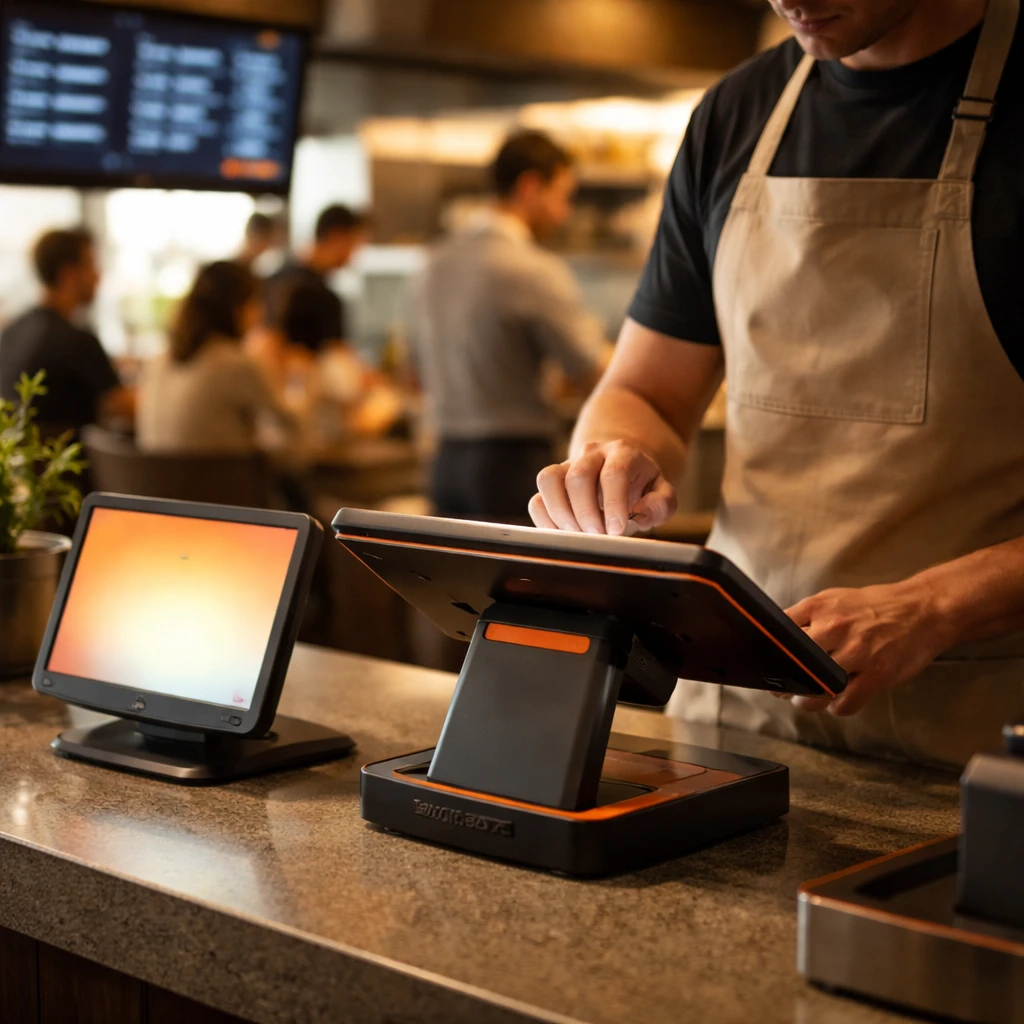
Toast builds point-of-sale hardware and an integrated software stack for restaurants: terminals, guest-facing displays, kiosks, kitchen display systems, online ordering, delivery integrations, reporting and analytics, and payments. In practical terms Toast is a restaurant OS: it collects transaction data, directs kitchen workflows, drives payments and back-office analytics. That vertical focus creates stickiness—multi-location operators standardize on the platform to consolidate menu management, reporting, and payments.
Why the market should care: restaurants are still a large addressable market, and improving efficiency there directly improves margins and throughput for operators. When a chain consolidates to Toast for ordering, POS, and payments, it raises the cost of switching. That combination of recurring software revenue plus payments and hardware services makes Toast less exposed to being swapped out overnight by point solutions.
Key fundamentals and valuation framing
Here are the concrete numbers that matter right now: market capitalization is about $14.8 billion and enterprise value is roughly $14.59 billion. Free cash flow sits at $608 million and cash of $1.4 billion gives Toast healthy liquidity. Profitability metrics show a return on equity of about 16.1% and return on assets near 10.9%, which is uncommon for a fast-growing SaaS that also sells hardware and payments.
Put another way, EV/FCF is in the mid-20s (enterprise value divided by last reported free cash flow), EV/Sales is roughly 2.37, price-to-sales sits near 2.6, and trailing price-to-earnings is near the high 40s. Those multiples reflect growth expectations baked into the stock. The key here is that you are paying a premium to growth but receiving substantial cash generation and recurring revenue from an embedded industry solution.
Technically, the stock is at a stress point: the 52-week high was $49.66 and today's low is $24.99, a large range that gives upside if operations continue to execute. Momentum indicators are signaling oversold conditions (RSI around 29.5), and the shorter EMAs sit above price, which often means mean reversion is possible if the company avoids disappointments.
Support for the thesis - numbers and recent trends
- Free cash flow: $608 million - a tangible cash-generation engine that gives optionality.
- Cash on hand: $1.4 billion - provides cushion for downturns and strategic investments.
- Liquidity: current ratio ~2.75 and quick ratio ~2.64 - comfortable short-term coverage.
- Shares/outstanding and float: roughly 590 million shares outstanding with a float around 482 million shares, and average two-week volume in the high single-digit millions - sufficient trading liquidity for institutional flows.
Catalysts that could re-rate the stock
- Better-than-feared guidance or an earnings beat that shows sustained margin improvement and continued free cash flow growth.
- Large rollouts or multi-brand conversions (enterprise wins) where Toast becomes the standard across regional or national chains.
- Improved monetization within the installed base - upsell of loyalty, payroll, or marketing modules increasing ARR per customer.
- Strategic partnerships or integrations that lock in distribution (examples: voice or AI partners that improve in-venue efficiency and reduce friction for operators).
Trade plan - actionable and time-bound
My actionable trade: initiate a long position at an entry price of $25.00. Place a stop loss at $22.50 to protect capital if the price breaks meaningfully below the current low. Target price: $40.00 over a long-term (180 trading days) horizon. That time horizon allows the company to report another quarter or two of performance, show continued FCF conversion, and for the market to re-rate mission-critical vertical SaaS relative to generalist SaaS names.
Why this duration: short-term headline risk is still active in software markets and could cause further volatility in the next few weeks. A 180 trading day view gives the trade room for operational news and macro normalization to impact sentiment. If you prefer a quicker swing, consider a mid-term plan of 45 trading days with a nearer-term target around $32 to capture mean reversion toward the 50-day SMA, but the primary plan assumes the longer window for fundamental progress to show through in the P&L or guidance.
Position sizing and risk framing
This is a medium-risk trade. The stop is tight enough to limit drawdown but wide enough to avoid getting shaken out by intraday noise. Given the shares outstanding and average volume, scale in incrementally rather than deploying the full intended allocation at once; use cost averaging between $25.00 and $24.00 if liquidity is favorable. Short interest and recent short-volume suggest the stock carries both conviction shorts and potential squeeze dynamics; that can amplify moves in either direction.
Risks and counterarguments
Below are material risks that could invalidate the thesis, plus a direct counterargument.
- AI and consolidation risk: New AI-driven platform entrants or incumbents bundling point solutions could, over time, displace single-function features in Toast's stack. If an end-to-end tech firm offers cheaper integrated payments and POS with comparable reliability, customers could re-evaluate. This is the core argument behind the recent "SaaS" drawdown in the sector on 02/11/2026 when broad AI tooling announcements triggered a rotation.
- Macro and restaurant weakness: Restaurants are sensitive to consumer spending. A slowdown in consumer dining frequency or a squeeze on margins could reduce new device orders and software uptake, pressuring revenue growth.
- Payments margin compression: Payments are a meaningful revenue stream. Competitive pressure or interchange/regulatory changes that compress take rates would hit both revenue and margins.
- Execution and churn risk: If Toast fails to keep churn low in its core base or stumbles on large enterprise rollouts, the revenue growth underpinning current multiples could roll over.
- Valuation multiple re-rating: The stock carries SaaS-type multiples (P/E in the high 40s, EV/EBITDA north of 30); if the market demands higher margin visibility and Toast cannot deliver, multiples could compress further.
Counterargument: It is reasonable to argue that Toast is not immune to the structural software reset: giant cloud and AI players could embed payment and ordering features into broader offerings, and restaurateurs may prefer best-of-breed point solutions stitched together. If that happens faster than Toast can deepen its integration and increase per-location monetization, the business could underperform expectations. Put simply, the market is pricing growth, not cash generation alone.
What would change my mind
I would downgrade or move to neutral if Toast reports a quarter with materially higher churn, slower net new locations, or a significant drop in free cash flow conversion. Conversely, sustained FCF growth above the current run-rate, a clear path to margin expansion, or a series of enterprise wins would reinforce the buy thesis and justify higher targets. A regulatory change materially altering payments economics would also force a reassessment.
Conclusion
Toast is an out-of-favor, cash-generating vertical SaaS that is entering oversold technical territory. The company has real cash flow, a strong liquidity position, and a product that, in practical terms, acts as an operating system for restaurants. Those qualities make it a reasonable defensive growth pick inside a struggling software group. The trade is explicit: enter at $25.00, stop at $22.50, target $40.00 across a long-term (180 trading days) horizon, with incremental sizing and disciplined stops to manage headline-driven volatility.
Quick reference trade grid
| Action | Price | Horizon |
|---|---|---|
| Entry | $25.00 | Long-term (180 trading days) |
| Stop Loss | $22.50 | |
| Target | $40.00 |