
Hook & thesis
Lamb Weston (LW) is a beaten mid-cap that looks priced for more downside than fundamentals support. The stock trades around $45.03 after a year that included an ERP rollout that temporarily shaved roughly $135 million from sales, customer concessions, and a pullback in quick-service restaurant volumes. Those are real problems, but the company's underlying cash generation and valuation set up a trade: buy now with a defined stop while watching operational fixes and order flow.
My thesis is simple: Lamb Weston should re-rate higher as the ERP issues are resolved, order fulfillment normalizes, and pricing / customer negotiations shift from concession mode back to normal pricing. The company generates strong free cash flow — $648.2 million by the latest figures — and is trading at a P/FCF of roughly 9.8 and an EV/EBITDA around 9.4. Those numbers support a mid-term (45 trading days) long trade with limited downside versus attractive upside if catalysts align.
What the company does and why the market should care
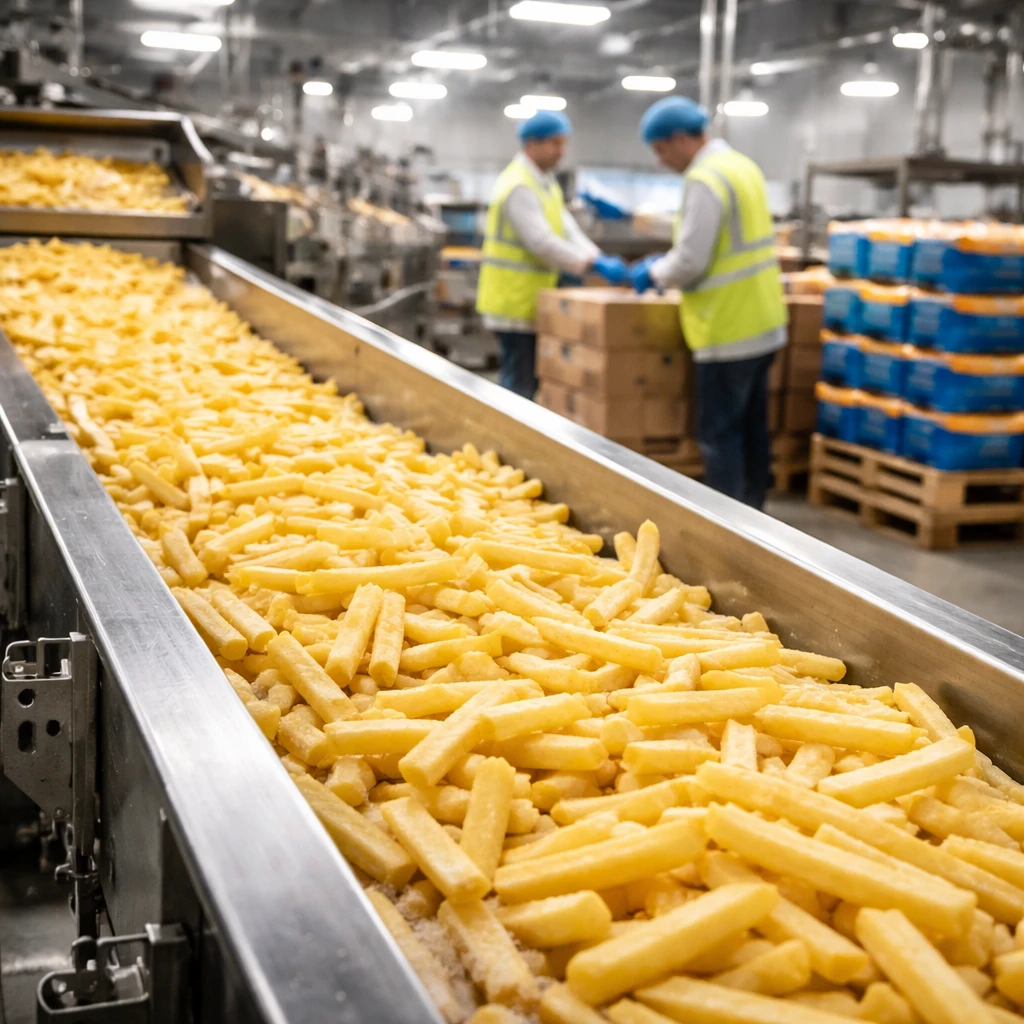
Lamb Weston is a global producer, distributor and marketer of value-added frozen potato products. The North America segment supplies quick-service and full-service restaurants, distributors, retailers and non-commercial channels. Essentially, LW's fortunes are tied to restaurant traffic, QSR volume and the company's ability to reliably fill large, recurring customer orders.
The market should care because Lamb Weston sits at the intersection of three investor-friendly attributes: predictable foodservice demand over time, strong cash generation, and a 3.24% dividend yield that cushions downside. When operational execution is fixed and customers are confident in supply continuity, the business is relatively defensive with pricing levers and scale advantages. Right now the company is under pressure, creating a tactical entry opportunity.
Supporting data points
- Share price: $45.03 (current).
- Market capitalization: approximately $6.25 billion.
- Enterprise value: about $10.21 billion, implying EV/sales ~1.58 and EV/EBITDA ~9.39.
- Earnings per share: $2.82, with a P/E near 16.5.
- Free cash flow: $648.2 million; price-to-free-cash-flow roughly 9.84.
- Dividend yield: ~3.24% and a history of returning cash to shareholders.
- Leverage is meaningful: debt-to-equity ~2.23, current ratio ~1.43 and quick ratio ~0.64.
- Technicals: short-term momentum is improving (MACD histogram turning positive), RSI about 47 — not overbought — and price sits near the 10/20-day moving averages but below the 50-day, signaling a useful risk/reward zone for entry.
Valuation framing
At roughly $6.25 billion market cap and EV ~$10.2 billion, valuation looks reasonable for a company with strong cash flow. The P/FCF of ~9.8 and EV/EBITDA of 9.4 imply the market is pricing in either continued margin pressure or additional execution risk. Put another way: investors are demanding a cheap multiple to compensate for a temporary operational issue and demand headwinds from the QSR channel.
Historically, mid-cap food processors and suppliers trade in the mid-to-high single digits on EV/EBITDA when growth is muted. Given Lamb Weston's free cash flow profile and a dividend yield above 3%, the current multiple leaves room for upside if margins recover modestly and sales lost to ERP issues are recaptured.
Trade plan (actionable)
Entry: buy at $45.03 (current price).
Stop loss: $39.50 — this is below the recent 52-week low area and limits downside if order-flow problems persist.
Target: $55.00 — a mid-term target that assumes a rebound in customer orders and sentiment-driven re-rating over the next 45 trading days.
This is a mid-term trade: hold for up to 45 trading days (mid term - 45 trading days). The thesis relies on tangible operational improvements (order fill rates and fewer customer concessions) and positive quarterly messages or early signs of margin stabilization. If LW posts renewed evidence of order fulfillment or guided a return of lost sales, the stock should move toward the $55 level. If those signs fail to appear and ERP fallout or legal overhangs escalate, the stop at $39.50 protects capital.
Catalysts to monitor
- Quarterly results and management commentary showing recovery in order fill rates and sales lost to the ERP rollout being recaptured.
- Evidence of margin stabilization or pricing normalization from large QSR customers.
- Reduction in legal overhang or a clear timeline/resolution around the class-action and related investigations (news items in mid-2025 referenced a $135M net sales impact).
- Continued strong free cash flow generation or a board action on buybacks/dividend increases (cash generation is already healthy at $648.2M FCF).
- Any commentary from major customers about restored confidence in supply continuity.
Key metrics snapshot
| Metric | Value |
|---|---|
| Price | $45.03 |
| Market cap | $6.25B |
| Enterprise value | $10.21B |
| P/E | ~16.5x |
| EV/EBITDA | ~9.4x |
| P/FCF | ~9.8x |
| Dividend yield | ~3.24% |
Risks and counterarguments
Any trade in Lamb Weston carries identifiable execution and cyclical risks. Below are the principal negatives to weigh:
- Ongoing ERP and execution issues: Management acknowledged material disruption from a prior ERP implementation that impacted ~$135 million of net sales. If fulfillment problems persist or additional systems issues arise, revenue and customer confidence could deteriorate further.
- Customer pricing pressure and concessions: Large QSR customers can demand concessions after supply disruptions. If concessions persist or expand, margins could be permanently impaired, lowering free cash flow.
- High leverage: Debt-to-equity is about 2.23 and enterprise value is roughly $10.2 billion. A prolonged sales/margin slump would stress liquidity and limit strategic optionality.
- Legal and reputational overhang: Multiple news items in mid-2025 flagged investigations and potential claims related to the ERP rollout. Litigation outcomes are uncertain and could produce headline risk or settlement costs.
- Macroeconomic sensitivity: A deeper slowdown in restaurant traffic, especially at big QSR chains, would reduce volumes and hurt Lamb Weston disproportionately because foodservice is a large part of sales.
Counterargument
A reasonable counterpoint is that the market's discount correctly prices persistent structural damage: if Lamb Weston loses long-term share to co-packers or customers permanently change supply strategies after the disruption, recovery could be limited. In that scenario, multiple compression would persist and the company might need to invest more to rebuild trust, compressing free cash flow and returns.
Conclusion and what would change my mind
Recommendation: Initiate a long trade at $45.03 with a stop at $39.50 and a target of $55.00 over a mid-term horizon (45 trading days). The risk/reward is attractive given a P/FCF near 9.8, EV/EBITDA at 9.4, robust free cash flow generation ($648.2M), and a dividend yield of ~3.24% that provides carry while the turnaround unfolds.
I will change my view if any of the following occur: 1) management confirms that ERP-related sales losses are larger or more persistent than previously disclosed; 2) major customers announce long-term sourcing changes away from Lamb Weston; or 3) a near-term earnings print shows margin deterioration and negative free cash flow. Conversely, signs that order fill rates are normalizing, reduced legal overhang, or a quarter with cash flow expansion would strengthen the bullish case and warrant tightening the stop or adding to the position.
Trade checklist: buy at $45.03, stop $39.50, target $55.00, horizon mid term (45 trading days). Monitor order fulfillment, customer commentary, cash flow, and legal developments closely.
Note: This is an actionable trade idea based on operational recovery and valuation. Keep position size commensurate with the company-specific risk profile.