
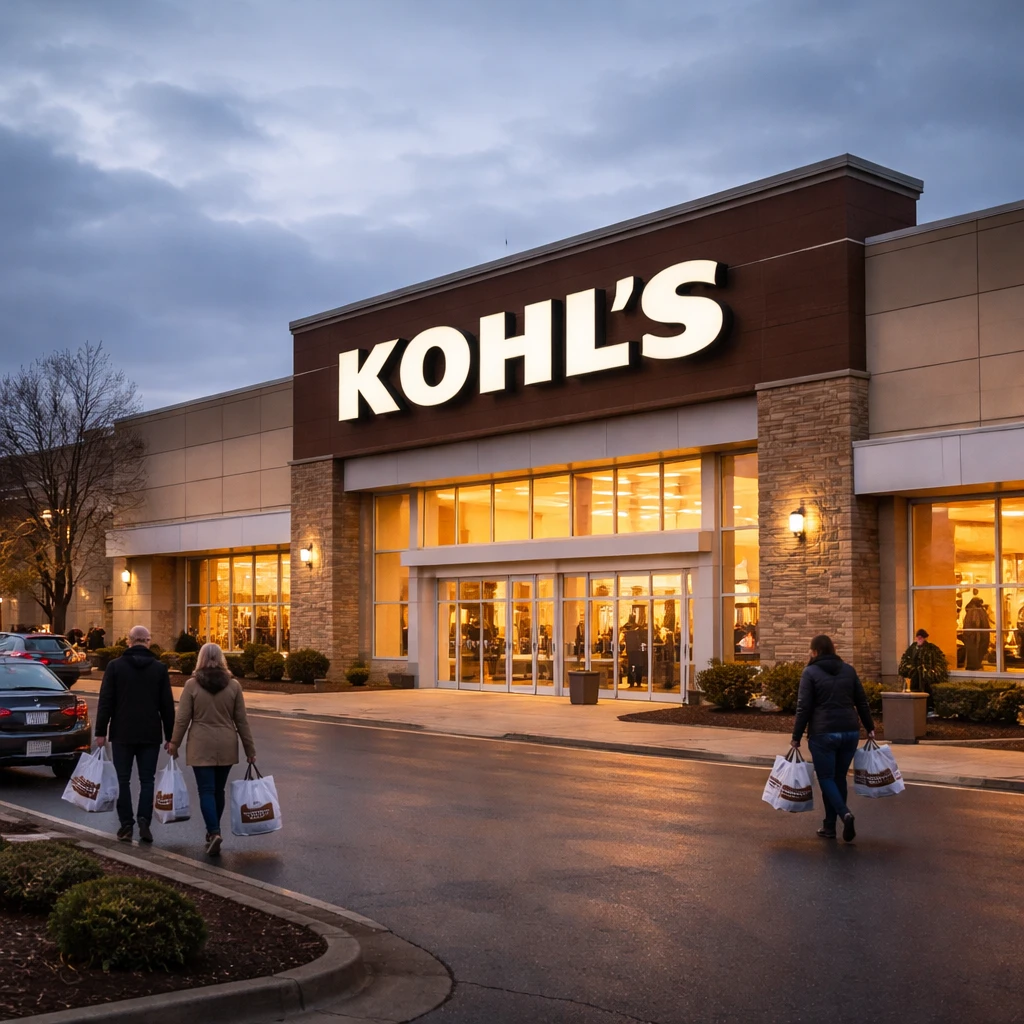
Hook and thesis
Kohl's has been a volatile story: a 64% rally in 2025 on momentum and headlines, followed by fresh skepticism around sales and margins. The datapoint that matters for the next few months is that comparable-store sales decline slowed in 2025, giving management breathing room to execute inventory and margin fixes. At current levels - the stock is trading around $17.57 - the market is pricing in a lot of downside. That creates a tactical, mid-term long opportunity: if comps stabilize and cost actions continue to flow through, the valuation gap should compress quickly, aided by high short interest and active trading volume.
My trade thesis: buy a cautious position now for a mid-term swing (about 45 trading days). Targets are based on mean reversion toward prior trading levels and conservative multiple expansion. The trade is not a long-term fundamental endorsement of Kohl's competitive positioning versus big-box and e-commerce rivals; it's a time-limited bet on stabilization + rerating.
What Kohl's does and why the market should care
Kohl's operates family-oriented department stores selling apparel, footwear, beauty and home goods. The retailer's topline is driven by traffic, average ticket and inventory discipline; margin recovery depends on selling-through seasonal merchandise and trimming promotional leakage. Investors care because department stores are mature businesses where small improvements in same-store sales and inventory turns can produce outsized earnings leverage. At the current market cap of roughly $1.97 billion, the stock already reflects significant near-term risk, so any credible sign of stabilization can create rapid upside.
Supporting data points
- Market snapshot: current price roughly $17.57, market cap ~$1.97B, shares outstanding ~112.19M and float ~107.88M.
- Valuation: price-to-earnings about 10-10.8x (reported P/E ~10.15 to 10.85) and price-to-book near 0.5. Enterprise-value-to-EBITDA is ~4.85x.
- Cash generation: reported free cash flow sits at approximately $819M, a meaningful number versus the market cap.
- Balance-sheet and liquidity: debt-to-equity is roughly 1.03 and current ratio ~1.3. Quick ratio is weak (~0.12), and reported cash is small relative to liabilities.
- Technical and flows: 10-day SMA is $17.74 and 50-day SMA is $20.72; RSI ~40.9 suggests the stock is not overbought; MACD histogram shows a small bullish reading. Short interest has been elevated with ~29.1M shares short as of 01/15/2026 and days-to-cover north of 7, keeping the stock sensitive to short-covering rallies.
- Trading context: 52-week range is $6.04 (low on 04/04/2025) to $25.22 (high on 12/01/2025), signaling wide intrayear swings and scope for a mean-reversion move if sentiment improves.
Valuation framing
Kohl's sits at steeply discounted multiples: P/B ~0.5 and EV/EBITDA ~4.85x are both materially below what mature retailers trade at during stabilization phases. The market cap of ~$1.97B compared to reported free cash flow ($819M) implies the company can generate significant cash relative to its valuation in a benign scenario. Those multiples imply that the market expects further earnings deterioration or heavy balance-sheet pressure. If comparable-store sales continue to stabilize and margins recover modestly, even a partial multiple re-rating toward mid-single-digit EV/EBITDA expansion or a return to historical P/E levels would justify a material move higher from current prices.
Trade plan (actionable)
Direction: Long
Entry: Buy at $17.60 (enter a limit at $17.60 or better).
Target: $22.00 (primary price objective over the trade horizon).
Stop loss: $15.50 (strict risk control).
Horizon: mid term (45 trading days) - I expect any stabilization in comps and margin flow-through to show up in the next couple of quarters and for related sentiment/rerating to unfold over roughly 6-9 weeks.
Position sizing guidance: this is a higher-volatility retail trade. Limit position size to a fraction of portfolio risk budget (e.g., 1-2% of portfolio capital at risk) and be prepared to tighten the stop if price moves favorably. If the stock moves above $20 on expanding volume, consider trimming and raising the stop to breakeven.
Catalysts
- Quarterly results and guidance - a better-than-expected same-store sales trend or improved gross margins would be an immediate positive catalyst.
- Execution on inventory and promotions - clear evidence that markdown rates are moderating and sell-throughs are improving would lift operating leverage.
- Short-covering or sentiment shift - with elevated short interest and persistent high short volume, any sustained buying can trigger covering and amplify gains.
- Analyst revisions/coverage - a string of upward revisions to estimates or price-target increases after earnings would support the trade.
Risks and counterarguments
No trade is without risk. Below are the principal downside scenarios and at least one substantive counterargument to the long thesis.
- Competitive pressure and secular decline: Kohl's competes against large, well-capitalized players (discount big boxes and e-commerce). A prolonged traffic decline or loss of market share would pressure comps and margins.
- Margin squeeze and interest expense: Historical commentary suggests razor-thin operating margins. High interest expense could consume operating income, especially if comps slide again or promotional intensity increases.
- Balance-sheet and liquidity constraints: Debt-to-equity ~1.03 and modest cash metrics mean the company is more exposed in a downturn; unexpected liabilities or inventory write-downs would be negative.
- Volatility from short sellers and meme flows: Elevated short interest and active short-volume patterns create two-way volatility. That can sharpen losses quickly if momentum turns negative or headline risk emerges.
- Counterargument - valuation already discounts recovery: One plausible opposing view is that the stock's cheap multiples already reflect the best-case stabilization scenario. If the market believes recovery is temporary or that structural erosion will continue, the shares could remain range-bound or trend lower despite an interim stabilization in comps.
What would change my mind
I would abandon this trade if any of the following occur: (1) a new quarter shows accelerating comparable-store sales declines or heavy inventory markdowns, (2) management discloses significant balance-sheet deterioration or an inability to meet near-term obligations, or (3) the stock breaks below $15.50 on volume and fails to rebound within several sessions, indicating the market has lost faith in stabilization. Conversely, I'd increase conviction if comps continue to improve, guidance is raised, and we see durable margin expansion alongside falling days-in-inventory metrics.
Final take
This is a tactical, data-sensitive trade. Kohl's is not a sure thing as a long-term turnaround — the structural retail pressures are real. But the combination of slowing comp declines, cheap valuation, solid free cash flow, and elevated short positioning creates an environment where a measured mid-term long can produce outsized returns while keeping downside defined. Enter at $17.60, limit risk to $15.50, and target $22.00 over roughly 45 trading days. Monitor quarterly trends, inventory dynamics and headline-driven volatility closely and be ready to act if the operational story deteriorates.
Note: trade sizing and risk tolerance vary by investor; this is an actionable trade idea for experienced traders comfortable with retail-sector volatility.