
Hook & Thesis
Dollar Tree has been one of the clearest beneficiaries of consumer trade-down behavior over the past year, yet Mr. Market still treats the stock like a cyclically broken retailer. That disconnect creates an actionable opportunity: at $123.85 today, Dollar Tree is priced for modest outcomes while the business is showing improving top-line traction, better ticketing from a multi-price strategy and healthy free cash flow that supports optionality.
In short: the fundamentals are improving faster than the valuation reflects. This is a long trade that leans on continued execution over the next several quarters and a technical reset toward prior highs if management sustains margin recovery and comp growth.
What the company does and why investors should care
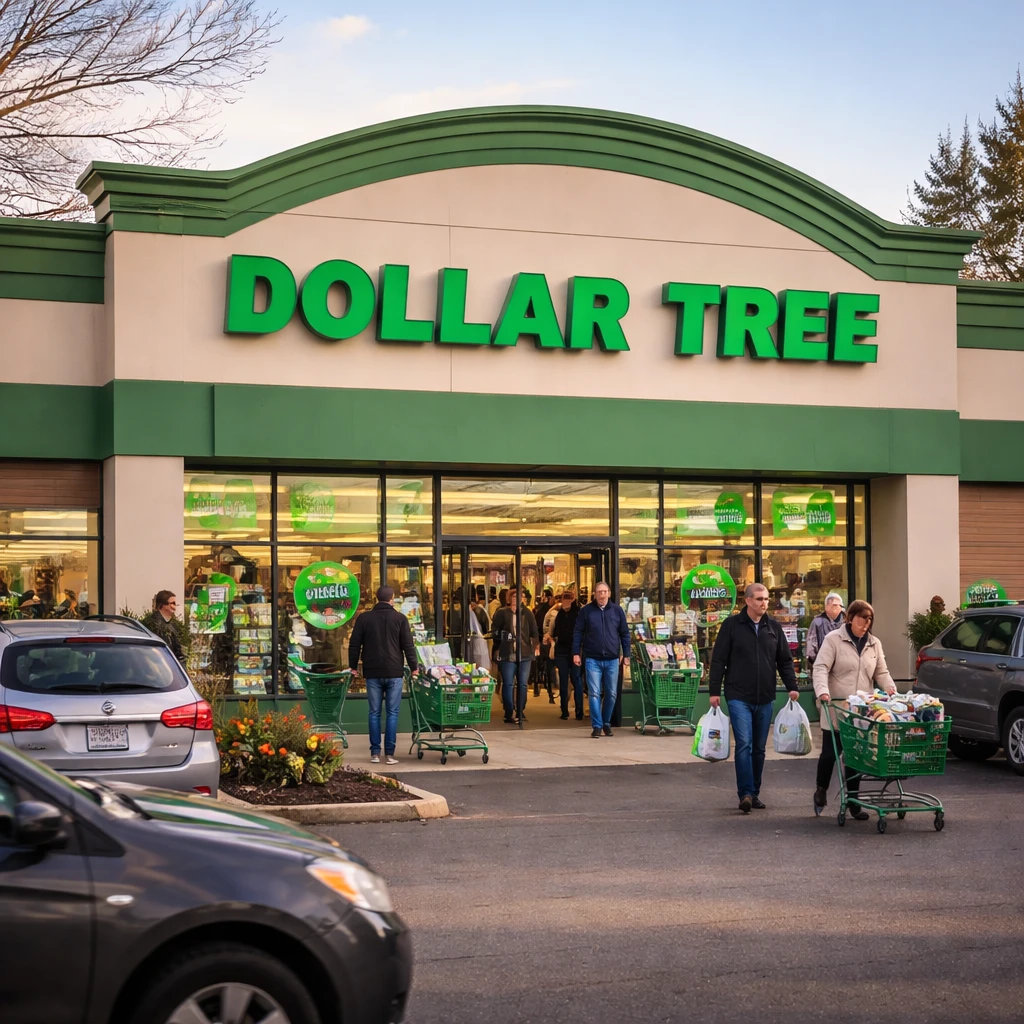
Dollar Tree operates discount variety stores under the Dollar Tree and Dollar Tree Canada banners, selling fixed-price and multi-priced merchandise to value-oriented shoppers. Its core appeal is stable demand in weaker consumer environments and a product mix that benefits from price-sensitive buying habits. For investors, Dollar Tree is a proxy for trade-down consumption trends: when consumers tighten budgets they visit discount chains more often and trade ticket to lower-priced categories.
Recent performance snapshot and fundamental drivers
Operationally, Dollar Tree is delivering. In Q3 2025 the company reported net sales of $4.7 billion, a 9.4% year-over-year increase, and reported EPS of $1.21 which beat expectations and allowed management to raise guidance for the year. Those read-throughs matter because they show the multi-price strategy is lifting ticket and margin simultaneously, rather than forcing a revenue-for-margin compromise.
From a cash-flow and valuation standpoint, the company generates meaningful free cash flow: free cash flow in the latest reporting is roughly $1.211 billion. With a market cap around $24.6 billion and enterprise value near $27.1 billion, price-to-sales of about 1.3 and EV/EBITDA of ~12.8, the stock is priced like a steady, somewhat mature retail operator rather than a high-velocity growth play.
| Metric | Value |
|---|---|
| Current Price | $123.85 |
| Market Cap | $24.6B |
| Enterprise Value | $27.1B |
| Free Cash Flow | $1.211B |
| Price / Sales | 1.3x |
| EV / EBITDA | 12.8x |
| 52-Week Range | $61.80 - $142.40 (high on 01/15/2026) |
Why the market is mispricing the setup
There are three forces compressing the stock: (1) lingering GAAP noise that depresses headline EPS, (2) investor conservatism about the durability of trade-down demand and (3) a stretched price-to-book ratio (P/B ~7.1) that looks odd given the company’s improving cash generation. The first is largely an accounting and non-operational story that can mask improving store-level economics. The second is cyclical caution; Dollar Tree’s core customer is more resilient than consensus expects. The third is a valuation quirk — high P/B can result from lean tangible book in retail while FCF-based multiples remain reasonable (price to free cash flow ~20.3, implying a roughly 4.9% FCF yield).
Catalysts that can re-rate the stock
- Continued adoption of the multi-price strategy leading to higher average ticket and improved margins (management flagged the strategy as a driver in the 12/03/2025 release).
- Further upside in quarterly sales and EPS — a repeat of the Q3 2025 beat/raise cadence would force analysts to lift estimates materially.
- Macroeconomic persistence of trade-down behavior: if consumers keep favoring discount formats, Dollar Tree should capture share from mid-tier discretionary retailers.
- Reduction in GAAP noise (one-time charges or impairments rolling out of the trailing 12-months), which should make GAAP EPS less volatile and improve investor confidence.
- Short-covering rally — short interest has been meaningful in recent months and a positive earnings surprise could accelerate a short squeeze dynamic.
Trade plan - actionable and time-boxed
This is a long trade:
- Entry: $123.85 (enter on size near the current print).
- Target: $140.00 (first take-profit; represents upside to prior 52-week high area where multiple compression should ease).
- Stop-loss: $110.00 (clearly defined risk level under which the set-up breaks structurally; protects capital if multi-price execution fails or comps collapse).
- Horizon: long term (180 trading days) — give the company two to three quarters of execution and the market time to re-assess earnings quality and cash flow.
Rationale for sizing and horizon: the catalysts that should move the stock are operational (quarterly comps, margin recovery) and behavioral (investor re-rating). These typically take multiple quarters to crystallize. The $110 stop sits below a reasonable operational shock threshold and limits downside to an acceptable trade-off for this setup.
Valuation frame
At a market cap of roughly $24.6 billion and enterprise value around $27.1 billion, Dollar Tree trades at ~1.3x price-to-sales and EV/EBITDA ~12.8x. Price-to-free-cash-flow is roughly 20.3x, consistent with mid-single-digit FCF yields. That combination says the market expects moderate cash generation but not meaningful upside in the top line. If multi-price sustains higher tickets and margins similar to the Q3 2025 trajectory, a move toward $140 implies a modest multiple expansion and earnings re-acceleration — a plausible outcome given the company's recent cadence of beats.
Risks and counterarguments
Any trade needs a realistic risk map. Here are the principal risks and a balancing counterargument.
- Macro Reversal - If unemployment or real wages deteriorate materially, discretionary spending patterns could shift again and margins could be pressured. That would hit Dollar Tree’s top line and compress multiples.
- Execution Risk on Multi-Price - The multi-price rollout could slow or produce stock-keeping complexity that pressures margins. If management mis-executes inventory or pricing, EPS momentum could reverse.
- GAAP Earnings Volatility - Historical GAAP EPS have been distorted by one-time items; another material charge would re-introduce headline volatility and could spook investors despite healthy cash flow.
- Competition & Pricing - Other value retailers (including discount and flexible-price chains) could cut prices or execute more aggressively, stealing share or forcing margin competition.
- Short-term Technical Risk - Momentum indicators are neutral to slightly bearish (MACD shows negative histogram and RSI ~49), and a short-term pullback could hit the stop before fundamental catalysts reassert.
Counterargument: The principal counterargument is that the company’s LTM GAAP results look messy and justify a discounted valuation. That stance is reasonable: GAAP EPS can’t be ignored and could keep a subset of investors sidelined. However, if free cash flow remains north of $1B and comp trends hold, operational reality will likely outweigh accounting noise over a 180-trading-day horizon, re-anchoring the valuation on cash-generation metrics rather than temporary GAAP impairment effects.
What will change the thesis
I will lose conviction if any of the following occur: sequential deceleration in comparable-store sales across two consecutive quarters, a materially weaker free cash flow print (substantially below $1B), or a strategic pivot that materially increases capital intensity without commensurate returns. Conversely, sustained double-digit comp growth or an accelerating margin tailwind would strengthen the bullish case and justify raising the target.
Bottom line
Dollar Tree is a pragmatic, cash-flowing retail business exposed to a durable secular tailwind: consumer trade-down. At $123.85 the market is underweight the probability that the company's multi-price strategy can convert into sustained top-line and margin improvement. This trade captures that mismatch with a clear entry, stop and target and a time-boxed horizon to let the fundamental story play out. Treat this as a measured, event-driven long — not a momentum chase.
Trade plan recap: Buy DLTR at $123.85, target $140.00, stop $110.00, horizon long term (180 trading days).