
Hook & thesis
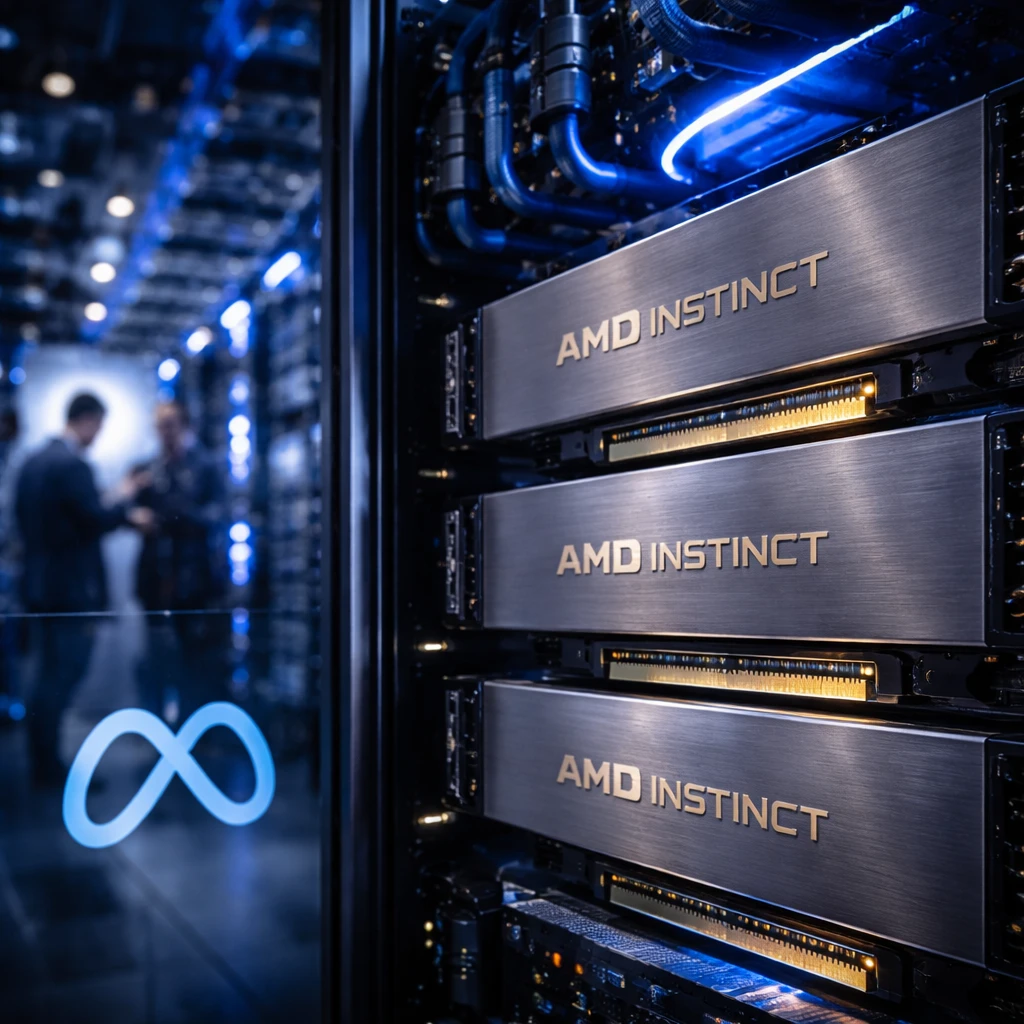
AMD ripped higher after news that Meta signed a landmark multi-year supply agreement for up to 6 gigawatts of AMD Instinct GPUs and received warrants for 160 million AMD shares. The market bid the shares sharply - the stock was up roughly 20% from the prior close and opened at $211.63 before trading up into the $216 area. This is a classic buy-the-news setup where headline-driven demand and real commercial traction line up. I think there is a tradable, asymmetric opportunity to own AMD for a tactical swing: buy now, limit downside, and target the area of meaningful resistance closer to the 52-week highs.
Why this matters
Meta's commitment converts headline AI demand into explicit, multi-year purchase visibility for AMD's data center accelerator business. For AMD the deal does three things: it provides multi-year demand for Instinct GPUs, it signals hyperscaler confidence in AMD as a meaningful Nvidia competitor, and it creates a strategic investor dynamic with warrants that could change long-term ownership structure. Those are not trivial when the market is re-pricing AI infrastructure winners on multi-year supply deals.
The business in two paragraphs
Advanced Micro Devices designs CPUs, GPUs, accelerators and adaptive SoCs that target gaming, client, and data center workloads. In the current cycle the high-growth, high-margin data center GPU business drives valuation. AMD is selling Instinct accelerators into hyperscalers and cloud providers for AI training and inference, and the recent deals with OpenAI and now Meta are the clearest evidence yet that demand for non-Nvidia accelerators is real.
Why the market should care - the numbers
Market participants should treat this as incremental revenue visibility on top of already strong demand. The snapshot shows AMD trading near $216.32 with a market capitalization of about $352.7B and daily liquidity well above its two-week average (today's volume ~57.1M vs average ~31.6M). The company’s trailing metrics show a P/E roughly in the mid-70s (~74), price-to-book ~5.09, and free cash flow of roughly $6.735B. Enterprise value sits around $318.2B with EV/sales ~9.19 and EV/EBITDA in the high 40s. Those are premium multiple readings that reflect high-growth expectations for data center revenue.
Contrast the valuation with operating leverage: return on assets is ~5.64% and return on equity ~6.88% - not enormous, but improving as data center sales scale. Importantly, AMD’s 52-week range is wide: a low of $76.48 and a high of $267.08. The current price at ~$216 sits nearer the top of that band after the news, implying the market is already assigning a sizable story premium to AMD’s accelerator growth.
Technical and market-context bullets
- Price action: After the deal the stock opened at $211.63 and traded as high as $216.39; current prints are in the mid $216s.
- Momentum indicators are mixed: 10-day SMA is ~$205.99 and the 50-day SMA is ~$219.22, so we are trading near short-term resistance territory; RSI ~50 suggests neither overbought nor oversold.
- Short interest and short-volume data show modest days-to-cover (~1), so squeezes can be fast but are less durable absent broader buying.
Valuation framing
At a market cap near $352.7B and a P/E near 74, AMD is priced for sustained above-market growth in data center GPU revenue. Free cash flow of about $6.7B helps justify a premium, but investors should recognize that multiples already embed strong execution. The company’s EV/sales (~9.19) and EV/EBITDA (~47.5) suggest the market expects continued margin expansion and high incremental returns from data center accelerators. In short: the news materially reduces execution risk for the growth narrative, but it does not eliminate valuation risk - you are buying growth that is already partially priced in.
Catalysts
- Revenue recognition from Meta contract as orders flow over the next several quarters - each tranche that converts to shipment confirms the valuation story.
- Nvidia’s upcoming earnings and commentary on hyperscaler spend (expected 02/25/2026) - strong comments could reinforce AI demand, weak ones could cool the group.
- AMD’s quarterly results and guidance updates - any acceleration in data center growth above management’s prior cadence will support re-rating.
- Execution milestones at major customers (OpenAI, Meta) and official purchase orders - real POs beating sell-side build will remove doubt.
Trade plan - exact, actionable
Trade direction: Long
Entry price: $216.32
Target price: $255.00
Stop loss: $192.00
Horizon: mid term (45 trading days) - plan to hold up to 45 trading days. The logic: the Meta supply agreement is a near-term headline; orders and customer confirmations will be digested by the market over several weeks. This horizon captures initial contract flow and the typical post-deal momentum window, while keeping exposure to shorter-term event risk like group rotation after Nvidia’s report on 02/25/2026.
Why these levels?
- The entry at $216.32 is anchored to the current print and the immediate post-announcement market. If you missed the initial gap, scale in around this level rather than chasing a higher print.
- The stop at $192 is below the prior close of $196.60 and well below the short-term SMA levels; breaking below $192 would suggest the headline-driven bid faded and broader sentiment is shifting.
- The target near $255 sits below the 52-week high of $267 and provides a pragmatic point to harvest gains if the sector re-rates or if additional demand evidence appears. That target gives a favorable risk/reward (~1:2.6).
Position sizing & tactical notes
Because AMD trades with high intraday volume and headline sensitivity, scale position sizing to a risk budget that tolerates the stop. Use a position size that limits portfolio risk to a comfortable percentage of equity if the stop is hit. Consider trimming at partial profits on the first strong reaction above $235 and moving stops up to breakeven after a 15-20% run to protect capital.
Risks and counterarguments
- Dilution and warrants: Meta received warrants for 160 million shares as part of the deal. That is meaningful potential future dilution and could pressure supply/demand dynamics if exercised or sold into the market.
- Premium valuation: A P/E near the mid-70s and EV/EBITDA in the high 40s mean the stock needs continued above-consensus growth to justify the price. Any slowdown in data center demand will force multiple compression.
- Competitive displacement: Competitors like Nvidia remain dominant in many AI segments, and Intel’s recent tie-ups with startups (e.g., SambaNova) show incumbents are trying to reclaim share. A competitor technical win at a hyperscaler could reverse the narrative quickly.
- Macro and sentiment rotation: The AI trade can rotate out of large-cap semiconductors into other tech pockets. Nvidia’s 02/25/2026 commentary or a weaker-than-expected macro data release could spark a group-wide pullback.
- Execution risk: Supplying multi-gigawatt capacity at hyperscaler scale is operationally complex. Supply-chain delays, yield issues, or customer design changes could defer revenue recognition.
Counterargument
One strong counterargument is that the market has already priced in the best-case scenario for AMD’s accelerator business. With the stock trading near $216 and the 52-week high at $267, investors may be buying a headline with minimal incremental upside left unless AMD demonstrates sustained margin expansion and recurring hyperscaler bookings. If Nvidia reinforces dominance or the warrants become a selling overhang, the stock could give back today’s gains quickly. That risk is why I place a disciplined stop at $192 and set a finite mid-term horizon of 45 trading days.
What would change my mind
I would reconsider the trade if any of the following occur: (1) AMD provides clear quarterly guidance that reduces data center revenue trajectory; (2) Meta’s warrants are exercised or resold and the market signals material dilution pressure; (3) Nvidia announces overwhelming takeaways from reseller/hyperscaler conversations that undercut AMD’s expected share wins; or (4) broad AI spending visibly decelerates at hyperscalers. Conversely, I would add to the position if AMD reports clear, multi-quarter order flow from Meta or shows accelerating data center revenue and margin expansion on the next earnings report.
Conclusion
The Meta deal is a tangible de-risking event for AMD’s data center story and creates a tradeable near-term asymmetric opportunity. The headline is not just hype - it represents multi-year demand and strategic validation for AMD’s Instinct platform. Still, valuation is elevated and dilution from warrants is a real overhang. The recommended trade is a tactical long at $216.32 with a stop at $192 and a target of $255 over a mid-term 45 trading day horizon. Stay disciplined on stops and watch for both order confirmations and any dealer commentary that could shift the competitive landscape.
Execution note: This is a tactical swing trade idea designed to capture post-deal momentum while containing downside. Manage position sizing to your personal risk tolerance and update the plan if new public information materially changes the revenue or dilution picture.