
Hook / Thesis
SNDK has gone parabolic: the stock has surged into the upper end of its range after reports showing AI-driven demand has tightened NAND supply and sent prices higher. That has translated into real, measurable upside in company performance - revenue and margins are accelerating, and management is forecasting even stronger quarters ahead. For traders and position investors willing to accept above-average volatility, the case here is straightforward: the market is paying up for a structural tailwind - AI data-center buildouts - and Sandisk's recent operating leverage argues that results can still outpace expectations.
Put simply, I view Sandisk as a strong buy here. The business is delivering triple-digit adjusted EPS growth in the near term, free cash flow is healthy, the balance sheet is conservative, technical momentum remains bullish, and short interest is low relative to float. The trade is not without risk - cyclicality in semiconductors and the possibility of supply normalization are real threats - but for a disciplined buyer with explicit stops, the upside looks compelling versus the downside.
What the company does and why the market should care
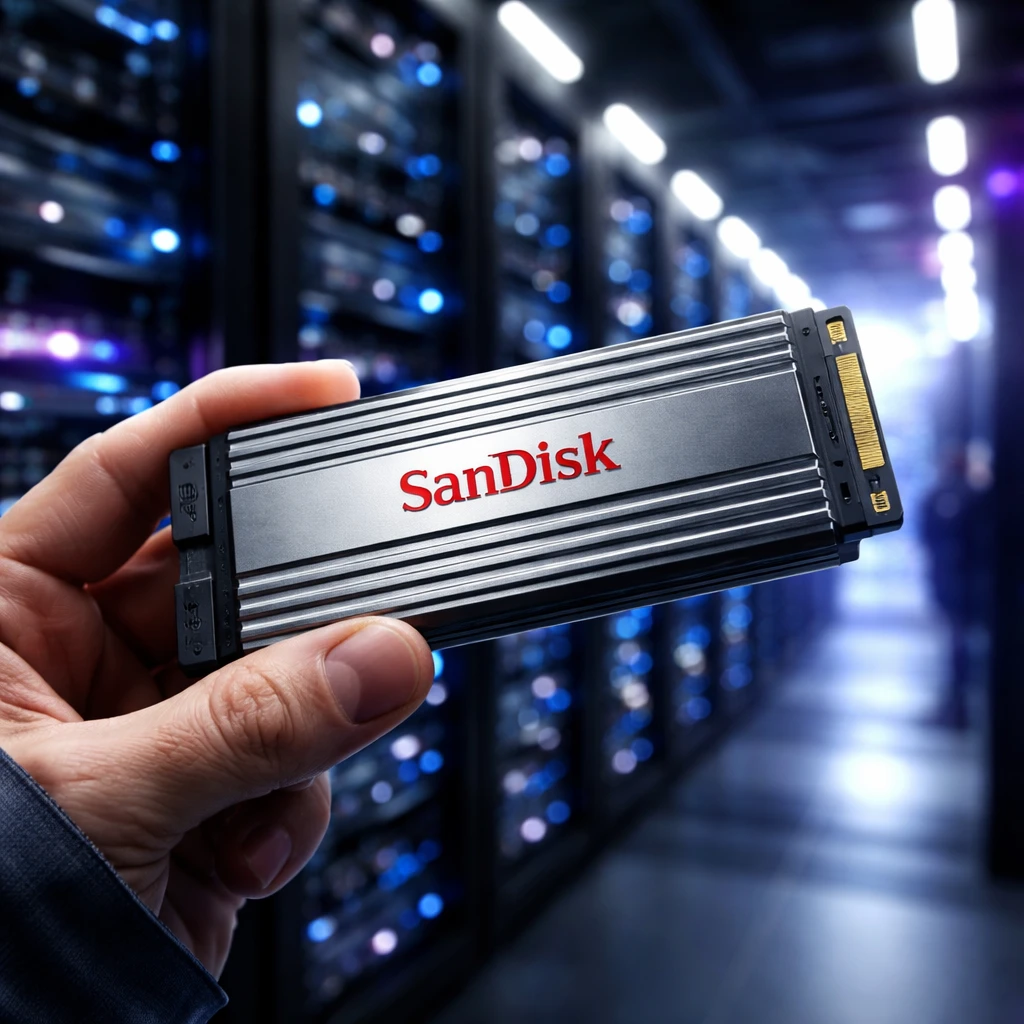
Sandisk develops and sells NAND flash storage products used in SSDs, memory cards, and other flash-based storage solutions. The company sits at the center of the AI data-center supply chain: AI training and inference architectures require large, fast, durable storage layers, and NAND pricing and supply constraints directly impact Sandisk's top line and margins.
Why that matters right now: reports show a NAND supply shortage tied to the AI hardware supercycle. That shortage has driven higher selling prices and better product mix for Sandisk, translating into rapid revenue growth and margin expansion. Institutional buyers - hyperscalers and systems OEMs - are scaling capacity, and Sandisk is positioned to capture a meaningful share of that incremental spend.
Key numbers that support the bull case
- Revenue momentum: the company reported revenue of roughly $3.0B in the recent quarter, up 61% year-over-year and driven by AI data-center demand.
- Profitability surge: adjusted EPS jumped 404% to $6.20 in the quarter, and management guided Q3 adjusted EPS to roughly double into the $12-$14 range while forecasting revenue of $4.4B-$4.8B.
- Margins expanding: gross margins moved from the low-30s historically to 50.9% in the reported quarter and management guided to gross margins in the mid-60s (64.9% - 66.9%) next quarter.
- Cash generation: free cash flow was reported at about $1.449B, and the balance sheet is conservative with low debt-to-equity (~0.06 per recent metrics).
- Valuation and market size: the company’s enterprise value sits around $85.3B while reported market capitalization is roughly $104.2B, reflecting high investor expectations for continued earnings growth.
Valuation framing
On headline multiples the stock looks expensive: price-to-sales and EV-to-sales are elevated, and trailing GAAP EPS can be negative (recent metrics show GAAP EPS at -$7.05), which inflates PE-based comparisons. That said, those GAAP numbers mask the current operating momentum and one-time accounting items tied to the company's corporate timeline.
More relevant is forward-looking math. Street commentary in recent days put a high-end view on fiscal 2027 EPS (a Bernstein note cited roughly $90.96) and a price target uplift to $1,000 from some sell-side teams. If Sandisk can deliver guided revenue and margin expansion into the mid-60s with the free cash flow profile it currently shows, multiples that look stretched today become more palatable. In short: valuation is expensive on static metrics but has a clear path to justify a higher absolute stock price if the AI-driven cycle persists.
Technicals and market structure
Technically, the stock retains bullish momentum: the 10-day SMA sits around $551.80 and the 9-day EMA is roughly $569.64, both below the current price, while RSI is elevated near 66 indicating strength but not yet extreme overbought territory. The MACD histogram is positive and the MACD is in bullish momentum, supporting continuation risk. Short interest and days-to-cover are low (days-to-cover generally around 1), which reduces the risk of a large short-squeeze-driven reversal but also means fewer forced sellers to cap upside.
Catalysts (what could keep this moving higher)
- Continued NAND tightness - if supply constraints persist, pricing power and revenue per unit should remain elevated.
- Further upside to guidance - incremental beats on revenue or margins would re-rate the multiple quickly.
- Large hyperscaler purchasing cycles - any announcement of material OEM or hyperscaler supply deals will improve visibility on future quarters.
- Positive analyst revisions - several notes already increased targets; more upgrades would add fuel to momentum.
Trade plan (actionable)
Entry: $585.00
Target: $1000.00
Stop-loss: $520.00
Risk level: high
Horizon: two legs.
- Swing leg (mid term - 45 trading days): hold with a view that near-term momentum and seasonal purchasing by hyperscalers carry the stock toward $725 and beyond. If price gets toward $725 within ~45 trading days, consider taking partial profits and tightening stops.
- Position leg (long term - 180 trading days): hold the remainder for up to 180 trading days to ride a structural re-rating if Sandisk converts the margin guidance into sustained earnings power. The $1,000 target is ambitious but aligns with bull-case street scenarios that assume multi-quarter margin retention and accelerating earnings.
Why these levels? $585 is close to today's trade and within the near-term support/resistance bands given the 10-day SMA around $552 and 21-day EMA near $484. Stop at $520 sits below recent short-term support and comfortably under the 10-day SMA. The $1,000 target mirrors higher-end sell-side scenarios and gives a clear reward-to-risk: roughly $415 upside versus $65 downside at entry, near a 6.4:1 gross payoff on price alone (before position-sizing and portfolio risk adjustments).
Risks and counterarguments
Below are the principal risks that could invalidate the trade, and a brief counterargument to the bull case.
- Semiconductor cyclicality: NAND and memory markets are historically cyclical. If supply normalizes faster than the market expects, prices could collapse and Sandisk's revenue and margin expansion would reverse quickly.
- Valuation compression: The stock's multiple already reflects aggressive growth. Any small miss in revenue or margin could trigger sharp multiple contraction and heavy downside.
- Macro shock or demand slowdown: A broader slowdown in data-center capex, or macro risk that delays AI buildouts, would remove the growth driver supporting the current price.
- Execution risk: Rapid scale-up can expose manufacturing, quality, or supply-chain execution problems; if Sandisk misses on yield, costs could rise and margins compress.
- Market technical risk: Elevated momentum can flip fast; daily volatility has been large and intraday liquidity dynamics could create price gaps below the stop.
Counterargument: Critics point out that the rally already prices in perfect execution and continued supply tightness; any sign of easing would prompt a fast de-rating. That is reasonable. However, the company is showing FCF generation (roughly $1.45B) and is guiding to margins that, if achieved, materially improve free cash flow conversion and make current market expectations less heroic. For disciplined traders, sizing and a clear stop manage the downside while letting the upside run if execution holds.
What would change my mind
I would become materially less constructive if any of the following occur:
- Management pulls revenue or margin guidance, or issues a profit warning that points to demand softening.
- Quarterly results show a sharp sequential decline in gross margin (for example, moving back toward historical low-30s levels) that suggests the pricing environment is reversing.
- Free cash flow materially deteriorates or leverage increases meaningfully (debt-to-equity rising well above current ~0.06).
Conclusion
Sandisk is a high-conviction, high-volatility buy on the premise that AI-driven demand sustains elevated NAND pricing long enough for the company to convert that environment into durable margin expansion and significant free cash flow. The trade plan above gives a clear entry, a disciplined stop, and tiered targets tied to near-term momentum and a multi-quarter re-rating scenario. This is not a low-risk pick; expect swings and respect the stop. But for investors willing to accept the cyclical nature of semiconductors, the asymmetric upside here is real.
Trade quick-reference
| Entry | Stop | Target | Horizon | Risk |
|---|---|---|---|---|
| $585.00 | $520.00 | $1000.00 | two legs: mid term (45 trading days) & long term (180 trading days) | high |
Entry and targets are tactical. Size the position relative to your portfolio risk tolerance and be prepared to act if the trade breaks down through support around $520.