
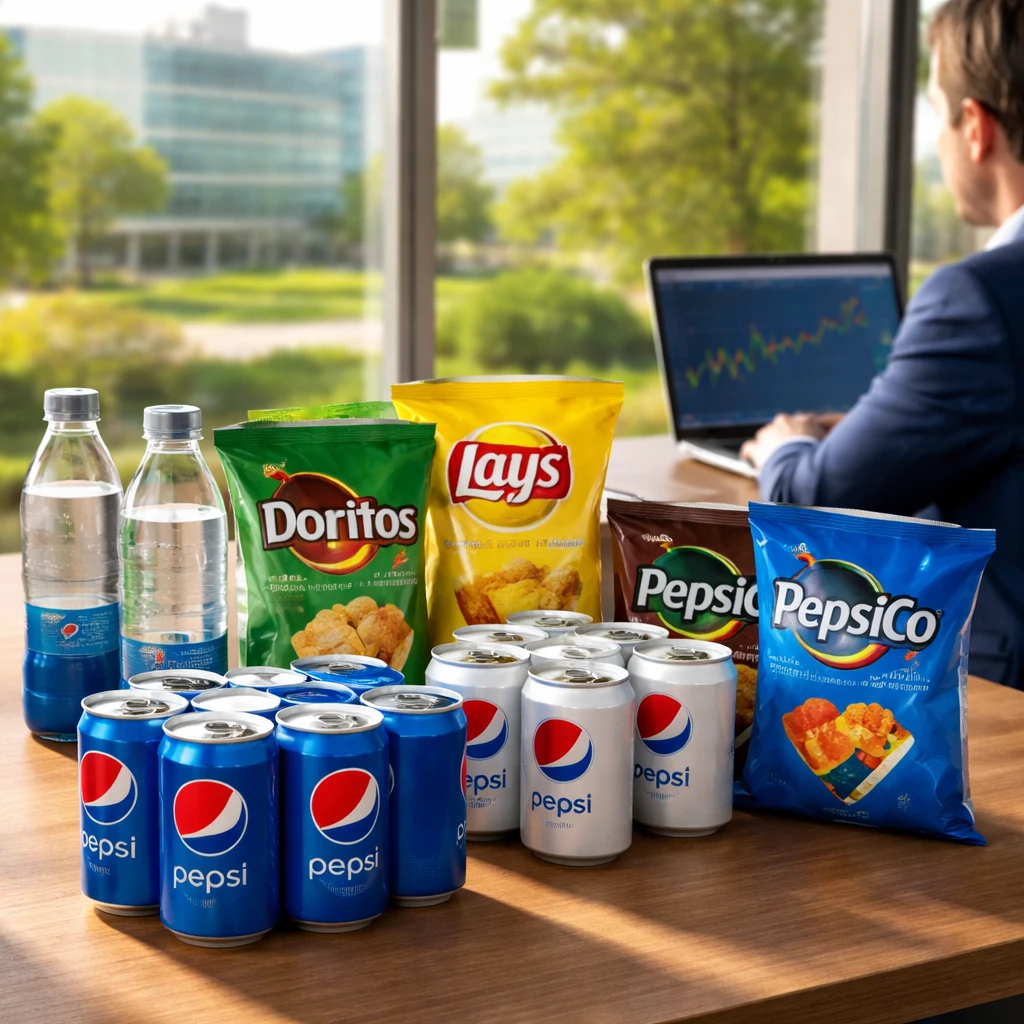
Hook & thesis
PepsiCo is the kind of blue-chip consumer name investors reach for when they want steady cash flow, reliable dividends and defensive exposure. Recent developments - including a $4 billion investment from Elliott Management and a beat in Q4 2025 that coincided with refreshed strategy moves - reinforce the bull case: better integrated beverage-snack distribution, portfolio streamlining and margin-focused initiatives.
That said, momentum has pushed the share price into an overbought condition. The trade here is not to chase. I maintain a Buy stance, but recommend a patient, staged entry below near-term resistance. Valuation is not dirt-cheap - the stock trades at roughly $170 and a mid-to-high twenties P/E - but free cash flow and a 3.3%+ dividend make the risk-reward attractive if you buy with discipline.
What PepsiCo does and why the market should care
PepsiCo, Inc. manufactures, markets, distributes and sells beverages, foods and snacks globally. Its business is diversified across PepsiCo Foods North America (PFNA), PepsiCo Beverages North America (PBNA), international beverage franchises (including SodaStream), EMEA and Asia Pacific foods, plus Latin America. That product mix gives PepsiCo both defensive beverage revenue and higher-margin snack businesses - a structural advantage versus single-category peers.
The market cares because PepsiCo generates consistent cash flow, returns capital to shareholders and can reshape distribution and pricing to protect margins. Key fundamentals underpinning investor interest today include a trailing earnings per share of $6.03, free cash flow of about $7.67 billion, and a market cap of roughly $235 billion. Management is using those resources to boost shareholder returns - the board just declared a quarterly dividend of $1.4225 per share and increased the annualized payout starting June.
Support for the bullish case - the numbers
- Share price: trading around $170.47, near the 52-week high of $170.75 reached on 02/06/2026.
- Profitability: EPS trailing at $6.03 and a P/E near 28.3x - implying investors are paying for durability, not rapid growth.
- Cash generation: reported free cash flow roughly $7.67 billion, which supports dividends, buybacks and selective investments.
- Dividend: quarterly payout at $1.4225 per share (a 5% year-over-year increase) and a yield in the ~3.3% range - attractive for income-focused investors.
- Balance sheet/valuation metrics: enterprise value about $273 billion, EV/EBITDA about 16.3, price-to-sales about 2.48 and price-to-book ~11.42.
Technical & market context
Technically the stock is extended: the 10-day SMA is about $156.77, 50-day SMA is $147.84 and the 9-day EMA is $160.12, while the daily RSI sits at an elevated ~85 - a classic sign the short-term move is overheated. Short interest levels are modest (days to cover roughly 2.6), and short-volume prints show active trading around recent price moves. That combination creates a two-edged sword: momentum can carry the stock higher, but near-term pullbacks are likely and will present cleaner entry points.
Valuation framing
At about $170.50 a share (market cap roughly $235 billion), PepsiCo is not cheap. The trailing P/E around 28x reflects a premium to the broader consumer staples sector historically, but it also embeds PepsiCo's reliable cash flow, global scale and dividend attractiveness. EV/EBITDA of ~16.3 is reasonable for a global consumer leader with strong brands and category breadth, but it's not a value bargain; investors are paying for quality, predictability and capital returns.
Qualitatively, this valuation makes sense if management can convert strategic changes into margin improvement and sustainable organic growth. The recent activist investment and explicit initiatives - integrated beverage-snack distribution, portfolio pruning, brand refreshes and selective price cuts to drive consumption - are aimed at exactly that. If those translate into better top-line mix and modest margin expansion, downside at current levels is limited; if not, the premium multiple could compress.
Catalysts (2-5)
- Execution on integrated beverage-snack distribution - improved cross-selling and route-to-market synergies should increase velocity and margins.
- Activist-engagement related moves from Elliott Management - the $4 billion stake aligns incentives and could accelerate capital return or operational changes.
- Subsequent quarterly results and guidance - evidence of margin recovery or volume stabilization will re-rate the stock.
- Dividend increases and buyback cadence - continued shareholder returns reduce total-return volatility and underpin valuation support.
Trade plan (actionable)
Stance: Maintain Buy, but wait for a disciplined entry. Do not chase above the 52-week high.
| Entry | Target | Stop Loss | Horizon |
|---|---|---|---|
| $168.00 | $190.00 | $158.00 | Long term (180 trading days) |
Rationale: The recommended entry at $168.00 is intentionally below the current price to avoid buying into an overbought rally and to capture a modest pullback toward short-term support. The stop at $158.00 sits beneath the 50-day SMA (~$147.84) buffer zone and gives room for normal volatility while protecting capital should distribution patterns change. The $190.00 target reflects a mid-to-high single-digit multiple expansion or successful execution that materially improves margins and investor sentiment over the next six months.
Timeframe: This is intended as a long-term trade to be held up to 180 trading days. Why long-term (180 trading days)? The strategic initiatives and activist-related changes take time to manifest in results and guidance; operating leverage and distribution changes are multi-quarter stories. A 180 trading-day window lets management demonstrate initial execution and the market to re-rate earnings power if initiatives stick.
Risks and counterarguments
- Execution risk - the strategic push (refranchising decisions, distribution integration, product portfolio changes) may take longer or cost more than anticipated, compressing margins instead of expanding them.
- Macro & consumer demand - slowing consumer spending or sticky input-cost inflation could pressure volumes and margins; snacks and beverages are not immune to recessionary downgrades.
- Leverage - debt-to-equity near 2.41 is material. If free cash flow weakens, the balance sheet constrains buybacks/dividends and raises refinancing risks for opportunistic investors.
- Valuation vulnerability - at ~28x earnings, the stock is exposed to multiple contraction if growth disappoints. A failure to show margin progress could lead to a sharp re-rating.
- Competitive pressure & innovation - rivals, private-label entrants and shifting consumer tastes toward healthier or premium alternatives could limit pricing power in key categories.
Counterargument: One could argue that the Elliott investment and a dividend hike are already priced in; the move to $170+ reflects that optimism. If the market is overly enthusiastic and PepsiCo cannot demonstrate sequential margin improvement, the shares can easily slip back toward the $127.60 52-week low seen mid-2025. That is a legitimate reason to sit on the sidelines or size positions conservatively.
What would change my view
- Positive: If upcoming quarters show a clear uptick in organic revenue growth, margin expansion and sustained FCF conversion above current levels (free cash flow north of $8.5 billion annually on a sustained basis), I would increase my size and raise the target above $190.
- Negative: If management reports a decline in FCF, cuts the dividend or signals a pause in buybacks while leverage remains high, I would lower conviction and potentially move to Neutral or Reduce.
Conclusion
PepsiCo remains one of the more reliable ways to own global consumer staples: diversified product mix, strong brands, recurring cash flow and a shareholder-friendly capital return profile. Recent activist activity and management initiatives make the story more interesting and justify a Buy thesis. However, the charts say patience - momentum has already run hard and valuation reflects quality, not cheapness. The practical way to trade this is with discipline: wait for an entry near $168, protect capital at $158 and give the thesis time to play out over the next 180 trading days.
Trade idea: Buy on weakness to $168.00, target $190.00 in 180 trading days, stop $158.00. Size according to your risk tolerance and remain alert to quarterly evidence of execution or weakness.