
Hook / Thesis
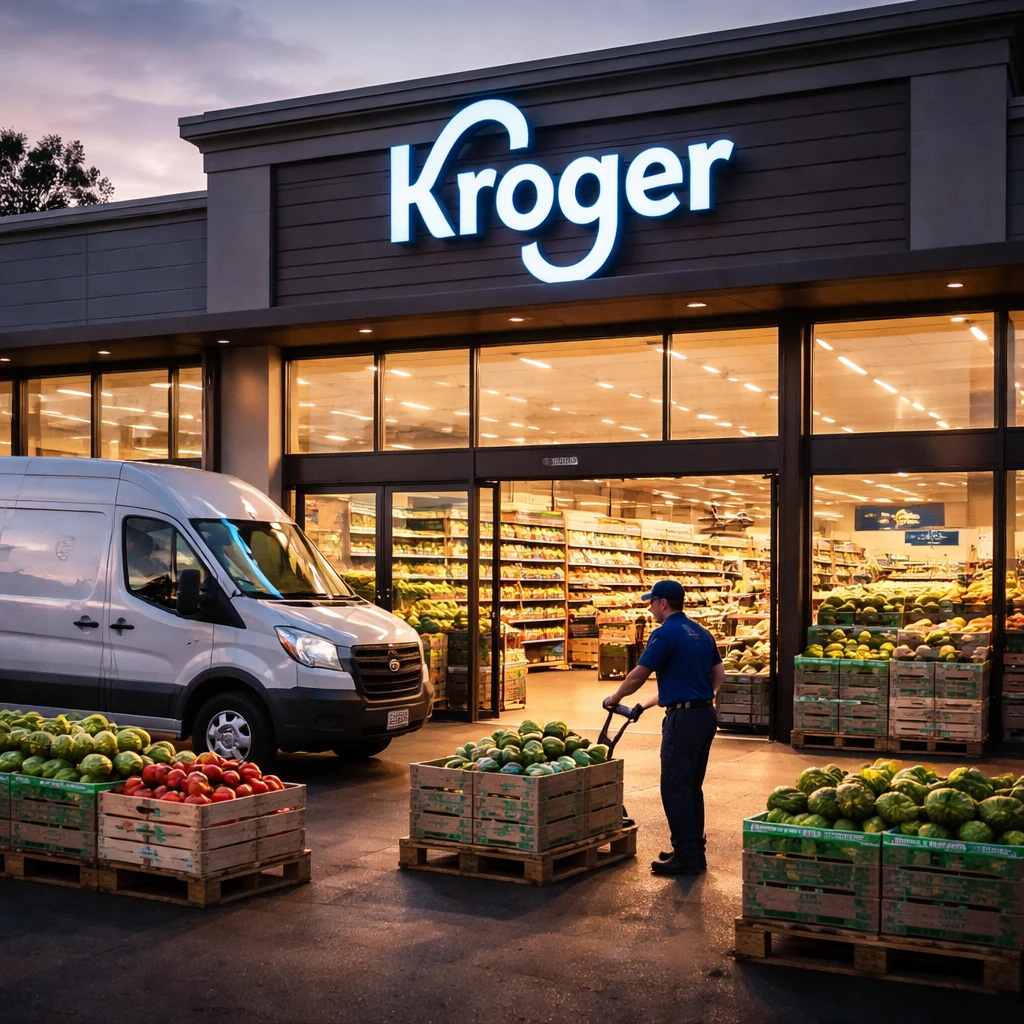
Kroger is not glamorous, but it is the sort of company you want on the books when markets get rattled: steady cash flow, a rising dividend, and concrete productivity programs that compound over time. The stock has run from the January low of $58.60 to today's trade near $71.58, and that move has a sensible foundation - operational cost savings, smarter personalization that should boost basket size, and targeted capital allocation after pruning non-core assets.
This is a trade, not a speculation. The plan is to buy Kroger with a long-term outlook - meaning a trade that will be held for up to 180 trading days - and to treat the position as a conservative growth-plus-income idea inside a volatile market. The company pays a quarterly dividend (35 cents declared on 01/30/2026), produces meaningful free cash flow ($2.269B), and trades at an enterprise multiple (EV/EBITDA ~11.5x) that is reasonable for a high-quality retailer with scale.
What Kroger does and why the market should care
Kroger is a national grocery operator that blends traditional grocery, retail pharmacy and fuel. Its strategy centers on four pillars: Fresh, Brands, Data & Personalization and Seamless. Those pillars are not buzzwords - they drive measurable outcomes: private-label penetration (Simple Truth and others) lifts margin, data & personalization increase repeat purchases, and seamless fulfillment improves cost per order. Management has signaled a willingness to redeploy capital away from non-core units (Vitacost sold 01/09/2026) toward areas with higher return on invested capital.
Concrete numbers that matter
- Market cap: about $45.07B (snapshot market cap).
- Free cash flow: $2.269B, which supports dividends and reinvestment.
- P/E: roughly in the 50s-60s depending on date (snapshot P/E ~61.8; trailing EPS shown $1.27 counted against the earlier $67.50 price gives a P/E ~53.1 on 02/06/2026).
- EV/EBITDA: ~11.53x - a tolerable multiple for a defensive retailer with scale and steady cash generation.
- Dividend: $0.35 per share declared on 01/30/2026, payable 03/01/2026, ex-dividend 02/13/2026; dividend yield roughly 2%.
- Balance sheet/coverage: debt-to-equity is elevated at ~2.56, and current ratio is ~0.82; the company retains an investment-grade posture but leverage is a point to watch.
Why this matters for investors
In a market that can swing on interest rate noise, macro surprises and sentiment-driven flows, Kroger's predictability is an asset. Free cash flow covers the dividend and leaves room for reinvestment; EV/EBITDA leaves upside if margin initiatives stick; and the business benefits from secular tailwinds like e-grocery adoption and improved refrigeration/fulfillment tech (commercial refrigeration market growth supports Kroger's cold-chain investments).
Operational and strategic catalysts
- Cold-chain automation: Corvus Robotics announced dedicated cold-chain drones and Kroger is an early deployer (news 02/09/2026). Reduced labor exposure in sub-zero environments and faster inventory cycle counts should lower shrink and labor costs in frozen/refrigerated categories.
- AI-driven personalization: Kroger expanded its partnership with Google Cloud to implement Gemini Enterprise features (news 01/12/2026). Personalized offers and an in-app shopping assistant can lift basket size and frequency while improving promotional ROI.
- Portfolio focus: Kroger completed the sale of Vitacost (01/09/2026) to reallocate capital to higher-return areas of the grocery business.
- Dividend growth track record: The board declared a quarterly dividend on 01/30/2026; the company has grown dividends since reinstatement, supporting income-minded holders.
Valuation framing
At a market cap roughly $45B and an enterprise value near $56.8B, Kroger trades at an EV/EBITDA of ~11.5x. Grocery is typically a low-single-digit revenue growth sector, so multiple compression is common when macro growth stalls. That said, EV/EBITDA in the low-teens for a national supermarket operator is reasonable given Kroger's scale and efficiency programs. The headline P/E (mid-50s to low-60s) looks rich because reported earnings are volatile and influenced by commodity costs, promotional cadence and timing of markdowns. Looking through that noise, FCF generation and EV-based multiples give a more sensible valuation anchor.
Trade plan (actionable)
- Entry: Buy at $71.58.
- Stop-loss: $66.00.
- Target: $80.00.
- Horizon: long term (180 trading days). Expect to hold up to 180 trading days to allow operational improvements and seasonality (spring merchandising and Q2 comps) to flow through the P&L.
Technical and market context
Technically, the name has moved fast: 10/20/50-day averages are all climbing and the 9-day EMA (~66.22) suggests recent bullish momentum; the RSI is elevated (~76.4), so expect short-term consolidation or pullbacks. Short-volume data shows heavier shorting activity in recent sessions, which increases the chance of intraday swings. These technicals are why the trade is structured over a longer horizon - to let fundamentals catch up with sentiment.
Risks and counterarguments
- High leverage: Debt-to-equity at ~2.56 is meaningful for a retailer with margin volatility. A sustained rise in interest rates or a credit rating cut would pressure free cash flow and restrict flexibility.
- Valuation sensitivity: P/E in the 50s-60s implies expectations of earnings stability. If commodity inflation or promotional activity compresses margins, EPS could disappoint and sentiment could swing quickly.
- Execution risk on tech initiatives: AI personalization and automation projects have implementation risk. If these programs fail to drive measurable sales lift or cost savings, the valuation support weakens.
- Competitive pressures: Walmart, Amazon/Whole Foods and dollar formats continue to compete on price and convenience. Kroger must maintain private-label momentum and omnichannel economics to defend share.
- Short-term overbought market: Elevated RSI and concentrated short-volume mean the stock can retrace sharply in the near term - this is controlled by the stop but remains a trading risk.
Counterargument: The most persuasive short-case is valuation coupled with overbought technicals - why buy now when the stock has already rallied from $58.60? That is reasonable. If you prefer a lower-risk entry, you could wait for a pullback toward $66 or a retest of the 21-50 day EMAs. My constructive stance assumes Kroger's margin initiatives and capital redeployment accelerate cash returns and earnings; if early signals of margin degradation appear, I will step back.
What would change my mind
I would downgrade this trade if Kroger reports a meaningful hit to free cash flow (sequential decline or negative guidance), if leverage increases materially (debt-to-equity moving meaningfully higher) or if management pauses the dividend growth cadence. Conversely, better-than-expected margin improvement or a consistent lift in digital sales and basket size tied to Gemini personalization would reinforce the bullish view and prompt a higher price target.
Conclusion
Kroger fits a portfolio sleeve that needs durable cash generation, modest yield and upside from operational leverage. The trade proposed is pragmatic: buy at $71.58, protect capital with a $66 stop, and target $80 over a long-term 180 trading day horizon. The upside is supported by concrete catalysts - automation in cold-chain, AI-driven personalization, and focused capital allocation after the Vitacost divestiture - while risks are manageable if monitored closely. For patient investors and traders who want a defensive market exposure with real earnings optionality, Kroger is a reasonable buy at the stated levels.