
Hook & Thesis
BorgWarner is not broken: it builds turbochargers, e-drive modules, inverters and battery systems that virtually every OEM still needs as the industry stitches together ICE, hybrid and EV portfolios. But the market has priced in too much perfection. At roughly $58.85 a share and a market capitalization near $12.2 billion, the stock trades at a premium relative to historic trough multiples and to the cyclicality of parts demand. That combination - high expectations plus ordinary execution/cycle risk - is why we downgrade the name and propose a mid-term short trade.
Our view is pragmatic: the business earns real cash (free cash flow around $1.18 billion annualized) and declared a quarterly dividend of $0.17 (payable 03/16/2026; ex-dividend 03/02/2026). But profit multiples (P/E ~45x) and recent price strength (52-week high at $70.08 on 02/12/2026) leave little margin for error. We prefer to be sellers here rather than buyers.
What BorgWarner Does and Why the Market Should Care
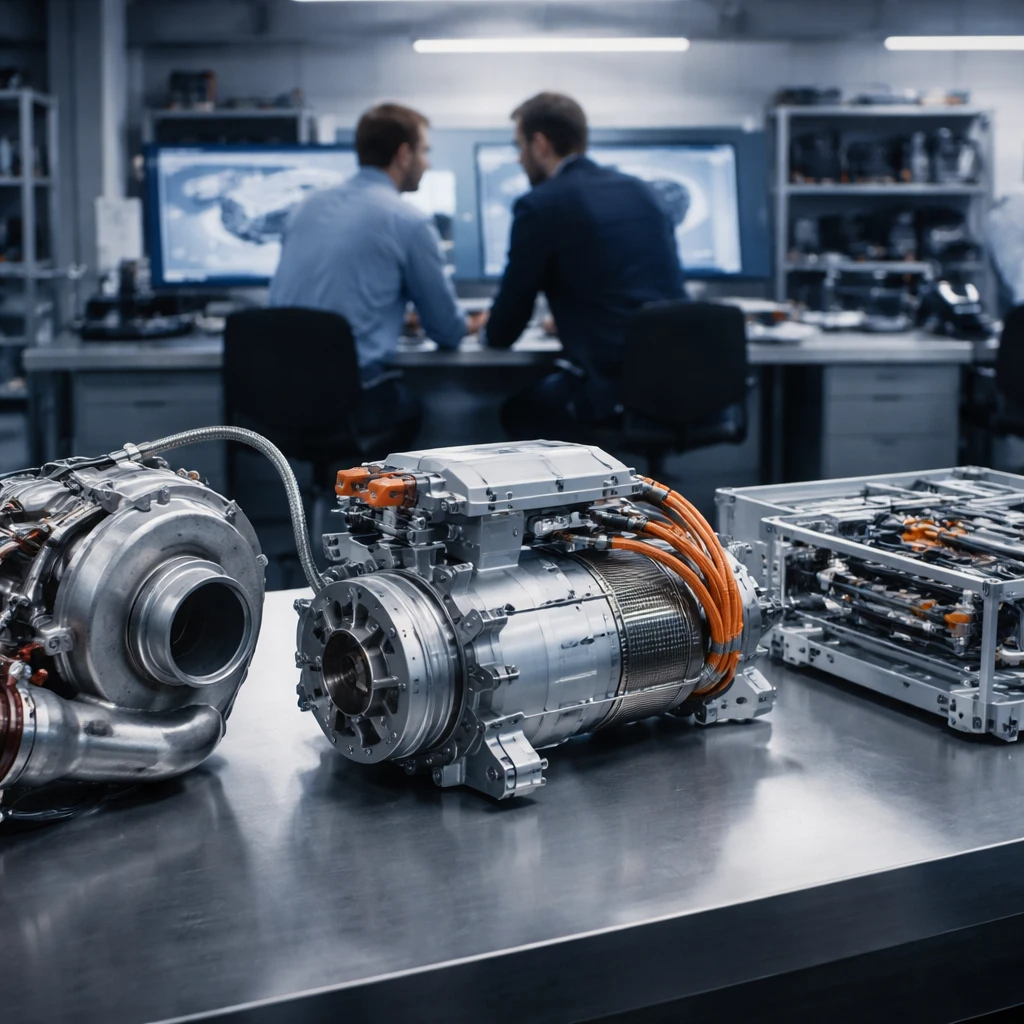
BorgWarner is a diversified automotive supplier with four main businesses: Turbos & Thermal, Drivetrain & Morse Systems, PowerDrive (power electronics and electric machines), and Battery & Charging Systems. That mix positions the company at the intersection of legacy internal combustion powertrains and electrification components. For investors, that means exposure to two competing dynamics: near-term demand steadied by ongoing ICE and hybrid production, and medium-term growth driven by electric powertrain adoption.
Why the market pays attention: turbo and thermal content is benefiting from OEMs downsizing engines and adding boost for efficiency, while PowerDrive and Battery systems are long-term addressable market opportunities. Growth in turbocharger markets is cited in industry reports at roughly ~10-11% CAGR through 2031, and electric powertrain markets are forecast to expand at double-digit CAGRs, supporting structurally higher content per vehicle over time.
Numbers that Matter - The Fundamentals
Key data points:
- Market cap: about $12.18 billion.
- Price-to-earnings: ~45x (the stock is priced for sustained margin expansion and growth).
- Free cash flow: roughly $1.179 billion (solid cash conversion by industrial standards).
- Enterprise value: ~$13.63 billion (EV/EBITDA ~6.14x; EV/Sales ~0.95x).
- 52-week range: $24.40 - $70.08, showing prior deep volatility and a strong rebound into early 2026.
- Dividend: $0.17 per share quarterly (payable 03/16/2026; ex-dividend 03/02/2026).
Those numbers tell a mixed story. On the one hand, BorgWarner generates meaningful cash and occupies high-value product niches. On the other hand, the multiple is elevated relative to the cyclical nature of its end markets and to the company's historical risk profile. The EV-facing businesses justify a higher structural valuation, but they are still a work in progress and carry execution risk.
Technical & Sentiment Snapshot
Technicals show recent momentum but some tension: the 10-day SMA is about $60.99 while the stock trades near $58.85, and the 9-day EMA sits at $59.09. RSI at ~61 signals constructive internal strength but not runaway bullishness. Short interest is material: roughly 11.6 million shares on the last reported settlement, and recent days show sizable short volume activity — a reminder that the name is watched closely by both longs and shorts. The MACD histogram has softened, signaling weakening bullish momentum.
Valuation Framing
At a P/E near 45x and EV/EBITDA around 6.1x, BorgWarner sits in an awkward spot analytically. The EV/EBITDA multiple is respectable for a capital-intensive supplier, but the earnings base is elevated relative to trailing cyclically weak periods; the P/E suggests investors expect either continued margin expansion or materially faster earnings growth. Given free cash flow of roughly $1.18 billion, the market capitalization implies the market is paying up for future profit growth rather than current cash flows alone.
Without a peer table in this note, the relevant comparison is to BorgWarner’s own history and to the capital goods cycle: when production weakens, parts suppliers typically see compressed margins and downgrades. The stock's 52-week high near $70 reflects a stretch of optimistic prints; our view is that the odds are higher for sideways to down performance until growth and margin durability are clearer.
Catalysts (what could move the stock down or up)
- Negative catalyst: any sign of OEM order cuts, extended destocking, or guidance shortfalls on upcoming quarterly results (likely to surface as narrower margin guidance or revenue weakness).
- Negative catalyst: disappointing execution in PowerDrive or Battery & Charging programs — missed milestones, slower ramp-ups, or cost overruns.
- Positive catalyst: large OEM design wins for integrated electric drive modules or battery packs announced and tied to multi-year production ramps.
- Positive catalyst: further margin improvement with better mix toward high-margin electrification products or stronger pricing in turbo/thermal businesses.
Trade Plan - Actionable Short (Mid-Term)
We propose a mid-term short trade with tight risk controls. Trade specifics:
- Trade Direction: Short
- Entry Price: $58.85 (current market level)
- Target Price: $50.00
- Stop Loss: $63.00
- Time Horizon: mid term (45 trading days) - we expect that any guidance misses or OEM order chatter that pressures the shares would surface within the next one to two quarters; 45 trading days lets a catalyst play out while limiting overnight exposure.
Rationale: the entry sits near today’s price where conviction is high; the first target at $50 translates to ~15% downside from entry and sits below near-term technical support lines but above the lower 52-week base. The stop at $63 protects against a momentum squeeze and respects that the 10-day SMA and short-term moving averages could push the stock toward the $60+ area if positive news arrives. We size the position conservatively because of the potential for short squeezes — the name has meaningful short interest and volatile volume days.
Risk Management & Positioning
Because BorgWarner is a cash-generative industrial with continuing relevance across powertrain types, this trade should be sized as a tactical hedge or opportunistic short rather than a core portfolio position. Keep position size small relative to net exposure and consider using options (if liquid and priced fairly) to define risk. Update the thesis on any quarter where management provides meaningful new model-year content wins or materially changes guidance.
Risks and Counterarguments
- Execution upside: BorgWarner could report better-than-expected wins in PowerDrive or Battery that materially strengthen revenue visibility and justify the current multiple. If management announces sizable OEM design wins or faster ramps, the short would be vulnerable.
- Macro resilience: If global auto production avoids a cyclical slowdown and demand for turbo/hybrid components stays strong, revenue could surprise to the upside and compress the timeframe for downside.
- Short squeeze risk: Liquidity and recent short activity mean the stock can move quickly on positive flow; our stop is designed to limit that risk but cannot remove it entirely.
- Valuation re-rating beyond fundamentals: The market may re-rate industrial suppliers due to broad market multiple expansion, which would work against a short position.
- Currency and commodity exposures: Steel, aluminum, and energy price movements can affect margins; favorable input trends would help the company and hurt the short thesis.
Counterargument summary: the strongest counterargument is that BorgWarner's mixed product set is exactly what's needed during an uneven powertrain transition. That gives the company diversified end-market exposure and entrenched relationships with OEMs, which could support a re-acceleration of profitability and justify the current multiples. If the company can demonstrate faster-than-expected electrification content ramps with attractive margins, the bear case weakens substantially.
Conclusion - What Would Change Our Mind
Our view is that BorgWarner is a solid industrial with attractive long-term secular exposure, but the stock's current valuation and the runway for near-term cyclical weakness make it a tactical short. We expect to capture downside into $50 over the next 45 trading days unless the company proves more durable than the market currently prices.
What would change our thesis: material, verifiable evidence of accelerating, profitable electric powertrain program ramps (specific OEM production schedules and margin details), or a sustained reduction in the firm's cost structure resulting in guidance upgrades. On the contrary, evidence of order softness, margin compression, or delayed electrification projects would reinforce our position.
Trade action summary: Short BWA at $58.85, target $50.00, stop $63.00, mid-term (45 trading days), size conservatively and monitor OEM order activity and quarterly guidance closely.