
Hook
There is an emerging theme in AI infrastructure that most investors are missing: raw compute is only as valuable as the power that feeds it. Hyperscalers building out AI data centers are less willing to accept grid risk, and they are willing to pay for on-site, reliable, and low-emission power. Bloom Energy (BE) owns a deployed solid oxide fuel-cell platform that converts natural gas or biogas into steady electricity without combustion, and it is sitting at the intersection of that demand wave.
Thesis
Bloom is not a software play, and that is part of its investment appeal. This is a hardware and services infrastructure name tied to physical capacity buildouts. The market is already repricing that reality: BE closed at $151.30 and currently carries a market cap of roughly $42.45B, trading near its recent highs after a 2025 recovery. The company reported Q4 2025 revenue of $777.7M, full-year 2025 revenue of $2.0B (up 37% year over year), and guided roughly $3.1B for 2026. With a reported backlog near $20B and partnerships with Brookfield and Oracle, Bloom is benefiting from AI data-center demand in a way software companies cannot duplicate.
What Bloom Does and Why it Matters
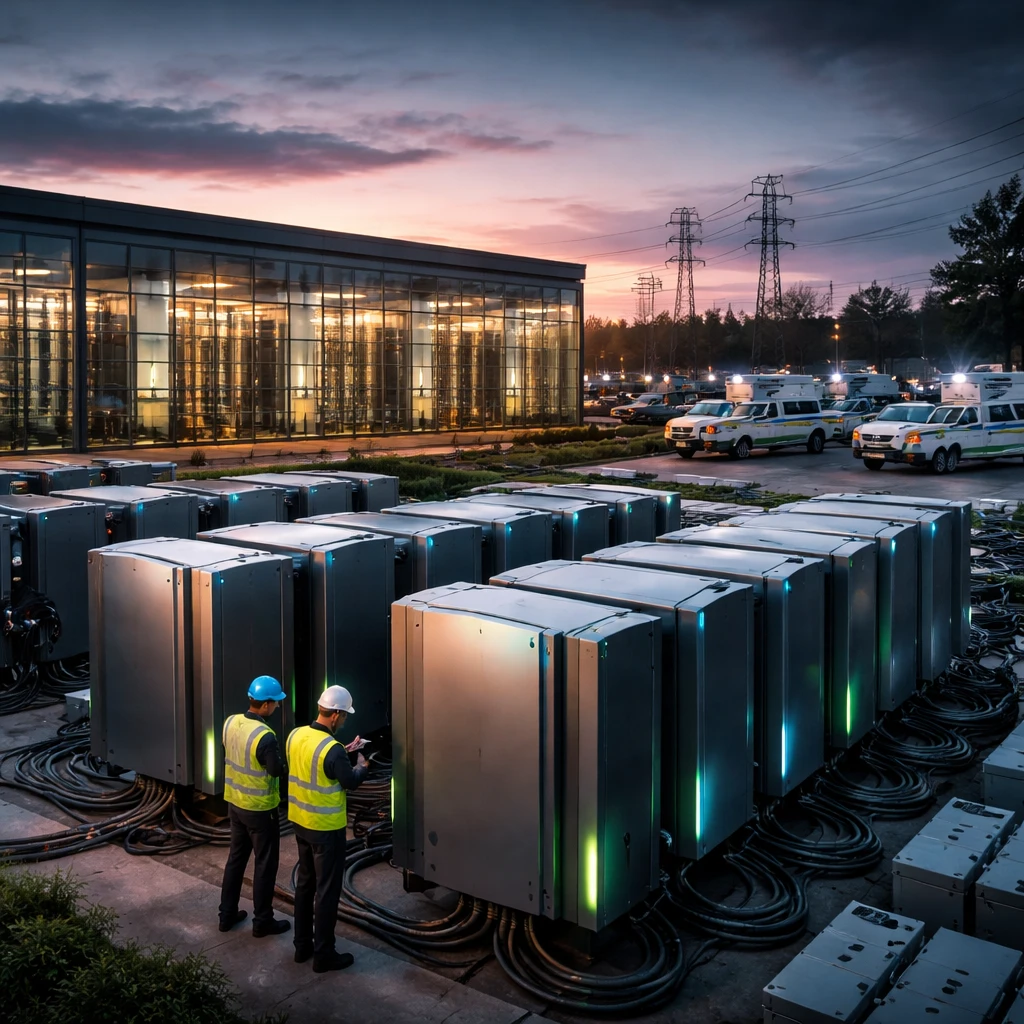
Bloom Energy manufactures and installs solid oxide fuel-cell based power servers. These systems are sold to commercial, industrial, and data-center customers who need reliable on-site generation. For AI infrastructure builders, uptime and predictable power quality are non-negotiable; rolling blackouts, grid constraints, and rising demand for dedicated capacity create a need for distributed generation solutions.
Why the market should care
AI capacity buildouts come with enormous incremental power requirements. Headlines estimate hundreds of billions in AI-related capex for hyperscalers in 2026 alone, and Bloom has cited direct, tangible demand from those customers. The company reported a $20B backlog and announced material deals — including a $2.65B agreement with American Electric Power announced in early February 2026 — that underscore enterprise-scale adoption. A revenue ramp from $2.0B in 2025 to a guided ~$3.1B in 2026 illustrates that this is not theoretical demand.
Hard numbers that support the case
| Metric | Value |
|---|---|
| Share Price (close) | $151.30 |
| Market Cap | $42.45B |
| Q4 2025 Revenue | $777.7M |
| 2025 Revenue | $2.0B (up 37%) |
| 2026 Guidance | ~$3.1B |
| Backlog | $20B (company commentary) |
| Price-to-Sales (trailing) | ~20.45x |
| EV-to-Sales | ~20.65x |
| Cash on balance sheet | $3.93B |
| Free Cash Flow | $57.19M |
| Debt-to-Equity | 3.72x |
Valuation framing
Bloom is valued like a high-growth software winner, not a hardware infrastructure supplier. Trailing P/S near 20.5x and EV/S around 20.65x imply the market is pricing in persistent rapid growth and significant margin expansion. On an enterprise basis the company sits at an EV of about $41.8B versus guided 2026 revenues of roughly $3.1B, implying an EV/S near 13.5x on forward figures if the guide holds. That forward multiple is still rich for a capital-intensive manufacturer with only a modest free cash flow runway ($57.2M most recently), but it's explainable if Bloom executes on backlog conversion and preserves strong gross margins over time.
Catalysts to drive the trade
- Backlog conversion - rapid customer deployments converting the reported $20B backlog into revenue and visible bookings.
- Large enterprise contracts - follow-on orders from major hyperscalers and utility partnerships (e.g., the AEP deal) that validate a repeatable sales motion.
- Margin inflection - stabilizing or re-accelerating gross margins after recent quarter-to-quarter pressure would justify higher multiples.
- Institutional accumulation - continued buying from long-only funds and infrastructure buyers can compress volatility and lift multiples.
Technical setup
On the tape BE is above its 10- and 20-day SMAs ($149.85 and $150.79) and comfortably above the 50-day SMA ($126.67). RSI sits around 53, suggesting room to run but not an overbought condition. Short interest has meaningfully declined from the 30–40M share range to ~22.7M as of 01/30/2026, lowering the magnitude of a forced squeeze but not eliminating short-driven volatility. Recent MACD shows bearish histogram readings, signaling momentum caution despite the fundamental story.
Trade plan (actionable)
Direction: Long
Entry: $151.30
Target: $220.00
Stop Loss: $120.00
Horizon: mid term (45 trading days)
Rationale: Entering at $151.30 aims to capture continued re-rating as the company converts backlog and reports successive quarters of top-line beats and margin stabilization. The primary target of $220 reflects a valuation re-rate supported by forward revenue growth to ~$3.1B and modest margin improvement—this target aligns with technical resistance projected in recent market commentary and is conservative versus more aggressive technical upside calls. The stop at $120 limits downside to structural risk (grid of competition, contract delays, or macro volatility) and respects capital intensity and leverage on the balance sheet. The trade duration is mid term (45 trading days) because the key catalysts - visible backlog shipments and quarterly updates - are likely to play out in that window and because momentum and institutional accumulation can move price faster than fundamentals alone.
Risks and counterarguments
- Valuation pressure: At trailing P/S ~20.5x the stock is priced for flawless execution. Any miss in bookings, revenue conversion, or margin trajectory could cause a sharp multiple unwind.
- Execution and supply chain: Bloom is a hardware business with complex manufacturing and installation cycles. Delays, component shortages, or project execution failures would hit revenue recognition and margins.
- Leverage and cash flow: The company shows $3.93B in cash but limited free cash flow ($57.19M most recently) and a high debt-to-equity ratio (3.72x). A prolonged slowdown could force dilutive capital raises or more expensive financing.
- Competition and technology risk: Alternative distributed generation or rapid advances in battery/hydrogen technologies could capture the attention of hyperscalers and shift procurement away from Bloom’s solid oxide fuel cells.
- Macro and policy swings: Changes in government incentives, utility regulation, or a broader slowdown in AI capital spending would reduce the pace of deployments.
Counterargument: One credible counterargument is that the market is still better served by software and AI layer winners—companies that monetize models and services without heavy capex. If hyperscalers find cheaper, faster, or lower-risk alternatives to on-site fuel cells (for example, long-duration batteries, firming from utilities, or direct grid upgrades), Bloom’s TAM could shrink and its elevated valuation would be difficult to justify. That outcome would likely cause a swift rerating.
What would change my mind
I would turn neutral or outright negative if Bloom reports: (1) materially lower-than-guided 2026 revenue or major contract delays; (2) renewed margin deterioration with no clear path to improvement; or (3) significant cash burn that forces dilutive financing. Conversely, consistent quarterly execution, visible backlog conversion into contracted revenue, and improving free cash flow would make me more aggressive and push the target higher.
Conclusion
Bloom Energy is a differentiated way to play AI infrastructure because it sells something that software cannot: physical, reliable power at the point of consumption. The market is already paying a premium for that exposure, and that premium is risky—but not unjustified if Bloom can execute on its backlog and expand margins. This trade is a tactical long: size it modestly, respect the $120 stop, and expect headline-driven volatility. If the company delivers on bookings and margins over the next 45 trading days, the stock should be well-positioned to reach the $220 target.