
Hook / Thesis
AI is a powerful narrative, but in the case of American Shared Hospital Services (AMS) the market has oversold a technological scare. Investors worry broad automation will hollow out clinical volumes and asset utilization for specialized radiosurgery equipment. That thesis ignores the reality: Gamma Knife and proton beam equipment are capital-heavy, regulatory-driven, and still require clinical staff, facility partnerships, and localized treatment centers. AMS is not a software play; it is a leasing-and-treatment operator with tangible assets and a recent track record of accelerating patient services.
At the current price near $2.10, the stock implies a market capitalization of roughly $13.8M and an enterprise value of $28.9M. For a company that reported double-digit revenue growth and an outsized 224% rise in direct patient services in Q1 2025, that valuation is startlingly low — and sets up an asymmetric risk/reward for patient, disciplined buyers.
What the company does and why the market should care
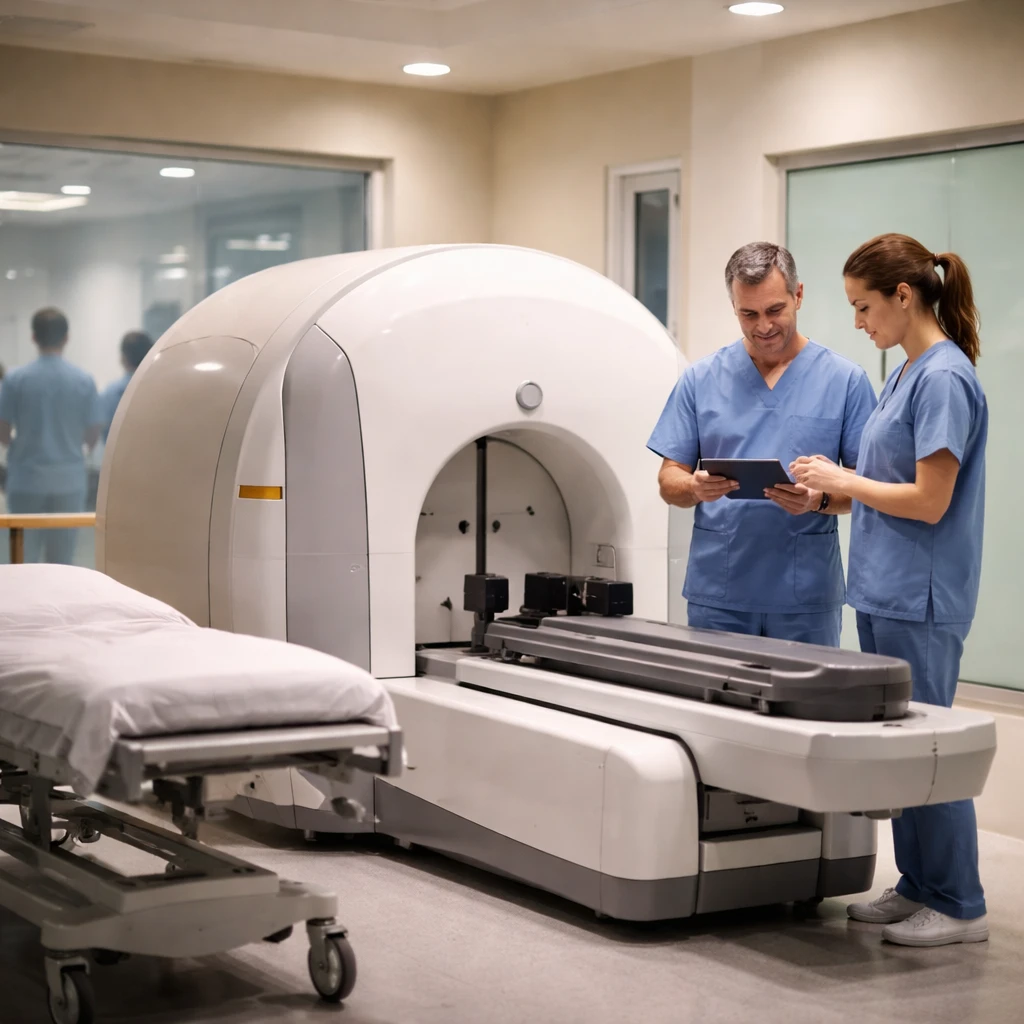
American Shared Hospital Services leases radiosurgery and radiation therapy equipment — think Gamma Knife, proton beam and image-guided radiation therapy (IGRT) systems — and operates direct patient services through retail treatment centers. The business has two clear drivers worth investors' attention:
- Capital-light demand from hospitals and systems - Hospitals increasingly prefer leasing high-cost radiosurgery assets rather than large capital outlays. That favors a leasing player who can structure long-term agreements and provide financing flexibility.
- Direct patient services growth - The company is expanding treatment centers, driving recurring revenue from patient flows and higher utilization of leased equipment.
On the numbers: the company reported a 17% year-over-year increase in first-quarter revenue (Q1 2025), and its direct patient services revenue spiked 224% driven by acquisitions and a new facility in Mexico. Those are material operating improvements for a microcap and demonstrate demand is real, not a mirage.
Key financial and valuation signals
- Market capitalization: ~$13.8M.
- Enterprise value: ~$28.9M, with EV/EBITDA around 4.23x and EV/Revenue near 0.98x — valuation multiples consistent with deeply discounted industrial / equipment leasing peers, not a growth software name.
- Price-to-sales: ~0.47; Price-to-book: ~0.56; EPS is negative at roughly -$0.34 (trailing), reflecting transition investment but leaving upside if operating leverage returns.
- Free cash flow is negative (-$10.2M), which signals heavy financing and investment activity; balance this against the recent revenue growth and the fact that enterprise value already embeds debt financing.
- Leverage: debt-to-equity ~0.82 — not trivial, but manageable for a leasing business if utilization continues to improve.
The takeaway: the stock trades like a troubled balance-sheet story when the operating trends suggest a growing business. EV/EBITDA of 4.23x is attractive if the company converts revenue growth into stabilized cash flows over the next year.
Catalysts that could re-rate the stock
- Continued ramp in direct patient services - more treatment centers or higher utilization at existing sites would expand margin and cash generation.
- Renewals and lease extensions with hospital partners - a roll of the GK Financing agreement or similar deals would de-risk future revenue.
- Investor focus returning to fundamentals - presentations at microcap conferences and a string of positive quarterly results have historically lifted the share price; another execution beat could trigger a re-rating.
- Operational appointments and sales leadership driving equipment placements; management moves earlier drove new business and could accelerate revenue again.
Trade plan (actionable)
Direction: Long. Entry, stop, and target are precise and sized for a microcap with higher idiosyncratic risk.
- Entry: Buy at $2.10. This is near the recent trade price and reflects an opportunistic entry into a cheap capitalization.
- Stop loss: $1.75. A break below $1.75 would indicate worsening sentiment and a move toward the 52-week low area; it also limits downside on a sub-$15M market cap situation.
- Target: $3.00. This target represents ~43% upside from entry and values the company closer to a modest EV/EBITDA uplift as utilization and patient services improve.
- Horizon: Long term (180 trading days). Reason: capital equipment leasing and treatment center rollouts take multiple quarters to book, ramp, and flow to EBITDA. Allowing 180 trading days gives time for realized revenue growth, potential lease renewals, and for the market to re-rate the EV/EBITDA multiple towards peers.
Position sizing and risk framing
This is a microcap with limited liquidity (2-week average volume roughly ~9,356 shares per day) and a float under 3.7M shares. Keep position sizes small relative to portfolio, expect volatility, and use limit orders to enter. The stop is tight enough to control losses but wide enough to avoid noise in low-liquidity trading.
Risks and counterarguments
Every trade has a flip side. Below are the principal risks and a balanced counterargument to the bullish thesis.
- Liquidity and execution risk: Average volume is low (~9.4k/day recently), and the float is small. Large orders could move the market sharply, and exits may be slow during stress.
- Cash flow and financing risk: Free cash flow was deeply negative (-$10.2M). If borrowing costs rise or access to capital tightens, the company may need dilutive financing or may be forced to slow placements.
- Balance-sheet constraints and working capital: Current ratio ~0.79 suggests near-term liquidity pressure. If utilization stalls, the company may face operational strain before revenue growth translates to free cash flow.
- Technology substitution risk (the central bear case): Critics argue AI and remote diagnostics will reduce demand for in-person radiosurgery. While plausible in the long run for some procedures, the technical, regulatory, and capital nature of radiosurgery makes rapid substitution unlikely. Still, if AI-driven alternatives achieve regulatory approval and reimbursement quickly, it would materially reduce demand for AMS's core assets.
- Management execution risk: This is a small team; execution on facility openings, lease structuring, and clinical partnerships matters. Failed rollouts or poor acquisitions could reverse momentum.
Counterargument: The bear case has merit: if AI-enabled therapies and less-invasive alternatives materially reduce demand, or if the company cannot stabilize cash flow, the current low valuation would be justified. Those outcomes are not impossible but are low-probability over the next 6-12 months given current treatment requirements, recent revenue growth, and active contract extensions in the last 12 months.
What would change my mind?
I would materially downgrade this long idea if any of the following occurred:
- Quarterly revenue growth reverses and direct patient services shrink sequentially.
- Cash burn accelerates and management discloses an inability to refinance maturing obligations without heavy dilution.
- Evidence of a rapid shift to AI-driven treatment pathways that are reimbursed and adopted by hospitals faster than expected, directly reducing equipment utilization.
Conclusion
For patient, risk-aware investors willing to accept microcap volatility, AMS offers an attractive asymmetric opportunity. The market's fixation on AI substitution has likely exaggerated the structural challenges for a company whose business is physical equipment leasing and localized patient care. With a market cap near $13.8M, EV/EBITDA around 4.2x, and concrete signs of revenue acceleration (17% YoY in Q1 2025 and a 224% jump in direct patient services), the setup favors a long entry at $2.10 with a $1.75 stop and a $3.00 target over a 180-trading-day horizon. Keep position size modest, monitor liquidity and cash-flow metrics closely, and be prepared to trim if management signals refinancing stress or markedly worse utilization trends.