
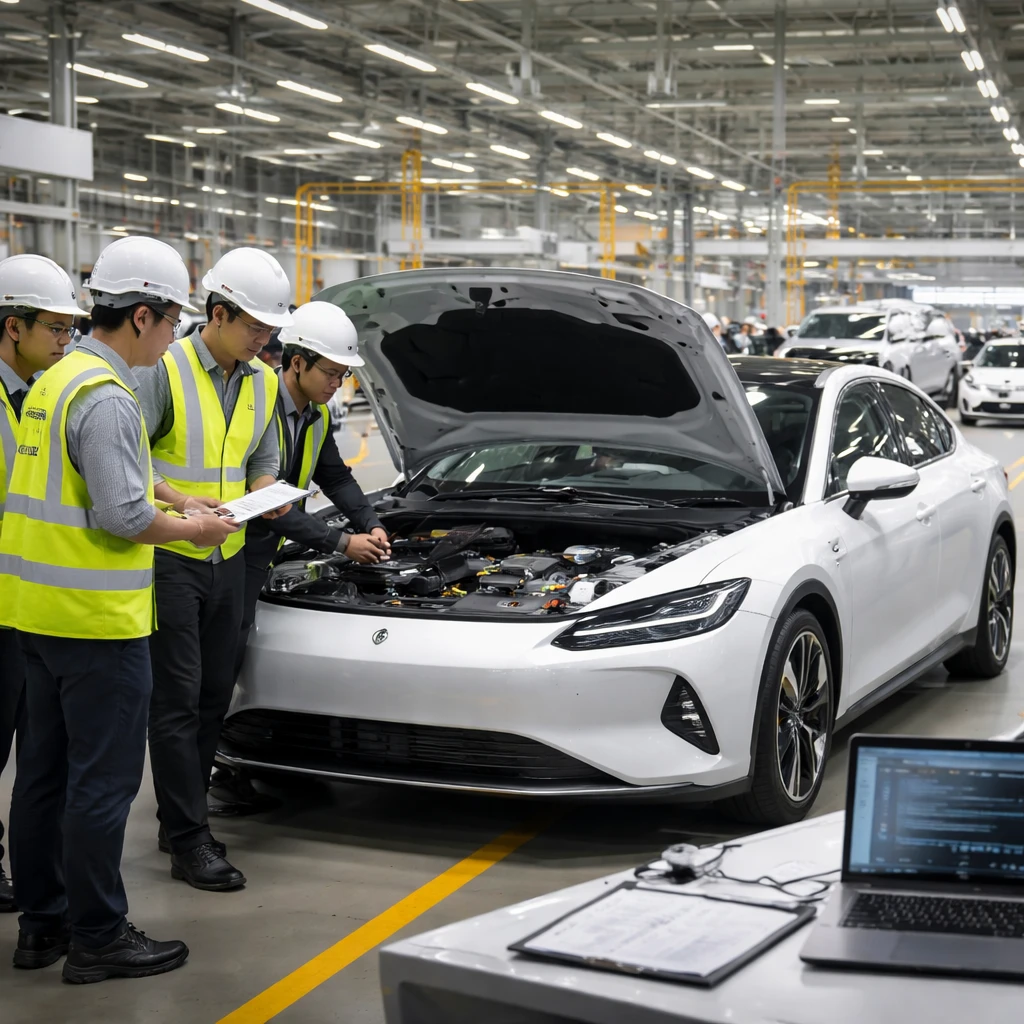
Xiaomi announced that it will establish a committee of external advisers to assess vehicle safety as it addresses mounting criticism related to several SU7 accidents.
The company said the committee will be complemented by a program of regular meetings with car owners, media representatives and outside experts to solicit feedback on vehicle safety. The first such session is scheduled for the first half of this year, Hou Jinglei, head of Xiaomi's EV safety department, said during a livestream from the company's EV factory in Beijing.
Xiaomi noted it already has a sizeable internal safety organization. The EV maker's safety team comprises more than 3,500 staff and includes an internal investigation centre that reviews accidents.
Reports this week described a fatal October crash involving a Xiaomi SU7 sedan in which the vehicle's doors were reported to have become inoperable after a power outage following a collision with another car, resulting in the driver being burned to death, according to a forensic report cited by Chinese media. Another Chinese news outlet that published the forensic findings also ran a commentary urging Xiaomi to recall all first-generation SU7s to "completely eliminate door handle hazards." Xiaomi did not respond to a request for comment on those reports.
A separate earlier crash involving an SU7 travelling in driving assistance mode, in which three people were killed, remains under investigation. Official accounts of both accidents have not yet been released.
Earlier steps taken by Xiaomi include a software update issued in September for more than 115,000 SU7 vehicles to address assisted driving issues. The company has also stopped producing the first-generation SU7 and plans to introduce in April an upgraded version of the sedan equipped with a backup power supply for the doors.
Deliveries of the SU7 have been substantial. Xiaomi reported that deliveries of the model had exceeded 381,000 vehicles as of February.
The series of widely reported accidents has coincided with a tightening of regulatory scrutiny. Authorities have implemented stricter rules governing marketing and safety standards for assisted driving. Regulators have also decided to phase out hidden car door handles starting in 2027 and are considering limits on EV acceleration.
The company has moved to expand both internal capabilities and external oversight as it responds to safety criticism while rolling out product changes and software fixes. The upcoming advisory committee and stakeholder meetings are intended to broaden input into safety reviews, even as formal investigations and regulatory responses continue.
Summary
Xiaomi will form an external safety advisory committee and hold regular consultations with owners, media and experts to address safety concerns stemming from several SU7 accidents. The company already maintains a safety team of more than 3,500 employees and has implemented software updates, halted first-generation SU7 production, and plans to launch an upgraded model with a backup door power supply in April.
Key points
- Xiaomi will set up an external advisory committee and host regular stakeholder meetings in the first half of the year to review vehicle safety - impacting the automotive and EV sectors and market perceptions of Chinese EV makers.
- The company has a safety organization of over 3,500 people and an internal investigation centre; it issued a software update in September covering more than 115,000 SU7s and will introduce an upgraded model in April - relevant to operations, manufacturing and aftermarket software management.
- Regulatory responses to widely reported accidents include tighter marketing and assisted-driving standards, a phase-out of hidden door handles from 2027, and consideration of EV acceleration limits - affecting regulators, automakers and components suppliers.
Risks and uncertainties
- Investigations remain ongoing for two serious SU7 crashes, and official accounts have not been released - creating uncertainty for safety outcomes and potential regulatory or legal actions that could affect the automotive sector.
- Calls in media commentary for recalling first-generation SU7s point to recall risk and further product remediation needs that would impact manufacturing, inventory and after-sales operations.
- Tighter regulatory standards on assisted driving and the phase-out of hidden door handles could require design and production adjustments for automakers and component suppliers, with potential cost and supply-chain implications.