
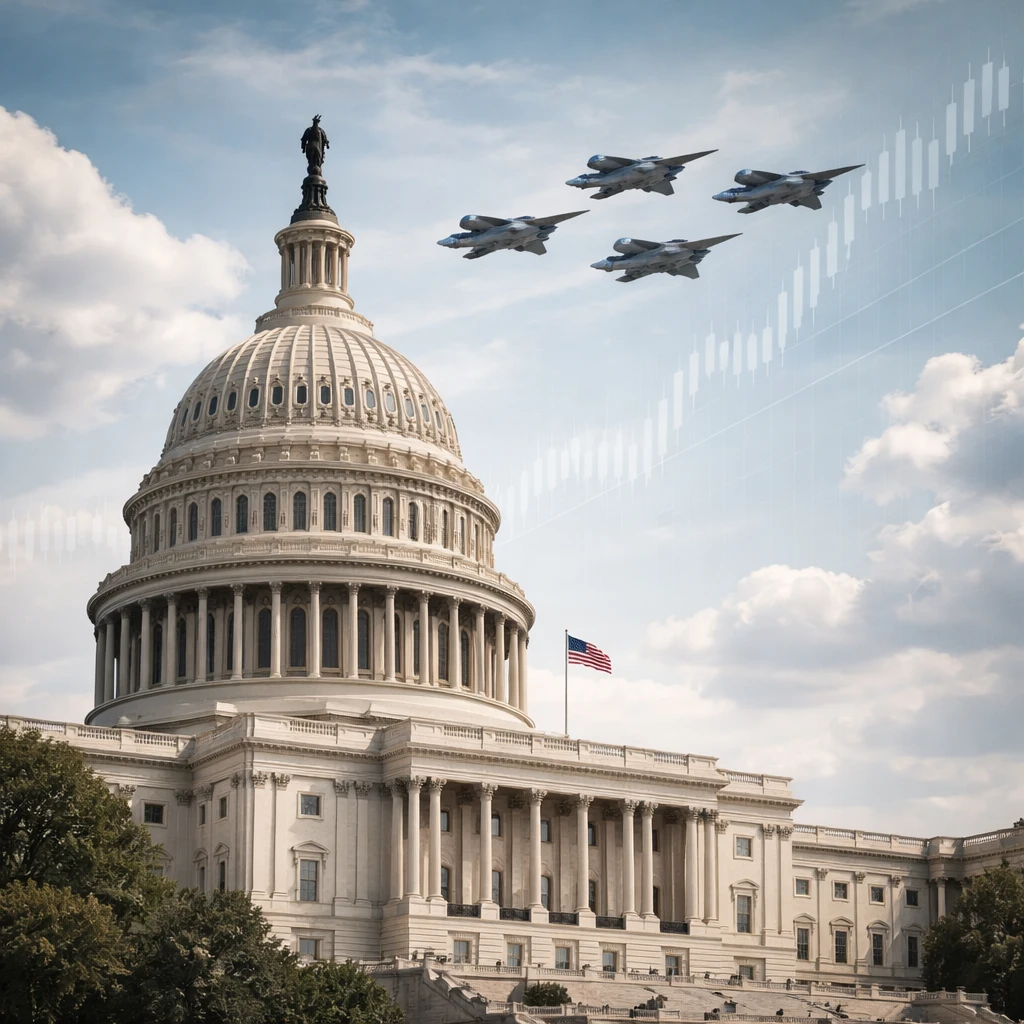
Wolfe Research analysts are skeptical that the U.S. legislature will endorse additional military funding for 2027, even as defense equities showed gains after the White House's announced spending target.
In early January, President Donald Trump proposed a 2027 defense budget of $1.5 trillion, a figure that exceeds the $901 billion Congress approved for the current year. Market responses to the announcement included a notable jump in an exchange-traded fund that tracks the U.S. aerospace and defense industry, and data from FactSet and Wolfe indicate that some of those gains have persisted.
Trump described the $1.5 trillion target as the product of "long and difficult negotiations with Senators, Congressmen, Secretaries, and other Political Representatives... especially in these very troubled and dangerous times." Any expansion of military spending, however, requires formal approval from Congress, which presents a political constraint for the administration.
Wolfe Research analysts Tobin Marcus and Chutong Zhu wrote in a client note that they do not expect lawmakers to further amplify what they describe as an already "strong" defense funding environment for 2027. The analysts pointed to the legislative calendar and the status of reconciliation as factors limiting the prospect of additional outlays.
"[W]e continue to believe strongly that there will not be a reconciliation bill in 2026, which largely rules out additional stimulus, healthcare reform, fiscal support for housing, and incremental defense funding,"
The analysts added that they doubt any new defense funding will materialize beyond the fiscal 2026 discretionary appropriation. They advised that the defense sector will need to rely on the momentum generated by Trump's signature "One Big Beautiful Bill" (OBBB) and developments in the global conflict landscape to sustain recent tailwinds.
"We doubt any new defense funding will come through beyond the [fiscal 2026] discretionary appropriation, so the sector will have to subsist on the tailwinds from OBBB funding and the global conflict landscape,"
Investors and market observers will be watching both congressional action and broader geopolitical developments for signals about the durability of defense-sector gains. According to Wolfe, absent a reconciliation vehicle or fresh appropriations beyond the discretionary spending already enacted, incremental defense funding appears unlikely in the near term.
Context for markets: The note frames a constrained fiscal outlook for potential incremental defense spending and highlights why recent stock gains may reflect investor positioning rather than guaranteed budget outcomes.