
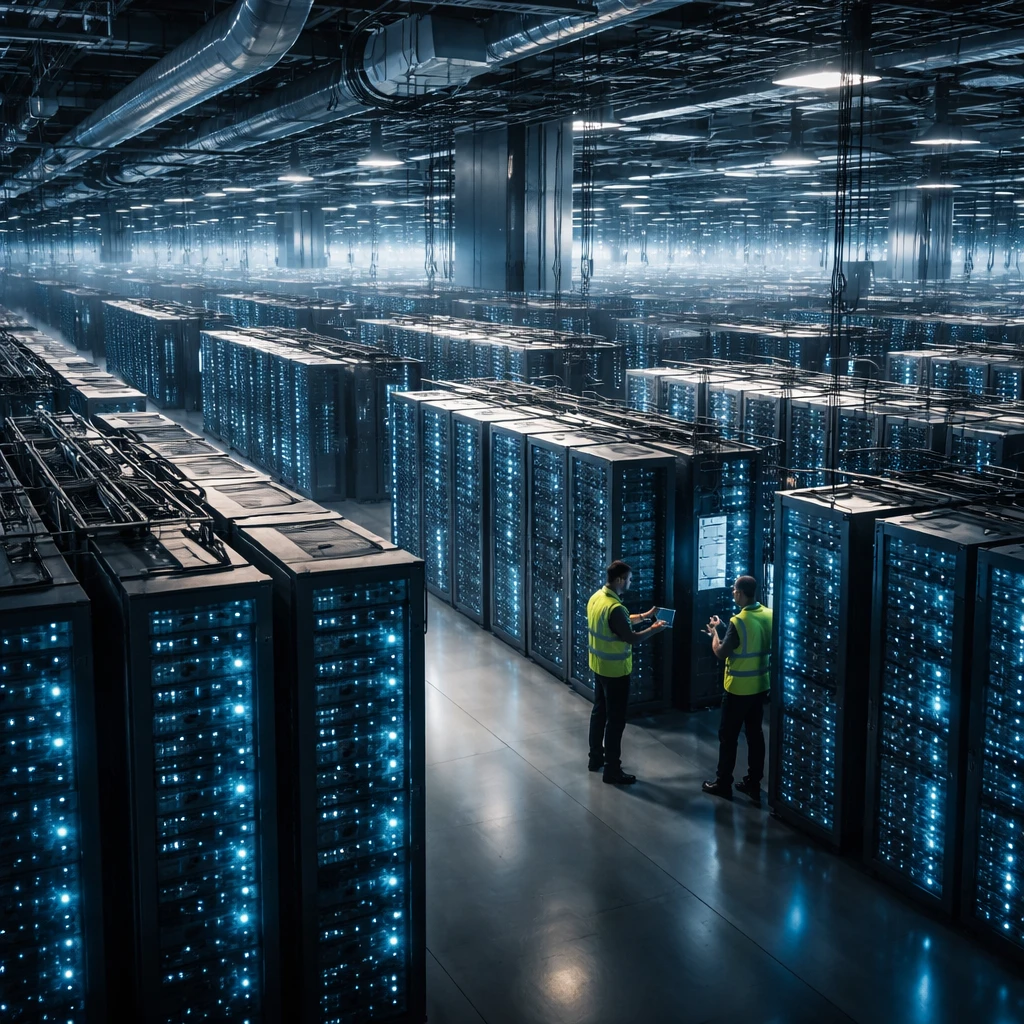
Wells Fargo forecasts a rapid expansion in hyperscaler compute capacity as generative AI workloads continue to push demand well ahead of supply. The brokerage said capacity will double to 98 gigawatts (GW) by 2027, up from an estimated 49GW at the end of 2025.
The firm estimates Alphabet, Amazon and Microsoft together represented roughly 39GW of the 49GW total at the end of 2025 - about 80% of industry capacity. Wells Fargo expects those three companies to retain roughly a 75% share of hyperscaler compute through 2027.
Projected additions to industry capacity are concentrated in the next several years. Wells Fargo sees capacity growth of 22GW in 2026 and 27GW in 2027 - a combined 49GW over those two years, exceeding the 20GW added across 2024 and 2025. Looking further ahead, the firm expects total hyperscaler compute capacity to top 125GW by 2028.
The brokerage provided company-level capacity forecasts through 2028. It expects Alphabet to add 19GW and remain the leader with 35GW by year-end 2028. Amazon is projected to add 16GW to reach 29GW, while Microsoft is also seen adding 16GW to reach 27GW. Meta Platforms is forecast to expand to 21GW by 2028, and Oracle to scale to 11GW.
Wells Fargo characterized compute capacity as becoming the principal constraint in cloud operating models, with shortages felt across chips, power and data center infrastructure. The firm estimated hyperscaler capital expenditures will nearly double to more than $860 billion by 2027, up from $427 billion in 2025.
Over the three-year window from 2026 through 2028, Wells Fargo projects total hyperscaler spending of $2.47 trillion, which it said is about 8% above consensus expectations.
In response to its capacity and spending outlook, the brokerage raised its revenue estimates for Microsoft Azure and said its forecasts for Amazon Web Services and Google Cloud Platform sit above Street expectations for 2026 and 2027.
Wells Fargo highlighted the centrality of compute access to competitive positioning in AI. As the firm put it: "Compute capacity is key success factor as AI-driven demand to materially exceed supply near to medium term. Cloud industry to grow meaningfully faster than consensus view," analyst said.
The report underscores a period of intense capital investment across hyperscalers as they seek to close the gap between compute demand and available infrastructure. The brokerage's projections suggest material shifts in data center buildouts, power provisioning and chip procurement over the coming years as operators scale to meet AI workloads.
Should you be buying MSFT right now? ProPicks AI evaluates MSFT alongside thousands of other companies every month using 100+ financial metrics. Using powerful AI to generate exciting stock ideas, it looks beyond popularity to assess fundamentals, momentum, and valuation. The AI has no bias - it simply identifies which stocks offer the best risk-reward based on current data with notable past winners that include Super Micro Computer (+185%) and AppLovin (+157%). Want to know if MSFT is currently featured in any ProPicks AI strategies, or if there are better opportunities in the same space?