
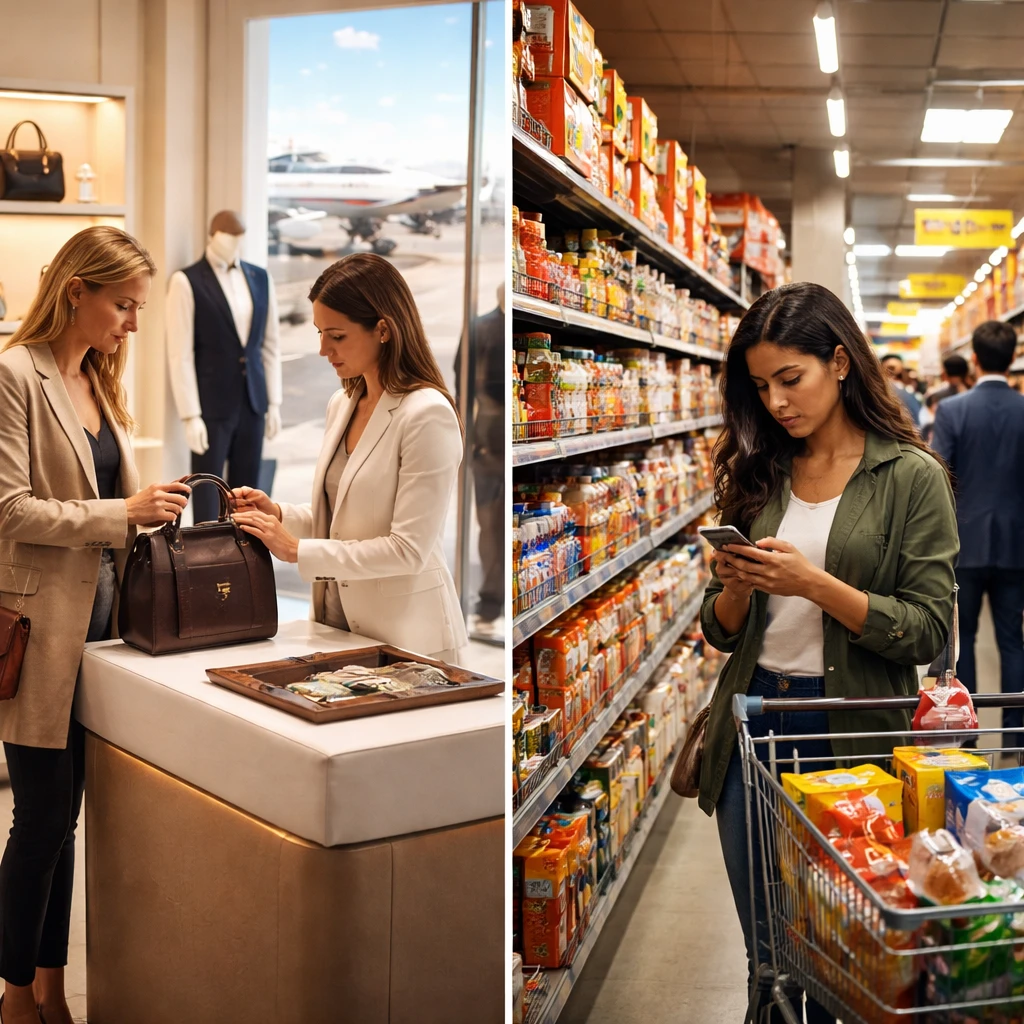
Corporate results and executive commentary from recent quarterly reporting cycles show the U.S. consumer landscape pulling in two opposite directions. Luxury and premium-focused firms reported stronger-than-expected results, benefiting from affluent customers who continue to purchase high-margin products and services. At the same time, companies geared toward value-conscious shoppers described ongoing pressure as cash-strapped households restrict discretionary spending.
Retailers and financial services that skew toward higher-income customers - including Ralph Lauren, handbag maker Tapestry and American Express - along with major carriers such as United and Delta, exceeded expectations in the most recent quarter as wealthier consumers remained active buyers. Those companies cited demand for premium goods and travel-related services that command higher margins.
Conversely, large consumer staples and payments firms flagged weakness among lower- and middle-income segments. PepsiCo, Kraft Heinz and PayPal all reported strains stemming from customers seeking more value and postponing purchases to make household budgets stretch further.
The pattern is consistent with what many executives and economists describe as a deepening K-shaped recovery in the United States - a recovery in which spending power and gains are concentrated among higher earners while other segments lag. A Moody's Analytics analysis of federal data shows the highest-earning 10% of households now account for nearly half of all U.S. consumer spending. By comparison, roughly 30 years ago those households represented a little more than one-third of overall consumer spending.
Bank of America analysts raised the prospect that middle-income households may also be losing ground. "Middle-income households' wage growth appears to have softened, even as higher-income gains remain resilient," they wrote, noting a divergence in wage dynamics across income groups.
Inflation is one arithmetic driver of the split. Lower-income households allocate a larger share of their budgets to necessities such as food, gasoline and rent, leaving less discretionary income available and smaller buffers for unforeseen costs. That budgetary squeeze limits spending on nonessential items for those households.
Broader confidence measures reflect the divide. The University of Michigan's Consumer Sentiment Index rose to 57.3 in February, the highest level since last August, but it still stood roughly 20% below its January 2025 reading. Joanne Hsu, director of the Surveys of Consumers, said sentiment improved among those with the largest stock portfolios while remaining stagnant and low for consumers without stock holdings.
Executives described how their sectors are adapting to the bifurcated market. U.S. airlines, for instance, are increasingly leaning on higher-margin revenue streams at the front of the cabin - corporate travel, loyalty program revenues and premium amenities such as lie-flat seats and champagne. "The strength in the consumer sector is at the higher end of the curve," Delta Air Lines Chief Executive Ed Bastian said. "The lower-end consumer is struggling. We fortunately do not live there."
Mass-market companies are responding with price moves and promotions to retain customers. After consumer backlash to multiple rounds of price increases, PepsiCo cut prices by as much as 15% on snacks including Lay's and Doritos. "We've spent the past year listening closely to consumers, and they've told us they're feeling the strain," Rachel Ferdinando, PepsiCo Foods U.S. CEO, said.
Kraft Heinz, after reporting muted 2026 earnings expectations, emphasized deteriorating consumer sentiment and softer industry trends, with Chief Executive Steve Cahillane pointing to growing volatility in the geopolitical landscape as another factor executives are monitoring.
Newell Brands also lowered prices on select items and CEO Chris Peterson highlighted that the pullback in spending was especially pronounced among consumers aged 18 to 24, who have cut purchases of kitchen storage and stationery. Peterson, along with Leeny Oberg, chief financial officer at Marriott, said they did not expect the K-shaped pattern to change materially in the near term.
Economists cited in these discussions see the spending gap widening. "The gap in spending between the well-to-do (the top 20%) and lower- and middle-income households has never been wider, and it continues to increase," Mark Zandi, chief economist at Moody's Analytics, said.
Bank of America's deposit data for January illustrated divergence in wage growth after taxes. The report showed after-tax wage and salary gains of 0.9% year over year for lower-income households and 1.6% for middle-income households, versus 3.7% for higher-income households. BofA analysts noted that while the sizeable gap between lower- and higher-income wage growth is not widening further, it also is not shrinking, which helps explain why spending growth among lower-income households continues to lag.
Payment and merchant services firms reported corresponding trends. American Express, whose cardholder base leans wealthier, said demand for premium products was "very strong." PayPal, by contrast, warned of pressure across its retail merchant base, particularly among lower- and middle-income consumers, reflecting more cautious purchasing patterns in those segments.
As the divergence persists, companies that rely on mass-market volumes are making tactical price adjustments and promotional efforts, while premium-oriented firms and travel providers push further into higher-margin services. The balance of consumer spending currently favors the affluent, and corporate plans appear aimed at capturing that concentration of buying power in the near term.