
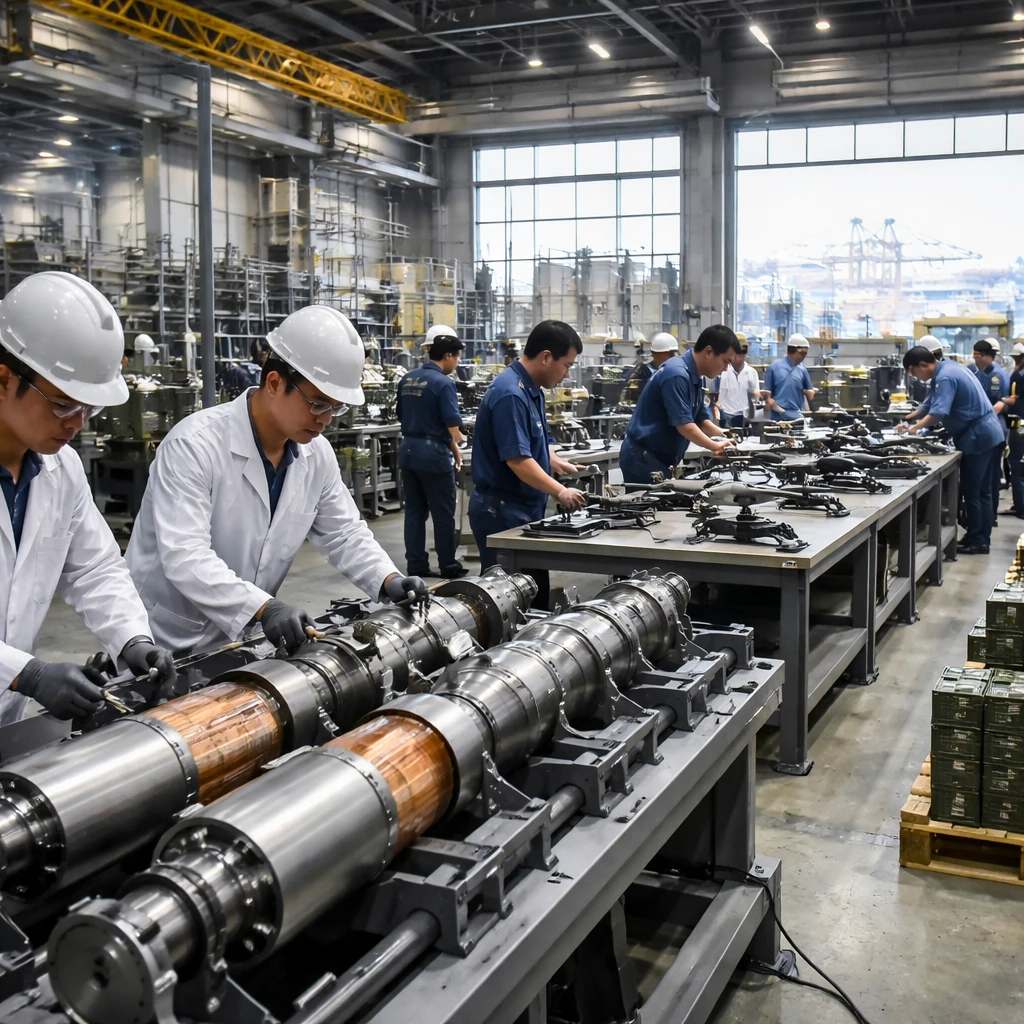
The Pentagon said on Friday that a U.S.-led defense manufacturing initiative will begin a program to produce missile motors with Japan in a leading role, advance a regional drone cooperation effort, and explore establishing an ammunition production line in the Philippines.
The initiative, known as the Partnership for Indo-Pacific Industrial Resilience or PIPIR, is a coalition of nations focused on increasing weapons and defense manufacturing capacity inside the Asia-Pacific area. The United States established the partnership in May 2024 with the stated aim of reducing supply chain vulnerabilities and enabling allies to produce and service military equipment nearer to potential operational needs.
Following a virtual meeting on Wednesday, the Pentagon published a joint statement outlining the group's decisions and noting that two countries - Thailand and the United Kingdom - had joined, lifting total membership to 16 nations spanning the Indo-Pacific and Europe.
On propulsion, members agreed to stand up a program to produce solid rocket motors - the propulsion units used in a variety of guided weapons - with Japan taking the lead. The decision is presented as a way to increase production capacity for this key component outside the United States.
Regarding unmanned aerial systems, participants committed to a series of measures intended to create common standards and shared supply chains for small military drones across the region. That work will include collaborative attention to batteries and the small motors that power these systems, and the group said it would explore manufacturing drones jointly for a range of military applications.
On the ammunition front, PIPIR members said they would consider the Philippines as a potential host for a facility to load, assemble and package 30mm cannon rounds. Those rounds are commonly used by military aircraft and ground vehicles, and the proposal is framed as an effort to locate production capacity closer to where such munitions may be required.
The joint statement and the decisions announced reflect the group's focus on bolstering regional industrial resilience by cultivating production and maintenance capacity nearer potential operational theaters and reducing reliance on distant supply chains.
Summary of actions announced
- Launch of a Japan-led solid rocket motor production program.
- Coordinated steps to develop standards and supply chains for small military drones, including work on batteries and small motors.
- Exploration of a Philippines-based facility to load, assemble and package 30mm cannon rounds.