
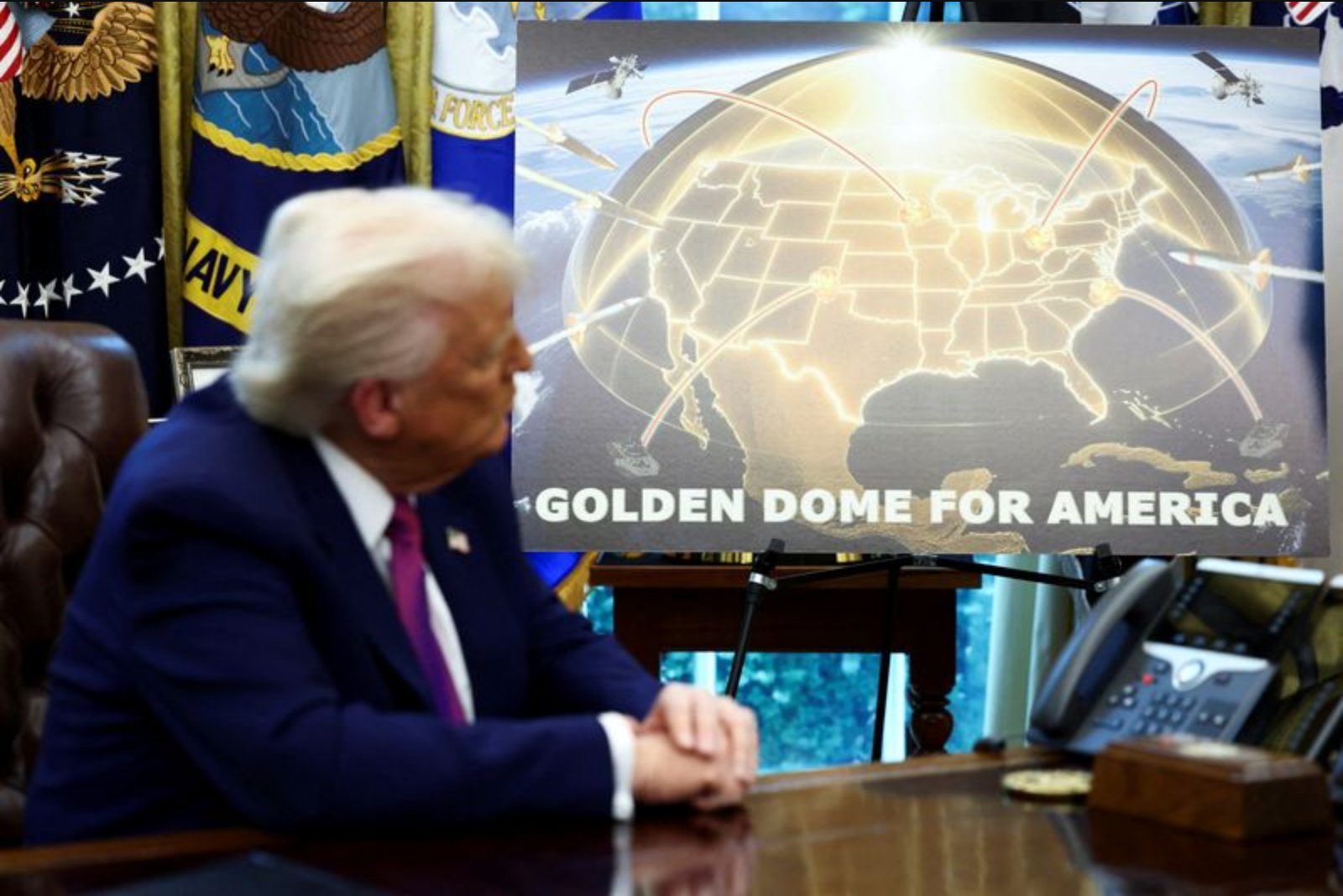
ARLINGTON, Virginia, March 17 - U.S. officials have increased the projected cost of the Golden Dome missile defense initiative to $185 billion, an increase of $10 billion intended to speed deployment of critical space-based capabilities, program leadership said on Tuesday.
The enlarged budget accompanies a move to bring three major defense contractors into the program as prime partners: Lockheed Martin, RTX and Northrop Grumman. Golden Dome is intended to broaden existing ground-based defenses - including interceptor missiles, sensors and command-and-control systems - and layer on space-based elements designed to detect, track and potentially counter threats from orbit.
Program manager Space Force General Michael Guetlein told attendees at the McAleese Defense Programs Conference in Arlington that the additional funds will be directed to three specific efforts: the Advanced Missile Tracking Initiative, a space data network, and the Hypersonic and Ballistic Tracking Space Sensor (HBTSS). HBTSS is described as a space-based sensor intended to detect and track hypersonic and ballistic missile threats, and its inclusion underscores Pentagon urgency as potential adversaries expand hypersonic capabilities.
Guetlein framed the $185 billion estimate as covering the program's "objective architecture" - a full-capability system planned for delivery over the next decade. He disputed external estimates that have placed Golden Dome costs above $1 trillion, saying those figures reflect cost assumptions tied to expensive, self-contained battlefield systems built for overseas combat, rather than a homeland defense approach he described as fundamentally different and less costly.
On program governance, Guetlein said a nine-company consortium now supports Golden Dome. That group reportedly began as a self-formed collection of six firms before Lockheed Martin, RTX and Northrop Grumman joined as prime partners. The consortium briefs the program director every Thursday evening and retains the ability to remove underperforming members by vote.
Guetlein identified space-based interceptors as the element of greatest risk within Golden Dome, pointing to scalability and affordability as the primary challenges. He pointed to directed energy systems and next-generation artificial intelligence as the most promising technologies for reducing cost-per-kill and improving magazine depth, though he framed those as potential enablers rather than guaranteed solutions.
Context and next steps
The raised estimate and the naming of major primes signal a shift toward accelerating space capabilities within a layered homeland defense architecture. The program manager's comments emphasize a decade-long delivery horizon for the full objective architecture and a governance model centered on a private-sector consortium that meets regularly with program leadership.