
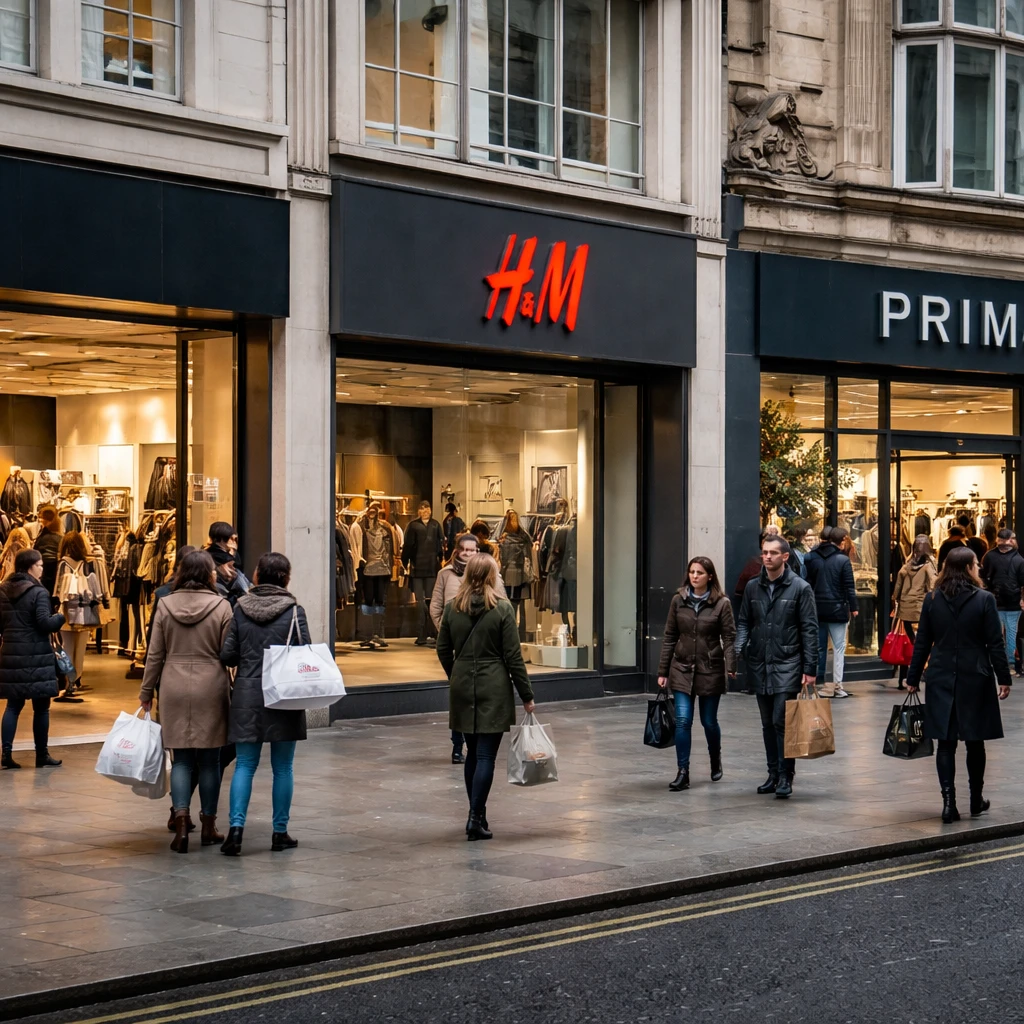
Barclays' most recent UK fashion market update depicts a sharply polarised retail environment. Across the industry, full-price sales edged down 0.1% year-on-year in the eight weeks to Feb. 1, yet the dispersion of performance between retailers broadened significantly.
Below are the firm-level developments highlighted by Barclays.
NEXT - Clear operational leader
NEXT stood out as the strongest operator in the period. The group recorded a sharp acceleration in full-price sales, up 18.8% year-on-year in the latest eight-week window compared with 3.8% previously. Total sales rose 14.3% and NEXT widened its market share by 140 basis points to 11.8% - the largest gain among peers. Barclays links the upswing to improved product availability, resilient underlying UK demand and potential share capture from competitors experiencing disruption. The combination of momentum, breadth of growth and material share gains positions NEXT as the cohort's top performer.
Marks & Spencer - Stabilising, but pricing power still repairing
Marks & Spencer is showing signs of recovery, though Barclays notes it has not fully returned to prior strength. Total sales climbed 3.3% year-on-year (versus 1.6% previously), and market share gains accelerated by 28 basis points. Full-price sales remain negative at -3.7%, but this represents a notable improvement from a -10.3% result in the preceding period. Barclays describes the business as stabilising after earlier disruption, with growth in online channels helping to offset softer performance on the high street. The trajectory is constructive, but underlying pricing power is still being rebuilt.
Primark - Stable value performance
Primark delivered steady results, with total sales up 3.2% year-on-year and full-price sales returning to marginal positive territory at 0.8% after previous declines. Market share rose modestly by 16 basis points. Barclays interprets this as evidence of resilience in Primark's value positioning, without the acceleration that has benefited NEXT.
JD Sports - Total sales strong, mix and promotions weakening full-price metrics
JD Sports' total sales remained robust, rising 10.9% year-on-year, but underlying mix weakened. Full-price sales fell 8.4% and market share gains moderated to 25 basis points. Barclays notes the divergence between healthy total sales growth and declining full-price performance suggests heavier promotional activity or pressure on product mix, with momentum slowing compared with earlier periods.
H&M - Significant deterioration
H&M experienced pronounced weakness. Total sales dropped 14.5% and full-price sales were down 16.8%, while market share contracted by 29 basis points. Barclays characterises the sharp deterioration across both revenue and share metrics as indicative of competitive challenges and demand softness, making H&M one of the weaker performers in the dataset.
Zara - Reversal of prior strength
Zara also recorded meaningful declines. Total sales fell 9.1%, full-price sales decreased by 12.2% and market share slipped 15 basis points. After previously strong growth, momentum has reversed, a pattern Barclays frames as a cyclical slowdown and potentially more difficult UK trading conditions relative to some domestic peers.
Shein - Sharp deceleration from rapid growth
Shein's growth profile contracted notably. Total sales were down 17.2% year-on-year, though full-price sales remained marginally positive at 3.2%. Market share declined by 16 basis points. Barclays suggests the sharp deceleration from earlier high growth could reflect normalization following rapid expansion or intensifying competitive pressure among digital-first players.
Temu - Volatile, promotion-led expansion
Temu showed continued volatility. Aggregate total sales grew 7.7%, but full-price sales turned negative at -3.0% and market share gains slowed to 4 basis points. Barclays interprets the pattern as growth that is increasingly promotion-led and less structurally robust than in prior periods.
Overall, Barclays' update paints a market where aggregate full-price sales are broadly flat year-on-year, but underlying performance varies substantially by retailer. NEXT is taking meaningful share, M&S is stabilising, Primark is steady, and several international and online-first names are either decelerating or seeing results driven more by promotions than by consistent full-price demand.